


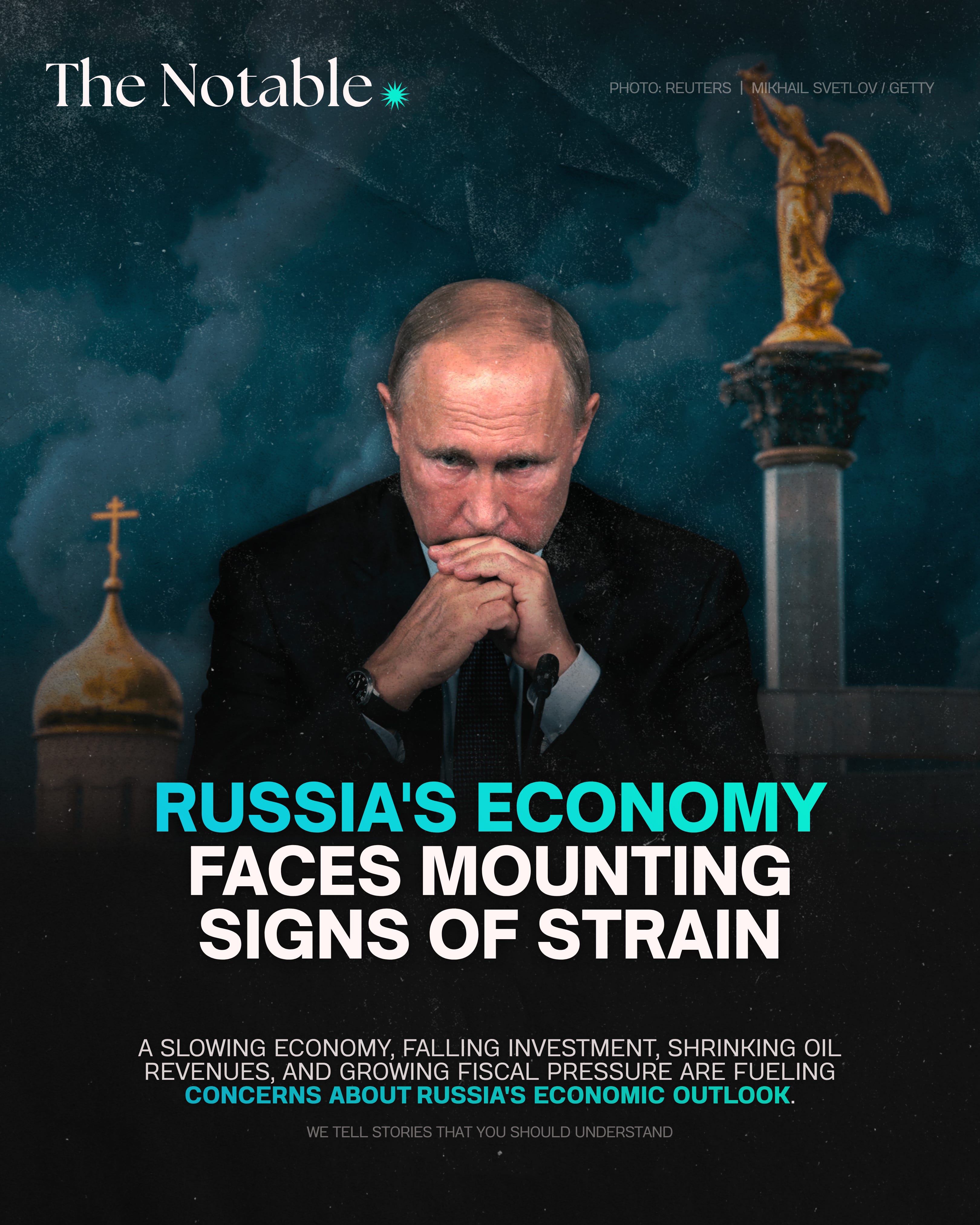
For more than four years, predictions of Russia’s economic collapse have repeatedly surfaced. Since the full-scale invasion of Ukraine in 2022, sweeping Western sanctions, export restrictions, and financial isolation have led many observers to forecast an imminent breakdown of the Russian economy.
Yet those predictions have largely failed to materialize.
Instead, Russia adapted. The Kremlin redirected energy exports toward China and India, expanded domestic military production, increased government spending, and relied heavily on state intervention to cushion the impact of sanctions. The result was a wartime economy that proved far more resilient than many expected.
Today, however, the picture is changing.
Recent economic data suggests that the pressures facing Russia are becoming more difficult to manage. The economy is slowing, investment is weakening, government finances are under increasing strain, and the costs of sustaining the war continue to mount. While this does not amount to an economic collapse, it does raise important questions about how long Russia’s current economic model can be sustained.
The First Signs of a Slowdown
Russia’s official statistics agency reported that the country’s economy contracted by 0.2 percent in the first quarter of 2026, marking its first quarterly GDP decline in roughly three years. Fixed investment also fell sharply, while private sector activity outside the defense industry continued to weaken.
At the same time, the Russian government is facing growing fiscal pressure. Lower global oil prices have reduced energy revenues, traditionally one of the Kremlin’s most important sources of income. Since oil and gas exports remain central to Russia’s budget, weaker energy earnings make it increasingly difficult to finance both military operations and domestic spending without expanding the deficit.
The country’s central bank has also maintained relatively high interest rates in an effort to control inflation. While tighter monetary policy has helped moderate price growth, it has also discouraged borrowing and investment, making it more expensive for businesses to expand and for consumers to spend.
A Wartime Economy Comes With Hidden Costs
Russia’s economy has not followed a conventional growth model since the invasion of Ukraine. Much of its recent economic performance has been driven by unprecedented levels of defense spending.
Military factories are operating at high capacity, defense contracts have supported employment, and government expenditures have boosted headline economic activity. On paper, these figures can create the appearance of strong growth.
But economists increasingly argue that this growth masks deeper structural weaknesses.
Labor shortages have become more severe as hundreds of thousands of workers have either joined the military, left the country, or shifted into defense-related industries. Civilian sectors face increasing difficulty finding skilled workers, while private investment remains subdued. Resources that might otherwise support innovation, infrastructure, or consumer industries are instead concentrated in sustaining the war effort.
This imbalance raises concerns about the long-term health of the broader economy.
Ukraine’s Drone Campaign Is Creating New Pressure
The battlefield is also having increasingly visible economic consequences.
Over recent months, Ukraine has intensified drone strikes targeting Russian oil refineries and fuel infrastructure. These attacks have disrupted refinery operations, contributed to regional fuel shortages, and forced Russian authorities to prioritize domestic fuel supplies.
For one of the world’s largest energy producers, the need to restrict diesel exports and import fuel in some regions underscores how the conflict is beginning to affect Russia’s own economic infrastructure.
President Vladimir Putin has acknowledged fuel supply problems and blamed Ukraine for attempting to destabilize the country’s economy. While these disruptions alone are unlikely to determine Russia’s economic future, they add another layer of pressure at a time when government finances are already becoming more constrained.
Why Predictions of Collapse Should Be Treated Carefully
Claims that Russia’s economy is on the verge of “complete collapse” have gained attention online, but the available evidence does not support such a conclusion.
Russia continues to finance its government, maintain its banking system, and sustain military operations. There are no signs of a nationwide financial crisis comparable to Russia’s 1998 default or other historical episodes of economic collapse.
That distinction matters.
An economy can weaken significantly without collapsing outright. Slower growth, declining investment, persistent inflation, widening budget deficits, and structural inefficiencies often develop gradually before producing larger consequences. In Russia’s case, many economists believe those underlying weaknesses are becoming increasingly apparent.
What Comes Next
The coming months may prove decisive.
Oil prices will continue to shape government revenues. Sanctions are likely to tighten further as Western governments seek to restrict Russia’s access to technology and financing. The costs of sustaining the war remain high, while labor shortages and weak private investment continue to weigh on long-term productivity.
None of these factors guarantees an economic crisis.
Taken together, however, they suggest that Russia’s wartime economy is entering a more difficult phase. The resilience that surprised many observers after 2022 is now facing a tougher test as temporary strengths give way to deeper structural challenges.
Whether Russia experiences a prolonged slowdown or a broader recession will depend not on a single headline, but on how these pressures evolve in the months ahead.
Economic collapse may not be imminent. But the foundations supporting Russia’s wartime economy are showing increasing signs of strain, and that story is likely to become far more important than the predictions that have dominated headlines for the past four years.