


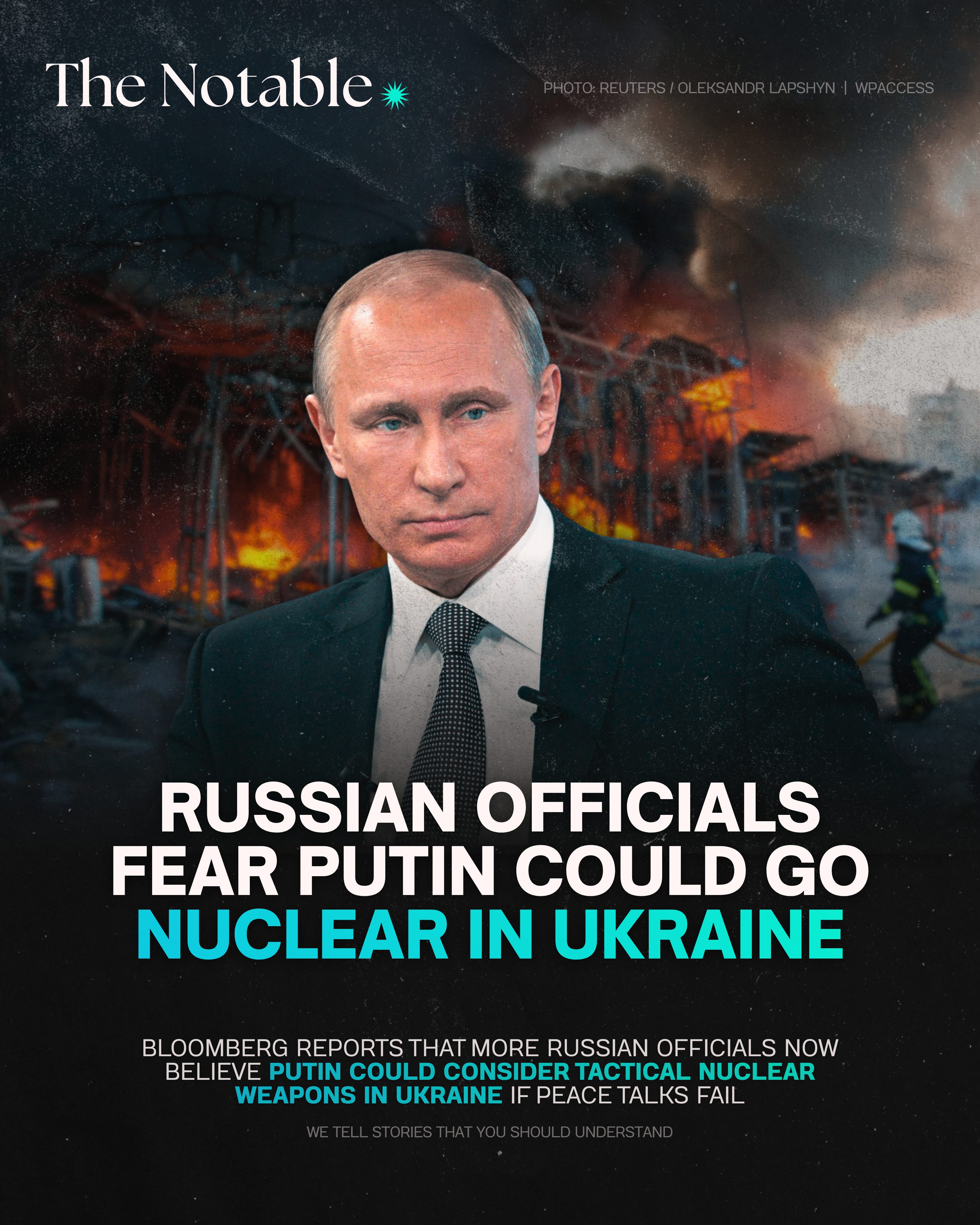
Russia’s war in Ukraine may be entering another dangerous phase.
According to reporting by Bloomberg, a growing number of Russian officials and people close to the Kremlin believe President Vladimir Putin could eventually resort to tactical nuclear weapons if he concludes that diplomacy has failed and that Russia cannot achieve its objectives through conventional means.
The report does not say that Putin has decided to use nuclear weapons, nor does it indicate that Russia is currently preparing for a nuclear strike.
That distinction is critical.
What has changed is the reported perception among some Russian officials that nuclear weapons could become a last-resort option if the war continues without a political settlement or a clear path toward Russian objectives.
The Immediate Shift Is Toward Conventional Escalation
Bloomberg’s reporting points first to a more immediate development: Moscow is preparing to intensify its conventional attacks on Ukraine.
Russian officials reportedly believe peace negotiations have reached a dead end. Rather than viewing diplomacy as producing a breakthrough, the Kremlin is increasingly preparing for another phase of military pressure.
That could involve heavier missile attacks against Ukrainian targets and critical infrastructure.
The logic is straightforward. If Moscow believes negotiations are failing, it has an incentive to increase the military costs for Kyiv in the hope of changing Ukraine’s calculations and strengthening Russia’s position at the negotiating table.
The danger is that escalation can become self-reinforcing.
If greater conventional attacks fail to produce the desired political result, pressure can build for still more aggressive measures.
That is where the nuclear question becomes significant.
Why Tactical Nuclear Weapons Matter
Tactical nuclear weapons are generally designed for use over shorter distances and against battlefield or theater-level targets, rather than the strategic destruction associated with intercontinental nuclear weapons.
But the distinction between “tactical” and “strategic” does not make nuclear use limited in its consequences.
Any Russian nuclear use against Ukraine would represent a historic threshold in the conflict and could fundamentally alter the relationship between Russia, Ukraine, the United States and NATO.
It would also challenge decades of assumptions surrounding the nuclear taboo, which has endured despite numerous wars and crises since 1945.
For that reason, the possibility of tactical nuclear use carries consequences far beyond the immediate battlefield.
This Is Not Yet a Nuclear Strike Warning
The most important qualification in the Bloomberg report is that there is no indication Russia is currently preparing to use a nuclear weapon.
The reported concern is about a possible future decision under increasingly extreme circumstances.
That makes the story less about an imminent nuclear attack and more about how Russian officials may be thinking about the trajectory of the war.
Analysts have also questioned the military usefulness of nuclear weapons in Ukraine.
Alexander Gabuev of the Carnegie Russia Eurasia Center has argued that the likelihood of actual tactical nuclear use remains extremely low because Russia still possesses substantial conventional military options and would face enormous political consequences for crossing the nuclear threshold.
Those constraints matter.
The Road to This Point
The nuclear discussion did not emerge overnight.
Throughout 2026, Russian nationalist hardliners have increasingly called for a more aggressive response to Ukrainian attacks inside Russia and for an end to what they regard as unproductive negotiations with the United States and Ukraine.
In June, Reuters reported growing pressure from Russian hawks for Putin to abandon diplomacy and escalate the war. Some advocated tactical nuclear weapons alongside other forms of military escalation.
The Kremlin, however, had not adopted the most extreme proposals.
The development is important because it illustrates a broader shift: nuclear weapons have increasingly become part of the public debate among Russia’s most hardline voices, even though their actual use remains highly consequential and uncertain.
Russia Has Already Expanded Its Nuclear Doctrine
The Kremlin’s nuclear signaling also has a formal policy foundation.
In November 2024, Putin approved an updated Russian nuclear doctrine that broadened the circumstances under which Moscow says nuclear weapons could potentially be used.
The revised doctrine lowered some of the ambiguity surrounding Russia’s response to large-scale conventional attacks and expanded the situations that Moscow could characterize as a threat to its sovereignty or territorial integrity.
The doctrine also introduced provisions concerning attacks by non-nuclear states supported by nuclear powers.
The changes were widely interpreted as an attempt to strengthen Russia’s deterrence and warn Western governments against deeper involvement in the Ukraine war.
But doctrine is not an automatic launch order.
A nuclear policy framework establishes conditions and signaling. It does not mean that Russia will necessarily use nuclear weapons whenever one of those conditions is arguably met.
Ukraine Has Increased Pressure Inside Russia
Another factor behind the escalation is the growing ability of Ukraine to strike targets far inside Russian territory.
Ukraine has increasingly targeted Russian oil infrastructure, logistics networks, military facilities and other strategic assets.
These attacks are designed to weaken Russia’s capacity to sustain the war and impose costs on the Russian economy.
From Moscow’s perspective, however, the attacks also provide political justification for retaliation.
Putin has accused Ukraine of targeting Russia’s economic infrastructure and warned that Moscow would respond against what he described as Ukraine’s most sensitive economic sectors.
This creates a dangerous cycle.
Ukraine increases pressure on Russia. Russia responds with heavier attacks. Ukraine retaliates. Russia faces greater internal pressure to escalate again.
The longer that cycle continues without diplomacy producing an agreement, the more difficult it becomes for either side to de-escalate without appearing to concede.
Peace Talks Are the Critical Variable
The nuclear question ultimately remains tied to the state of diplomacy.
If negotiations regain momentum, the incentive for Russia to pursue extreme military options could decline.
If negotiations remain frozen while battlefield pressure increases, the opposite could happen.
This is why the reported Kremlin assessment that peace talks have reached a dead end is so important.
For Moscow, the calculation appears to be shifting from whether military pressure can support diplomacy to whether military pressure must replace diplomacy.
That does not mean Putin has abandoned negotiations permanently.
It does mean the Kremlin may increasingly see military escalation as the mechanism for improving its negotiating position.
China and India Matter
Russia’s decision-making is also constrained by its relationships with countries that remain important to its international position.
China and India have both had strong incentives to prevent the Ukraine war from escalating into a nuclear conflict.
Both countries maintain strategic relationships with Moscow, but neither has an obvious interest in seeing Russia cross the nuclear threshold.
A Russian nuclear strike could create enormous pressure for international isolation and potentially destabilize the broader global economy.
For Putin, therefore, nuclear use would not simply be a military decision.
It would be a geopolitical gamble.
What Would Nuclear Use Actually Change?
A Russian tactical nuclear strike would create uncertainty over almost every major dimension of the conflict.
The immediate question would be how Ukraine and its Western partners respond.
The United States and NATO would face enormous pressure to demonstrate that nuclear coercion cannot succeed while also avoiding a direct NATO-Russia war.
Russia, meanwhile, would have to calculate whether nuclear use actually improves its military position or instead triggers greater Western intervention and international isolation.
The risk is that escalation could become difficult to control.
Once nuclear weapons are used in a European war for the first time since 1945, the assumptions that have constrained the conflict would change dramatically.
The Real Warning Is the Escalation Ladder
The most consequential element of the Bloomberg report is therefore not that Russia is preparing a nuclear attack.
It is that nuclear weapons are reportedly becoming part of the longer-term escalation calculus among more Russian officials.
That is a different, and more subtle, warning.
Wars rarely move directly from conventional fighting to nuclear use. They tend to move through stages: increased attacks, retaliation, mobilization, new weapons, expanded targets and progressively higher political stakes.
The concern is that every additional stage can make the next one easier to justify.
For now, Russia appears to be moving toward greater conventional pressure.
But if that pressure fails to produce the outcome Moscow wants, the question becomes how much further the Kremlin is prepared to climb.
What to Watch Next
Three developments will be particularly important.
First, whether Russia launches the larger conventional attacks described in the latest reporting.
Second, whether peace negotiations resume or remain stalled.
Third, whether Russian officials move from discussing nuclear weapons as a theoretical last resort toward publicly advocating their use under specific circumstances.
That last development would represent a meaningful change.
For now, the evidence does not support saying that Putin has decided to use a tactical nuclear weapon.
What the latest reporting does suggest is more troubling in a different way: as diplomacy stalls and conventional escalation intensifies, the nuclear threshold is increasingly entering the conversation inside Russia.
And in a war involving a nuclear superpower, even the normalization of that conversation matters.
Sources and reporting
This article is based primarily on the latest Bloomberg reporting on Russian officials’ assessments of Putin’s potential escalation decisions, supplemented by reporting from Reuters, The Associated Press, and analysis from the Carnegie Russia Eurasia Center on Russia’s military and nuclear posture.
We’re really heading into WW3 aren’t we in earnest?