


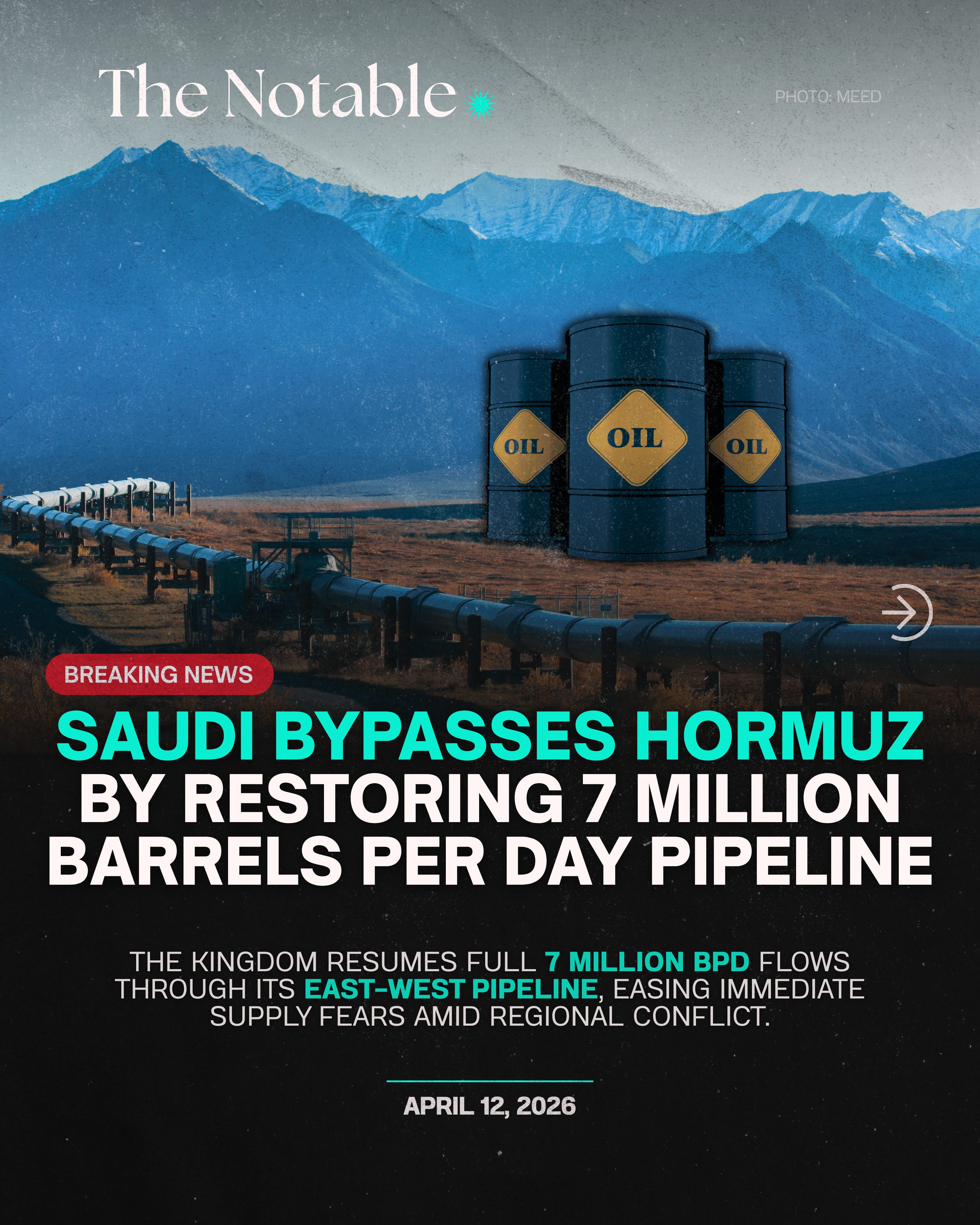
Saudi Arabia has restored its East–West oil pipeline to full capacity, resuming flows of roughly 7 million barrels per day.
The move comes after recent attacks disrupted operations, briefly constraining one of the world’s most important alternative oil routes. Now fully operational again, the pipeline allows Saudi crude to move from its eastern oil fields to the Red Sea port of Yanbu, bypassing the Strait of Hormuz entirely.
At first glance, this looks like a simple recovery. In reality, it reflects something more structural: the global oil system is being rerouted under pressure.
The East–West pipeline, often referred to as Petroline, was built for moments like this. Stretching across Saudi Arabia, it provides a direct path from the Gulf to the Red Sea, allowing exports to reach Europe and beyond without entering the Persian Gulf’s most vulnerable corridor.
That vulnerability is now central to the story.
The Strait of Hormuz typically carries around 20 to 21 million barrels of oil per day, close to one fifth of global consumption. It is the single most important chokepoint in the global energy system. When flows through that corridor are threatened or disrupted, markets react immediately.
In recent days, that threat became real.
Attacks linked to regional tensions damaged Saudi energy infrastructure, including parts of the East–West pipeline system. The disruption cut flows and raised fears that even alternative routes were no longer secure. Oil markets tightened, and the risk of broader supply shocks increased.
Saudi Arabia’s rapid restoration of the pipeline signals both capability and urgency. Within days, the system was repaired and returned to full throughput.
But the speed of recovery should not be mistaken for stability.
The return of 7 million barrels per day to global markets provides immediate relief. It restores a significant portion of Saudi export capacity and reassures buyers in Asia and Europe who depend on Gulf crude.
Yet the numbers reveal the limits.
Even at full capacity, the East–West pipeline can only carry about one third of the volume that normally passes through the Strait of Hormuz. It is a workaround, not a replacement.
This distinction matters.
What we are seeing is not a resolution of supply risk, but a redistribution of it. Oil is still flowing, but through fewer, more exposed channels. The system is adapting, but it is also becoming more fragile in new ways.
There is a deeper shift underway.
Energy infrastructure is no longer just a background system that supports the global economy. It is becoming a frontline asset in geopolitical conflict. Pipelines, ports, and shipping routes are now strategic targets, not just logistical components.
The recent attacks on Saudi infrastructure underscore this reality. The East–West pipeline was designed to bypass one vulnerability, only to become another.
This creates a new dynamic. Each workaround introduces a new point of exposure. Each alternative route becomes a potential pressure point.
In this environment, resilience is not about eliminating risk. It is about managing where that risk moves.
The restoration of the pipeline highlights a broader transformation.
For decades, the global oil system has been optimized for efficiency, with the Strait of Hormuz as its central artery. That system assumed relative stability in key transit routes.
That assumption is now being tested.
As flows through Hormuz become constrained, producers are forced to reroute supply. Saudi Arabia’s pipeline is one of the few large-scale alternatives available. Other countries have more limited options.
This creates an uneven landscape, where some actors can adapt more quickly than others. It also raises the stakes for any disruption along these alternative routes.
The result is a system that is no longer anchored to a single stable pathway, but shifting across multiple constrained ones.
For now, the immediate crisis has eased. Oil is flowing again, and markets have regained a degree of confidence.
But the underlying conditions remain unresolved.
The Strait of Hormuz is still under pressure. The East–West pipeline remains exposed. And the broader geopolitical tensions driving these disruptions have not subsided.
The key question is no longer whether oil will continue to flow. It is how secure those flows will be, and at what cost.
Because the story is no longer just about supply.
It is about control over the routes that supply depends on.