


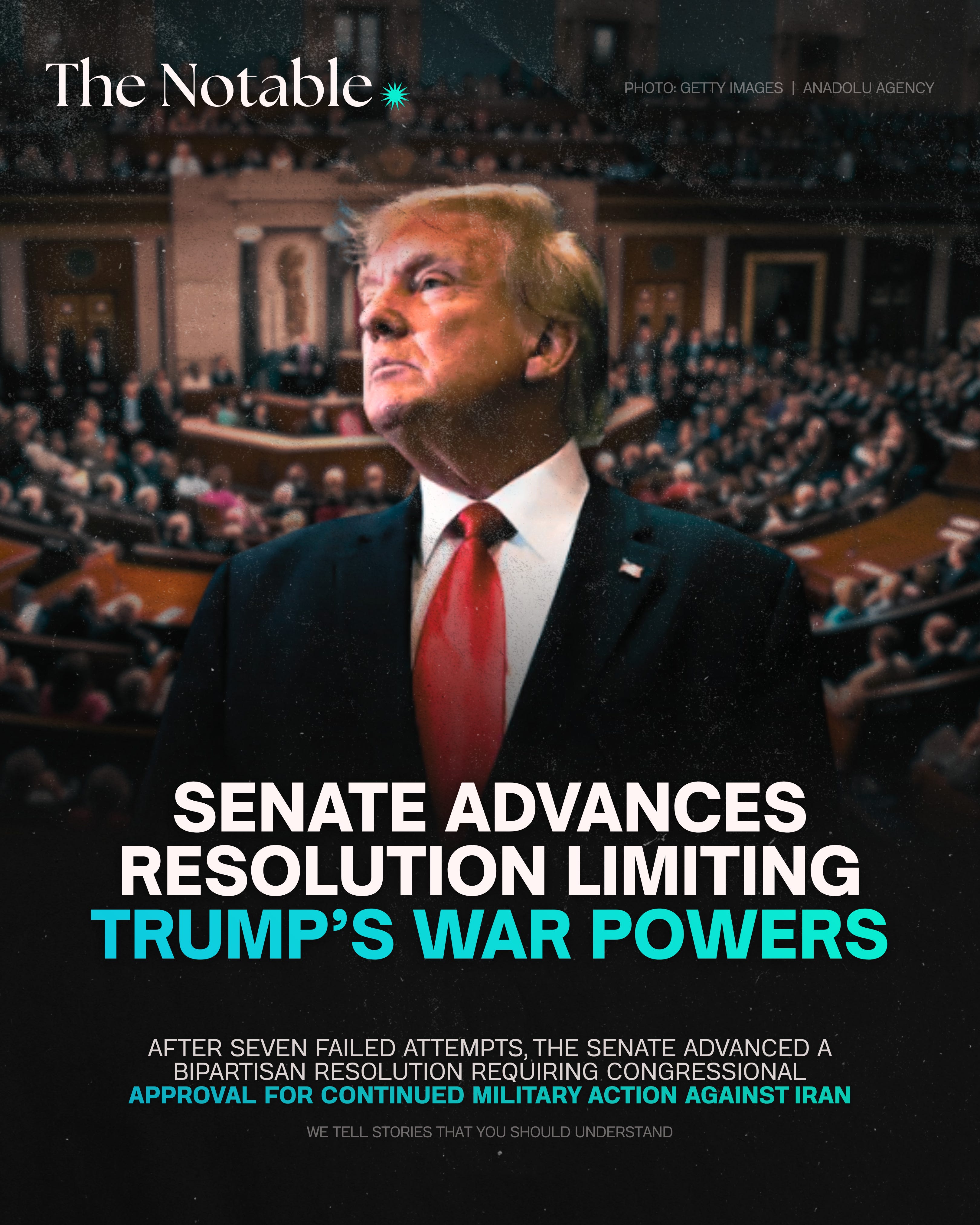
The U.S. Senate has officially advanced a bipartisan resolution that would limit President Donald Trump’s ability to continue military operations against Iran without congressional approval, marking one of the most significant challenges yet to presidential war authority during the escalating conflict.
In a 50-47 procedural vote, senators moved forward with the Iran War Powers Resolution after months of failed attempts to bring the measure to the floor.
The breakthrough came after several Republicans joined Democrats, reflecting growing concern inside Congress over the scope of U.S. involvement in the conflict and the administration’s legal authority to continue military action without formal authorization.
What The Resolution Would Do
The resolution does not immediately end U.S. military operations against Iran.
However, if ultimately passed into law, it would require the administration to seek explicit congressional approval for continued military action and broader involvement in the conflict.
The measure could force the White House to either secure formal authorization from Congress or scale back unauthorized military operations.
Politically, the vote represents one of the strongest bipartisan rebukes yet to Trump’s wartime authority.
The Constitutional Debate
At the center of the fight is the 1973 War Powers Resolution, a law created after the Vietnam War to limit unilateral presidential military action.
Under the law, presidents can deploy U.S. forces without congressional approval only temporarily before lawmakers must authorize continued hostilities.
Critics argue the administration has exceeded constitutional boundaries by continuing operations against Iran without explicit authorization from Congress.
The White House, however, maintains that current military actions remain legally justified under existing authorities and evolving ceasefire conditions tied to the conflict.
Why Congressional Concern Is Growing
For months, earlier attempts to advance similar measures repeatedly failed in the Senate.
But support gradually increased as concerns grew over:
regional escalation
prolonged military involvement
economic fallout
the possibility of a wider Middle East conflict
Several Republican senators ultimately joining Democrats became one of the most politically significant developments of the vote, signaling that concerns over the administration’s Iran strategy are expanding beyond Democratic opposition alone.
What Happens Next
The resolution now moves toward full Senate debate and a possible final vote.
Even if it passes the Senate, the measure would still face a difficult path through the House of Representatives and could ultimately be vetoed by President Trump.
Still, after months of failed efforts, Congress has now taken its clearest step yet toward reasserting authority over America’s expanding conflict with Iran.