


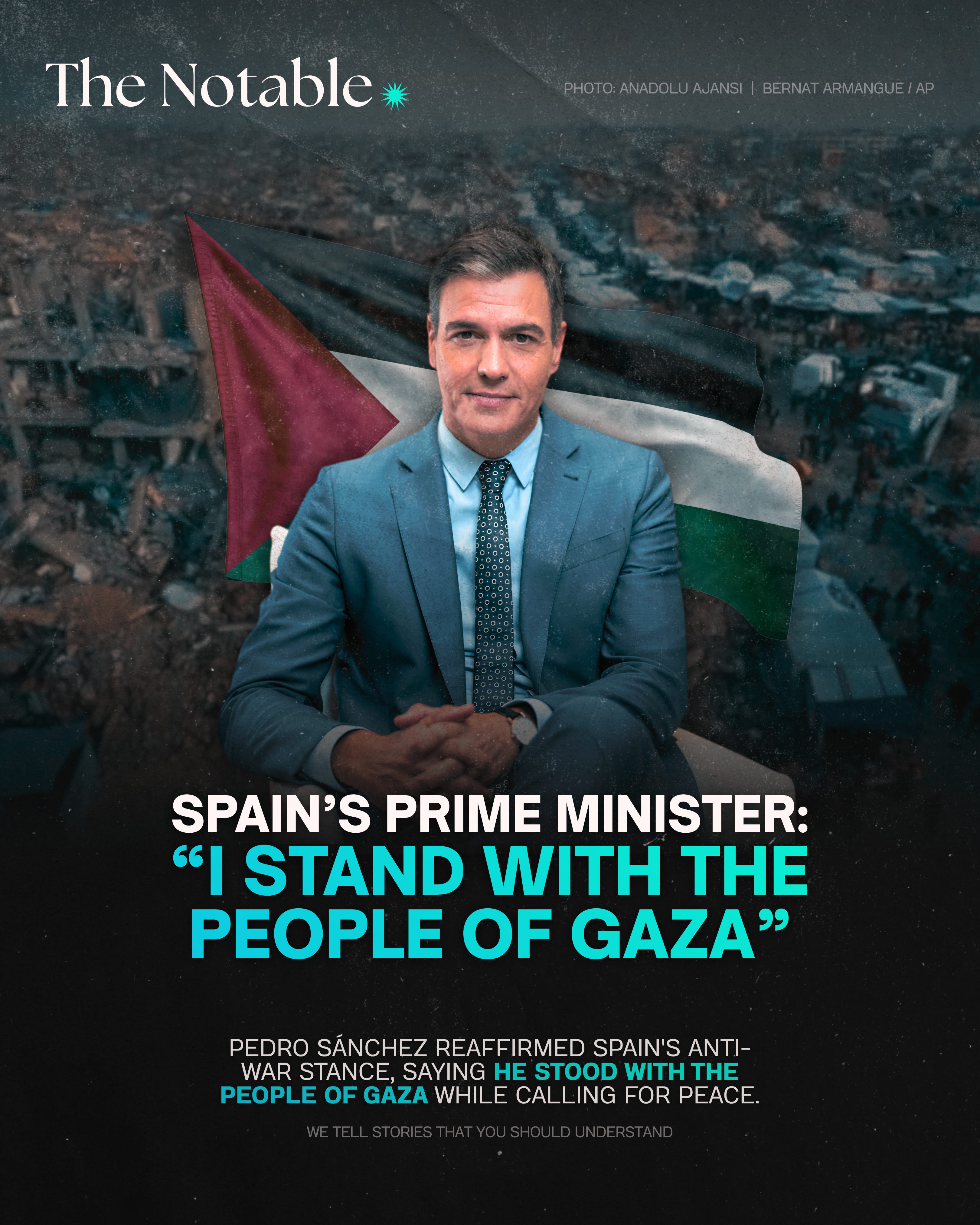
As violence continues to reshape the Middle East, Spanish Prime Minister Pedro Sánchez has reaffirmed Spain’s opposition to war, delivering one of Europe’s clearest statements in support of civilians affected by the conflict.
Speaking during the latest regional crisis, Sánchez declared:
“My position is clear: I cannot support war, and during this time I stand with the people of Gaza and Iran.”
He paired the remarks with Spain’s broader message of “yes to peace, no to war,” emphasizing diplomacy and the protection of civilian lives over military escalation.
While the comments have attracted widespread attention online, they are best understood as a continuation of Spain’s existing foreign policy rather than a significant policy shift.
A Consistent Anti-War Position
Sánchez’s remarks came as tensions expanded beyond Gaza, raising fears that the conflict could draw more countries into a broader regional confrontation.
Rather than focusing solely on one front, the Spanish leader framed Spain’s position as a general rejection of war and a call for de-escalation across the Middle East.
His statement emphasized several principles that have consistently defined Spain’s foreign policy in recent years:
opposition to further military escalation,
support for diplomacy and negotiated solutions,
protection of civilians regardless of nationality,
and respect for international humanitarian law.
Spain has repeatedly argued that military action alone cannot produce lasting security and that diplomacy remains essential to preventing a wider regional conflict.
Spain’s Distinct Position Within Europe
Spain has emerged as one of the European Union’s most outspoken voices on the humanitarian consequences of the Gaza war.
In May 2024, Spain formally recognized the State of Palestine, joining Ireland and Norway in a move that marked one of the most significant diplomatic developments within Western Europe during the conflict.
The decision drew criticism from Israel but was welcomed by Palestinian officials, who viewed it as increased international support for Palestinian statehood.
Since then, Madrid has consistently:
called for an immediate ceasefire,
expanded humanitarian assistance to Gaza,
supported the release of hostages,
advocated for unrestricted humanitarian access,
and urged all parties to comply with international humanitarian law.
Spain has also continued to support a negotiated two-state solution, arguing that lasting peace requires both Israeli security and Palestinian self-determination.
Why Sánchez’s Comments Matter
Although Sánchez’s latest statement has generated significant international attention, its importance lies less in the words themselves than in what they represent.
Many European governments have sought to balance support for Israel’s security with growing concern over civilian casualties in Gaza. Spain, however, has increasingly adopted a more direct and outspoken approach, placing humanitarian protection and international law at the center of its public messaging.
By stating that he stands with the people of Gaza while rejecting war, Sánchez reinforces Spain’s position that civilian suffering should remain a primary concern regardless of the broader geopolitical dynamics.
His inclusion of Iran in the same statement also reflects concern that escalating hostilities could evolve into a wider regional conflict with consequences extending far beyond Gaza.
A Region Facing Growing Risks
The Middle East remains highly volatile, with multiple interconnected conflicts increasing the risk of wider instability.
Humanitarian organizations continue to warn about conditions inside Gaza, while governments around the world have urged restraint to prevent additional escalation involving regional powers.
Against this backdrop, Spain has consistently argued that diplomacy, humanitarian access, and adherence to international law remain the most viable path toward reducing violence and preventing further regional destabilization.
Looking Ahead
Spain is unlikely to alter its overall approach in the near future.
The Sánchez government has repeatedly signaled that it will continue advocating for:
an end to hostilities,
protection of civilians,
increased humanitarian assistance,
respect for international law,
and renewed diplomatic efforts toward a lasting political settlement.
As divisions persist among European governments over the conflict, Spain’s position continues to distinguish it as one of the European Union’s strongest proponents of diplomacy and humanitarian protection.
Whether Sánchez’s latest remarks influence broader European policy remains uncertain. However, they reaffirm Spain’s determination to keep humanitarian concerns and peaceful resolution at the center of its foreign policy during one of the most consequential geopolitical crises of the decade.