


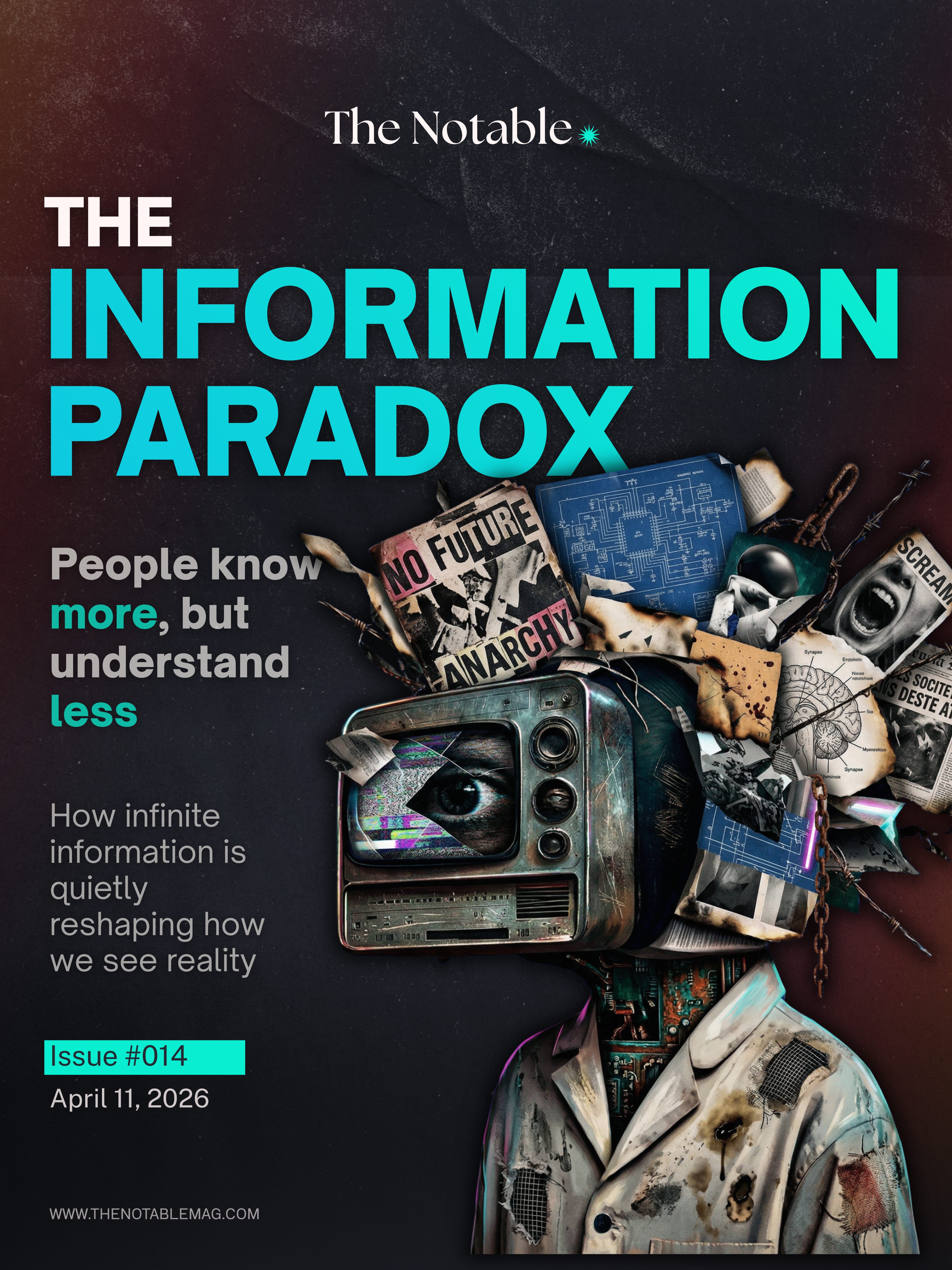
We know everything that’s happening… And still miss the point.
At 2:17 a.m., a price alert flashes.
Oil futures spike. Not dramatically, but enough to trigger attention. Within minutes, the explanation begins to circulate: a reported escalation near a strategic shipping corridor. A tweet from a regional analyst. A satellite image reposted without context. A short video clip with no timestamp.
By 2:25 a.m., the narrative feels complete.
Something happened. Markets reacted. People moved on.
But nothing, in any meaningful sense, was understood.
This is no longer an exception. It is the dominant way reality is processed.
Modern information systems have solved the problem of access. The average person today can track geopolitical developments, financial movements, and political statements in real time. Data that once moved through diplomatic cables or institutional briefings is now ambient, continuous, and globally distributed.
According to the Reuters Institute for the Study of Journalism, over 70% of adults in developed markets say they follow the news multiple times a day. Push notifications, live blogs, and algorithmic feeds have collapsed the delay between event and awareness.
But this compression has produced a different deficit.
Events are no longer experienced as part of a sequence. They are consumed as isolated signals.
A protest. A policy announcement. A military movement. A market reaction.
Each arrives fully formed, stripped of the structural conditions that produced it.
The result is a public that is continuously informed, but structurally disoriented.
This is not a story about misinformation.
It is a story about fragmentation.
The prevailing assumption is that confusion comes from falsehoods, bias, or manipulation. And those forces exist. But they are not the primary failure mode of the modern information environment.
The deeper issue is that the system delivers pieces without architecture.
People are not misinformed. They are under-contextualized.
They can tell you that oil prices moved, that a central bank raised rates, or that tensions escalated in a particular region. But the connective tissue—the incentives, dependencies, and constraints that make these events meaningful—remains invisible.
Information accumulates. Understanding does not.
This fragmentation is not accidental. It is produced by aligned incentives across platforms, media institutions, and even audiences themselves.
Start with platforms.
Companies like Meta Platforms and TikTok are optimized for engagement, not coherence. Their systems reward immediacy, emotional salience, and repeat interaction. A developing situation broken into multiple updates generates more engagement than a single, structured explanation.
In this environment, context becomes inefficient.
A fully explained story reduces the need for further updates. It closes the loop. But platforms benefit from keeping the loop open.
Then consider media organizations.
The economic model of digital media increasingly depends on visibility within these same platforms. Speed becomes competitive advantage. Being first matters more than being complete. Stories are published incrementally, often with partial information, and updated in real time.
What emerges is a kind of narrative atomization. Each update is accurate enough to stand alone, but insufficient to explain the whole.
Finally, audiences themselves are shaped by this system.
Continuous exposure to fragmented updates trains attention toward immediacy. People learn to track indicators rather than systems. Oil prices become a proxy for geopolitical risk. A politician’s statement becomes a proxy for policy direction. A viral video becomes a proxy for public sentiment.
These signals are not meaningless. But they are incomplete.
And over time, the habit of interpreting them structurally begins to erode.
The consequence is a subtle but profound shift in how people relate to reality.
They know more. But they feel less capable of making sense of what they know.
This is where the idea of being “omniscient but powerless” begins to take hold.
A 2023 report from the World Economic Forum identified information overload as a growing contributor to public anxiety and decision paralysis. Not because people lack data, but because they cannot integrate it into a coherent model of the world.
This is the contradiction at the center of modern information systems:
Access has expanded faster than interpretive capacity.
And when interpretation fails, power shifts.
Because understanding is not just cognitive. It is strategic.
Institutions, governments, and markets still operate on structured models. They analyze incentives, anticipate second-order effects, and act within a coherent framework.
The public, by contrast, is increasingly reacting to surface-level signals.
This creates an asymmetry.
Not of information—but of meaning.
In the short term, this fragmentation distorts perception.
Markets overreact to incomplete signals, then correct. Public discourse swings rapidly between narratives. Policy debates become reactive, driven by the latest development rather than long-term structure.
The 2022 energy crisis in Europe offers a clear example. As gas flows from Gazprom fluctuated, public attention focused on daily price movements and political statements. But the deeper issue—Europe’s structural dependence on external energy and the slow pace of diversification—received less sustained attention until the crisis had fully materialized.
The signals were visible. The system was not.
In the longer term, the effects are more consequential.
A population that cannot connect events into systems becomes easier to steer. Not necessarily through misinformation, but through selective emphasis. Highlight certain signals, obscure others, and the overall perception shifts without altering the underlying facts.
At the same time, institutional trust erodes. When people cannot reconcile what they see with what they experience, explanations begin to feel insufficient or manipulated. This is not always because they are wrong, but because they are incomplete.
The result is a feedback loop.
More information leads to less clarity. Less clarity leads to more demand for information. And the cycle accelerates.
The paradox is not that people are uninformed.
It is that they are informed in a way that prevents understanding.
The system does not hide reality. It disassembles it.
And in that disassembly, something essential is lost—not the facts themselves, but the structure that makes them meaningful.
Which raises a more difficult question.
If the modern world is experienced as a stream of signals rather than a system of causes, then the issue is no longer what people know.
It is whether knowing, in this form, still counts as understanding.