


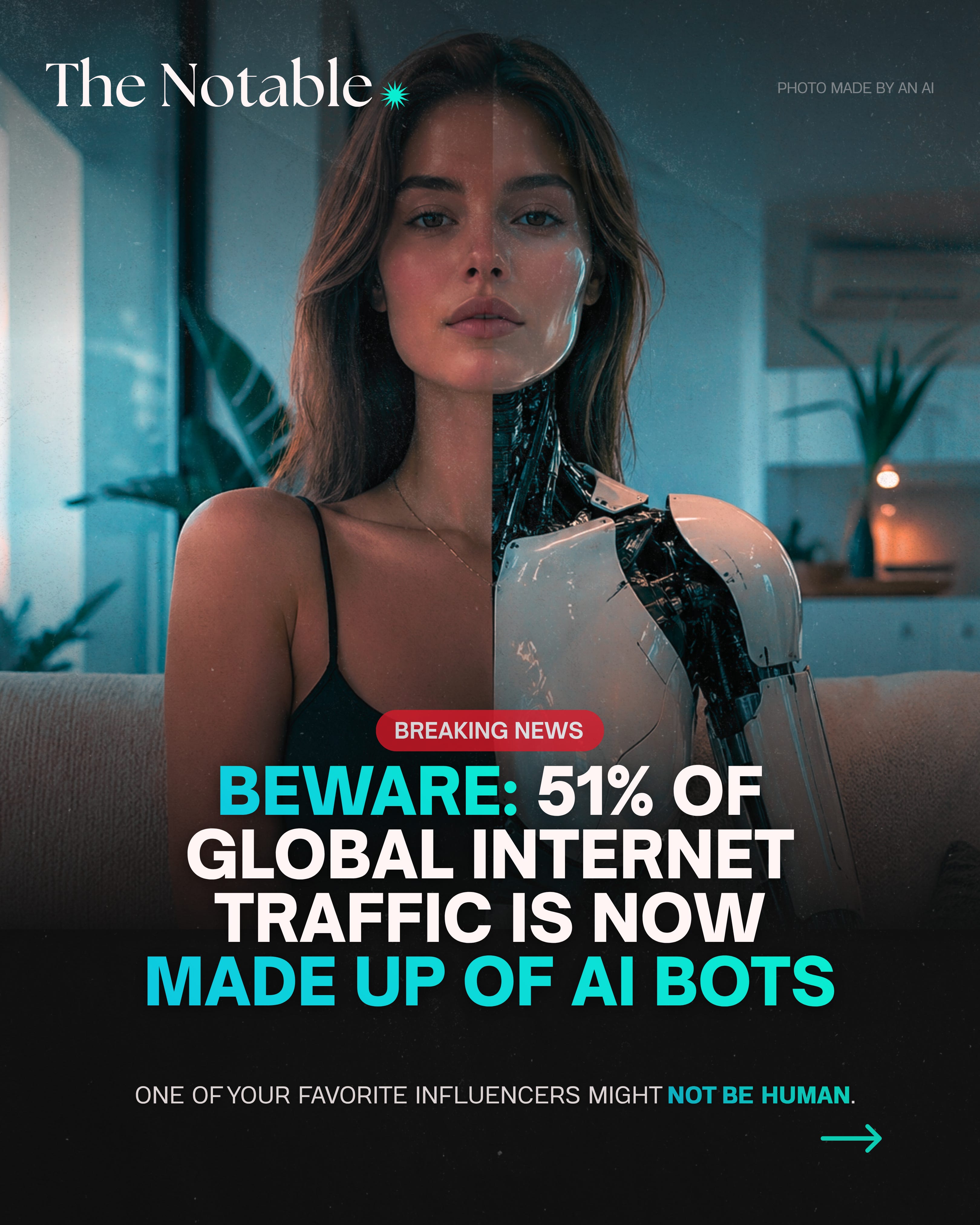
In April 2026, a quiet but profound statement signaled a turning point.
Lumen Technologies CEO Kate Johnson said that more than half of global internet traffic is now generated by “autonomous workers”, including AI bots, scrapers, and machine-to-machine systems.
At first glance, it sounds like another striking statistic in the age of artificial intelligence.
It is not.
It is a structural shift in what the internet actually is.
Johnson’s statement aligns with findings from the Imperva Bad Bot Report 2025, which showed that bots accounted for 51% of web traffic, the first time automated activity overtook human activity in over a decade.
This was not driven by a single breakthrough.
It was the result of several forces converging at once:
The rise of generative AI since 2023
The explosion of data scraping for model training
The emergence of autonomous agents that can act online
What used to be background activity has now become the dominant layer.
And unlike previous eras of automation, these systems are not just indexing the web.
They are operating within it.


What Counts as an “AI Bot”?
The term “bot” can be misleading.
It no longer refers only to spam or simple scripts.
Today’s automated traffic includes:
AI systems continuously scraping content to train models
Agents retrieving real-time data for AI assistants
Software performing tasks like booking, posting, or interacting
Malicious actors exploiting platforms at scale
Some of these systems are beneficial. Many are necessary.
But collectively, they are transforming the nature of online activity.
The internet is no longer a space where humans simply browse.
It is a system where machines increasingly act on behalf of humans.
Why This Changes Everything
For years, internet traffic has been treated as a proxy for human attention.
More traffic meant more users.
More users meant more value.
That logic is breaking down.
If a growing share of traffic is generated by machines, then:
Engagement metrics become less reliable
Content may be consumed by AI before it reaches people
Visibility is shaped as much by algorithms as by audiences
This has immediate consequences for media, platforms, and businesses.
Publishers are already facing a new reality: their content is being extracted, processed, and repurposed by AI systems, often without direct human readership.
The economic model of the open web begins to strain under this pressure.
What makes this moment significant is not just the percentage.
It is who is observing it.
Lumen Technologies operates one of the world’s largest backbone networks, giving it visibility into large-scale traffic flows across the internet.
When a company at that level signals that machines now account for the majority of activity, it reflects a change happening beneath the surface of everyday experience.
Most users do not see it directly.
But they are already interacting within it.
Not All Bots Are the Same
It is important to separate perception from reality.
Not all automated traffic is harmful.
Search engines, AI assistants, and enterprise systems rely on bots to function.
However, a significant portion of traffic includes aggressive scrapers and malicious actors.
This creates a dual pressure:
Platforms must support legitimate AI-driven use
While defending against exploitation and abuse
Cybersecurity, infrastructure design, and regulation are now being forced to adapt to this new balance.
From Human Internet to Machine Internet
The deeper shift is conceptual.
For decades, the internet has been understood as a human network.
People create content.
People consume content.
People interact.
That model is fading.
A new layer is emerging:
Machines that read, write, decide, and act online.
Not occasionally.
Continuously.
This does not mean humans are leaving the internet.
It means they are no longer the only meaningful participants.
The next phase is already underway.
AI agents are becoming more autonomous.
They will:
Navigate websites independently
Execute transactions
Communicate with other systems
Represent users in digital environments
At scale, this changes how the internet functions.
It becomes less like a public space and more like an operating system.
One where humans set intent, and machines carry it out.
The headline is striking: over half of internet traffic is now bots.
But the real story is deeper.
The internet is no longer defined by who uses it.
It is increasingly defined by what operates within it.
And for the first time, that is no longer primarily human.