


View the mini-mag post here. (April 6, 2026)
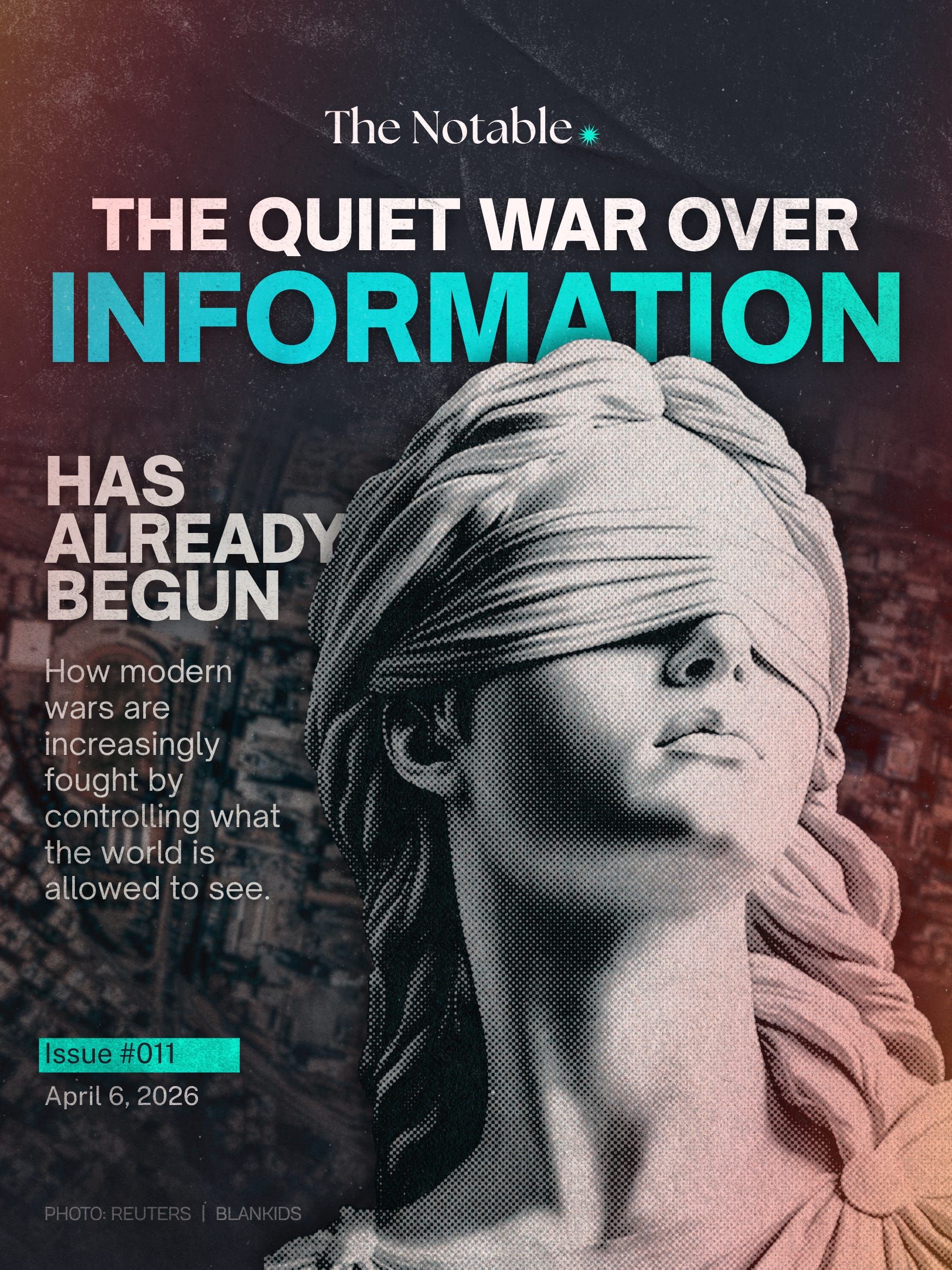
You are watching a war unfold in real time.
But you are not seeing all of it.
Not because the events are too distant or too complex, but because parts of that reality are no longer fully visible. Access itself is becoming selective. And when access changes, understanding changes with it.
This is the quiet shift now emerging in modern conflict.
Recently, Planet Labs agreed to indefinitely withhold satellite images of Iran following a request from the U.S. government. What began as short delays in releasing imagery has evolved into an open-ended restriction. Data that was once available to analysts, journalists, and even the public is now being managed behind controlled access.
At one level, the reasoning is clear.
Satellite imagery is not just information. It is intelligence. It can reveal military positions, expose strike outcomes, and map operational patterns. In an active conflict, that level of visibility can provide adversaries with real-time advantages. Restricting access, in this sense, is not unusual. It is strategic.
But this moment reveals something deeper.
For years, the world moved toward an era of radical transparency. The rise of commercial satellite technology meant that conflicts were no longer viewed solely through official statements. Independent analysts could verify claims. Journalists could challenge narratives. Even ordinary observers could see events unfold through imagery once reserved for governments.
This redistribution of visibility quietly shifted power.
Governments were no longer the sole gatekeepers of reality.
Now, that shift is being reconsidered.
The decision to restrict satellite imagery does not require sweeping public laws or visible enforcement. Influence can operate more subtly. Governments are among the largest buyers of commercial satellite data, creating structural dependence within the industry. When requests are made, alignment often follows.
This is not power imposed through force.
It is power exercised through position.
And it is not new.
Control over information has long been part of warfare. During the Gulf War, media coverage was tightly managed. In the Iraq War, journalists were embedded within military units, shaping what could be seen and reported. More recently, during the Ukraine War, open-source intelligence briefly expanded public visibility before access became more selective in sensitive contexts.
Each era develops its own method of managing perception.
What is different now is the scale.
We are no longer dealing only with media access or press briefings. We are dealing with the infrastructure of visibility itself. Satellite networks, data platforms, and digital distribution systems now determine what can be independently verified—and what cannot.
And when independent verification becomes limited, something else fills the space.
Narratives.
Without imagery to confirm or challenge claims, public understanding begins to rely more heavily on official accounts, institutional interpretations, and mediated explanations. This does not automatically produce misinformation. But it changes the balance of information.
The less the public can see, the more it must trust.
And trust, in times of conflict, is never neutral.
This is where the risk begins to take shape.
Because when access is restricted and verification is constrained, narratives gain structural advantage. They are no longer just interpretations of reality. They begin to define the boundaries of what can be accepted as reality.
This is not always deliberate. It does not require coordinated messaging or overt propaganda. It emerges from the environment itself—an environment where visibility is uneven, access is filtered, and certainty becomes harder to establish.
In that environment, perception becomes a strategic domain.
And that is the deeper shift.
For years, it was widely assumed that technology would continue to expand transparency. That more data would lead to more accountability. That greater access would lead to a more informed public.
But this moment suggests something more conditional.
Transparency is not permanent. It can be scaled back when it collides with strategic interests. It can be adjusted, restricted, or redirected—often quietly, and often without widespread attention.
The result is a new kind of battlefield.
Not just one defined by geography or firepower, but by visibility itself.
Who sees what.
Who verifies what.
Who decides what becomes known.
These are no longer secondary questions.
They are becoming central to how conflicts are experienced, understood, and remembered.
And perhaps the most important realization is this:
The future of war may not only be determined by what happens on the ground, but by what the world is allowed to see of it.