


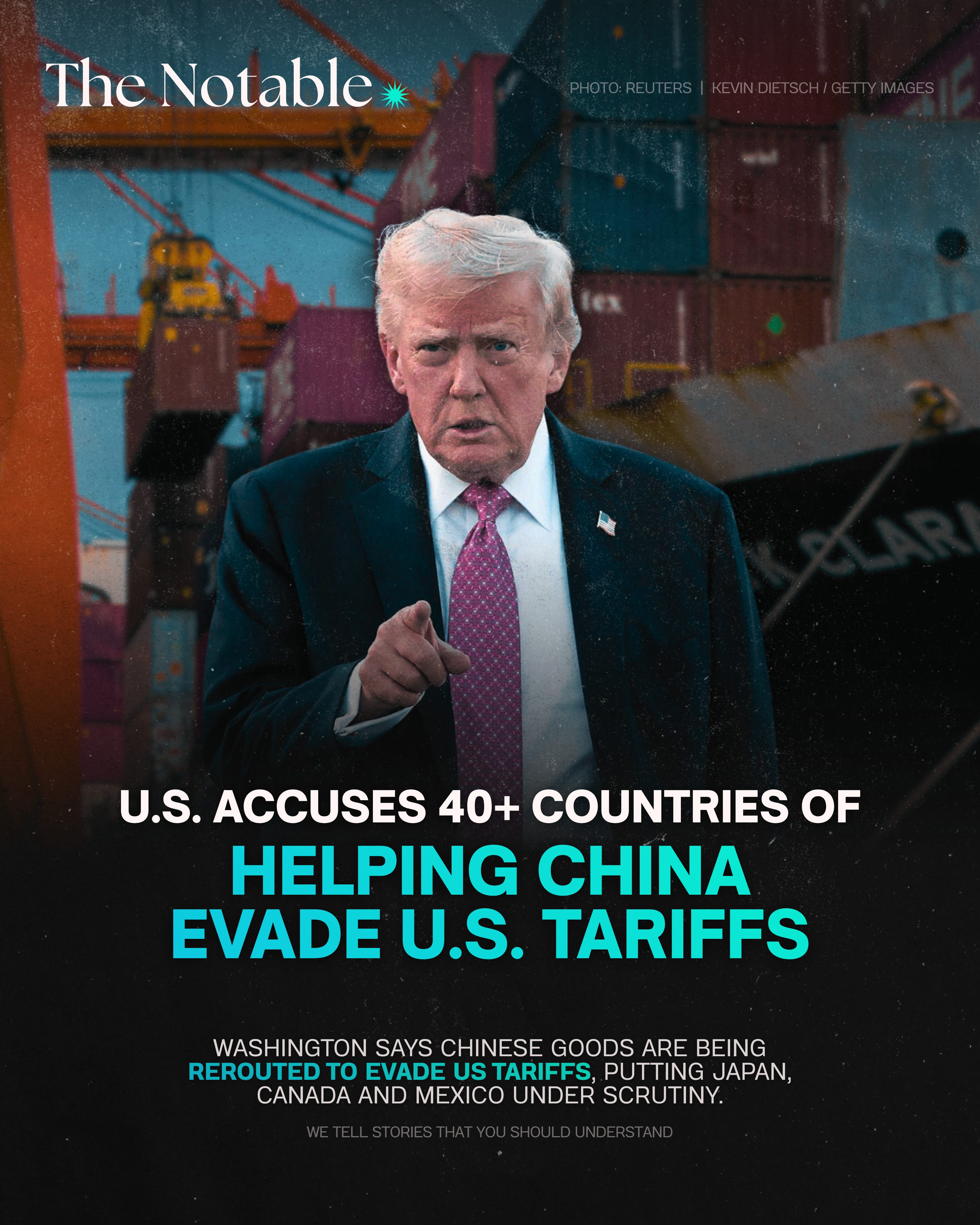
The Trump administration has expanded its campaign against Chinese tariff evasion, accusing Chinese exporters of exploiting global supply chains to circumvent U.S. trade barriers.
In a report released August 13, the White House identified more than 40 jurisdictions as having elevated risks of illegal transshipment. The list includes major U.S. economic partners such as Japan, Canada and Mexico, alongside countries including India, Vietnam, Malaysia, Thailand and South Korea.
The administration’s argument is straightforward: tariffs can lose their effectiveness if goods subject to high duties in China can be routed through another country before entering the United States.
But there is an important distinction. The White House has not established that every country on its list is knowingly helping China evade tariffs. The report describes elevated risks and identifies trade patterns that Washington believes warrant greater scrutiny. It also acknowledges that some production has genuinely shifted out of China rather than simply being disguised.
That distinction matters because the issue reaches far beyond U.S.-China trade. It raises questions about how far Washington is prepared to go to police increasingly complex global supply chains.
What Washington Is Alleging
The central issue is transshipment.
In legitimate international trade, goods can pass through several countries before reaching their final destination. A product manufactured in China, for example, might be shipped to another country for legitimate processing or assembly before being exported to the United States.
The problem arises when that routing is used to fraudulently change the apparent country of origin.
Chinese goods could potentially be relabeled, repackaged, re-invoiced or subjected to insufficient processing in another country before being exported to the U.S. If the product is then declared as originating from that third country, it could potentially receive a lower tariff than the same Chinese product would have faced.
U.S. trade rules generally distinguish between simple routing and legitimate “substantial transformation.” The question is whether enough manufacturing or processing occurred in the third country to legally establish a new country of origin.
Washington says some exporters are exploiting that system.
Why More Than 40 Countries Are Involved
The administration’s report is notable because its scope goes beyond China’s traditional trading partners.
The countries and jurisdictions identified by the White House include Canada, Mexico, Japan, India, Vietnam, Malaysia, Thailand and South Korea, among others.
That does not mean Washington is accusing all of their governments of participating in a coordinated scheme.
Rather, the administration is highlighting countries where it sees conditions or trade patterns that could facilitate illegal transshipment.
Those conditions can include substantial manufacturing links to China, major ports and logistics networks, free-trade zones, bonded warehouses, favorable labor costs and growing trade with the United States.
For Washington, the concern is that China’s manufacturing capacity can effectively be connected to the U.S. market through a much wider network than direct China-U.S. trade statistics reveal.
The Problem Began With the Tariff War
The current dispute has roots in Trump’s first administration.
In 2018, the United States began imposing broad Section 301 tariffs on Chinese imports, dramatically changing the economics of trade between the two countries.
The tariffs created a powerful incentive for companies to reconsider where goods were manufactured and how they entered the American market.
Some of that adjustment was legitimate.
Companies moved factories, diversified suppliers and built new production capacity outside China. Vietnam, Mexico, India and other manufacturing centers benefited from the broader reorganization of global supply chains.
But tariff differences can also create opportunities for fraud.
If an identical product faces a significantly higher tariff when it comes directly from China than when it enters from another country, the financial incentive to disguise its origin increases.
That is the structural problem Washington is now attempting to address.
The Numbers Are Large, But They Need Context
The White House estimates that roughly $60 billion in Chinese goods may be illegally transshipped annually.
Other estimates are substantially higher.
The administration’s report examines several studies and estimates that range from roughly $40 billion to $303 billion, depending on the methodology and definition used.
Those figures should not be treated as interchangeable.
The highest estimates can capture broader forms of trade diversion and potential exposure rather than proven cases of illegal transshipment. The White House itself acknowledges that trade moving away from China is not automatically evidence of fraud.
That is why the most defensible takeaway is not that hundreds of billions of dollars of Chinese goods have definitively evaded U.S. tariffs.
The stronger conclusion is that the scale of potential tariff leakage is large enough for Washington to make supply-chain enforcement a major trade-policy priority.
Billions in Potential Lost Revenue
The White House estimates that illegal transshipment could cost the federal government approximately $19 billion to $26 billion in tariff revenue each year under its modeling assumptions.
The administration also estimates that the economic effects could extend beyond lost customs revenue.
Its modeling associates the potential transshipment problem with reduced U.S. production, employment and economic output.
Those figures are estimates rather than directly observed losses. They depend on assumptions about how much trade is actually being rerouted illegally and what would happen if those goods were instead subject to the intended tariffs.
Still, the numbers explain why Washington is treating the issue as more than a customs technicality.
If tariffs are meant to reshape corporate behavior, then widespread circumvention can undermine the entire policy.
Washington Is Building a More Aggressive Customs System
The latest report also fits into a broader effort by the Trump administration to strengthen customs enforcement.
In June, Trump signed an executive order aimed at strengthening enforcement against illegal transshipment, undervaluation and misclassification.
The administration is now also promoting an AI-based system called “Detective Border.”
The goal is to use data and artificial intelligence to identify suspicious patterns in international trade.
That could involve examining shipping routes, ownership structures, production capacity, trade flows and country-of-origin information to determine whether a shipment appears inconsistent with the declared origin.
In theory, such a system could allow U.S. Customs and Border Protection to focus its resources on shipments that present the greatest risks.
But the technology also creates a difficult challenge: distinguishing sophisticated fraud from legitimate global manufacturing.
Why Japan, Canada and Mexico Make This Bigger
The inclusion of Japan, Canada and Mexico makes the story particularly significant.
These are not marginal players in the U.S. economy. They are deeply integrated into American trade and manufacturing networks.
Mexico and Canada are especially important because of the United States-Mexico-Canada Agreement, or USMCA.
The agreement allows qualifying goods produced within North America to receive preferential treatment under its rules.
That creates a legitimate economic framework for integrated North American manufacturing.
But it also means the U.S. government has an incentive to make sure Chinese products cannot simply enter North American supply chains and obtain preferential treatment without satisfying the agreement’s rules of origin.
For Mexico and Canada, therefore, the issue is not merely about customs enforcement. It touches the architecture of North American trade itself.
China Has a Much Larger Manufacturing Network Than Its Direct Exports Suggest
The deeper strategic issue is that China is no longer simply a country that manufactures goods and ships them directly to America.
Over decades, Chinese companies have become deeply embedded in international production networks.
Chinese firms have invested in factories abroad. Chinese components are used in products assembled elsewhere. Ports and logistics companies connect Chinese suppliers with manufacturers across Southeast Asia, Latin America and other regions.
This makes the traditional question, “Was this product made in China?”, increasingly difficult to answer.
A product might contain Chinese components, use Chinese machinery, be assembled by a Chinese-owned company in another country and then be exported under a different country’s origin rules.
That does not automatically make the product illegally transshipped.
But it makes determining its true economic origin considerably more complicated.
The Unintended Problem Created by Tariff Gaps
There is a larger economic principle underneath Washington’s crackdown.
The greater the difference between countries’ tariff rates, the greater the potential incentive to move goods through the lowest-cost route.
That does not necessarily mean companies will commit fraud.
They can respond legally by relocating production, changing suppliers or investing in new factories.
But when tariff differences become large enough, the potential returns from circumventing the system can also grow.
This creates a paradox for U.S. trade policy.
Washington can impose higher tariffs to protect American producers and pressure China.
But if tariffs differ dramatically from one country to another, the policy can encourage businesses to reorganize supply chains around those differences.
The result can be a continuous game of tariff enforcement versus supply-chain adaptation.
This Is Bigger Than China
The most consequential aspect of the new policy may be its implications for U.S. relations with its allies.
Washington’s objective is to prevent China from using third countries to neutralize U.S. tariffs.
But the more aggressively the United States investigates foreign supply chains, the more it will have to scrutinize companies and manufacturers operating inside countries that are themselves U.S. partners.
That could create friction with governments that reject any suggestion that their economies are serving as conduits for Chinese trade evasion.
It could also pressure allies to strengthen their own rules governing Chinese investment, supply chains, customs declarations and country-of-origin requirements.
The result could be a much more fragmented global trading system.
What Happens Next
The immediate question is how the White House turns its findings into enforcement.
The administration could increase inspections, impose penalties, challenge country-of-origin declarations, pursue companies accused of fraudulent transshipment and tighten the rules governing preferential trade treatment.
The development of “Detective Border” will also be worth watching.
If the system works as intended, Washington could increasingly use data analytics to map supply chains rather than relying primarily on individual shipment inspections.
But there is a difficult balance.
A legitimate shift of manufacturing from China to Vietnam, Mexico or another country is not necessarily tariff evasion. Nor is the presence of Chinese components automatically proof that a finished product is Chinese-origin.
The credibility of the policy will therefore depend on whether the U.S. can identify actual circumvention without treating legitimate supply-chain diversification as evidence of wrongdoing.
The Bigger Picture
The Trump administration’s latest move reflects a fundamental reality of modern trade: tariffs do not stop at national borders.
When Washington changes the cost of importing from China, companies respond by changing where they manufacture, source components, assemble products and route shipments.
China’s manufacturing power is therefore no longer measured only by the value of goods shipped directly from Chinese ports to America.
It is increasingly embedded in a wider global network.
Washington is now trying to police that network.
The question is whether the United States can close the loopholes without creating new trade barriers with the very countries it relies on to diversify away from China.
That could determine whether Trump’s tariff strategy actually reshapes global supply chains, or simply pushes them into increasingly complicated routes.