


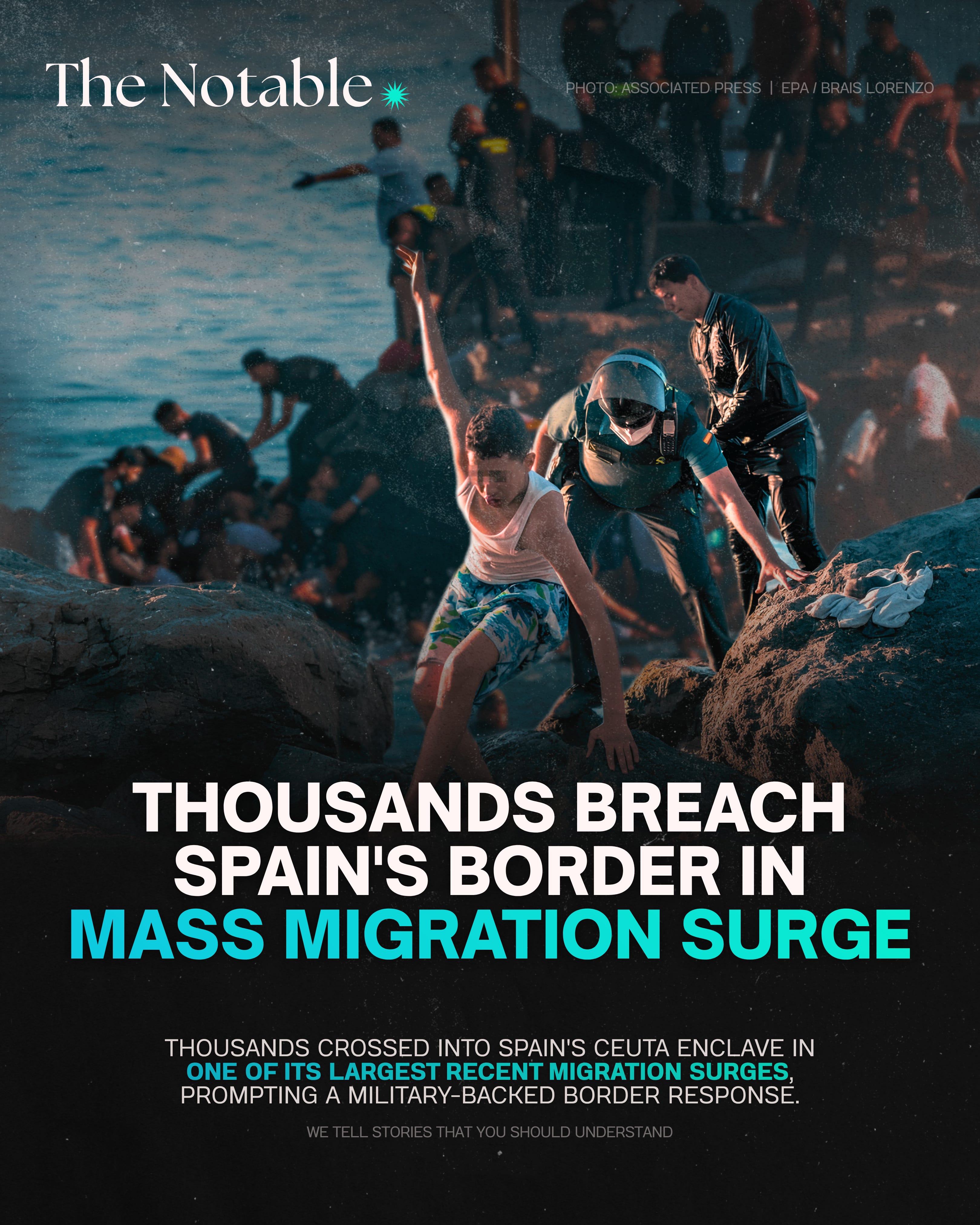
Thousands of migrants crossed from Morocco into the Spanish enclave of Ceuta over the past two days, overwhelming local authorities and prompting Spain to deploy military personnel alongside hundreds of additional police officers.
The sudden influx has become one of Spain’s largest recent migration incidents, drawing international attention after videos circulated online showing large crowds crossing the border by land and sea. Reception facilities in Ceuta quickly exceeded capacity, while emergency responders worked to manage the humanitarian and security challenges created by the surge.
Spanish authorities have also confirmed that at least nine people died while attempting the dangerous sea crossing, underscoring the risks many migrants face in their efforts to reach Europe.
What Happened in Ceuta?
Ceuta is a Spanish autonomous city located on the northern coast of Africa, directly bordering Morocco. Although geographically situated in Africa, it is legally part of Spain and therefore forms part of the European Union’s external border.
According to Spanish authorities and multiple international news agencies, an estimated 2,000 to 3,000 migrants entered Ceuta over a short period. Many crossed through the Tarajal border area, while others swam around border barriers using flotation devices or small boats.
The pace of arrivals quickly overwhelmed local reception centers. Authorities reported that available accommodation reached capacity within hours, forcing emergency services to establish temporary arrangements for newly arrived migrants.
The incident also prompted the regional government of Ceuta to request immediate assistance from Madrid, warning that local resources alone were insufficient to manage the scale of the crisis.
Spain’s Response
The Spanish government responded by reinforcing security around Ceuta.
Madrid deployed approximately 60 military personnel and around 200 additional National Police officers to support the Civil Guard and local authorities responsible for border management. The reinforcements were tasked with strengthening surveillance, restoring order, and assisting with migrant processing operations.
Prime Minister Pedro Sánchez and Interior Minister Fernando Grande-Marlaska also traveled to Ceuta following the surge, signaling the government’s intention to closely oversee the response.
Spanish authorities are simultaneously working with Moroccan security forces to reduce additional crossings while processing those who have already entered the enclave.
Officials have emphasized that the operation involves both humanitarian assistance and border security, balancing the need to provide emergency care with the responsibility to enforce Spain’s external border.
Why Ceuta Matters
Ceuta occupies a unique position in global migration.
Unlike most migration routes into Europe, migrants who reach Ceuta are already on European Union territory. This makes the enclave one of the shortest and most strategically important entry points into Europe.
The city has long experienced migration pressure because of its location. High fences, surveillance systems, and regular joint operations between Spain and Morocco have reduced crossings at various times, but periods of sudden mass movement continue to occur.
Official Spanish government data already showed that illegal land crossings into Ceuta had increased significantly during 2026 even before the latest incident, despite overall irregular migration into Spain declining compared with the previous year.
The latest surge therefore reflects growing pressure on one of Europe’s most sensitive external borders rather than an isolated event.
Who Are the Migrants?
While many headlines have focused on Morocco, the people crossing into Ceuta are not exclusively Moroccan nationals.
Spanish authorities and international reporting indicate that many migrants travel through Morocco after leaving countries across sub-Saharan Africa. Others are Moroccan citizens seeking economic opportunities.
Many are motivated by a combination of factors, including armed conflict, political instability, economic hardship, unemployment, and limited opportunities in their home countries. For many, reaching Ceuta represents the first step toward seeking asylum or building a new life elsewhere in Europe.
The route has also attracted organized migrant smuggling networks that profit from facilitating dangerous crossings across both land and sea.
A Humanitarian and Political Challenge
The events in Ceuta illustrate one of Europe’s most persistent policy dilemmas.
European governments face increasing pressure to strengthen border security while also meeting international obligations to protect asylum seekers and vulnerable migrants. Sudden mass arrivals place enormous strain on local infrastructure, emergency services, and migration systems, particularly in small border communities like Ceuta.
The humanitarian cost is also significant. The deaths reported during the sea crossings serve as a reminder of the dangers migrants are willing to face in pursuit of safety or economic opportunity.
At the same time, migration remains one of the most politically sensitive issues across Europe. Public debate continues over border enforcement, asylum procedures, burden-sharing among European Union member states, and cooperation with neighboring countries such as Morocco.
What Triggered the Surge?
Authorities are still investigating the precise cause of the sudden increase in crossings.
Spanish officials have suggested that migrant smuggling networks may have sought to exploit a recent Supreme Court ruling affecting the immediate return of some migrants arriving by sea. However, investigators have not established a direct link between the legal ruling and the latest surge.
Moroccan authorities have continued cooperating with Spain in efforts to reduce additional crossings, and there is currently no indication that the incident stems from the type of diplomatic dispute that contributed to the much larger Ceuta migration crisis in 2021.
For now, officials continue to treat the event as an active border management and humanitarian operation while investigations continue.
What Happens Next?
Spanish authorities are expected to continue reinforcing security around Ceuta while processing newly arrived migrants under Spanish and European Union law.
The government is also likely to expand cooperation with Morocco to strengthen border controls and disrupt migrant smuggling networks operating along the North African route.
Beyond the immediate response, the incident is expected to intensify discussions across Europe about migration policy, border management, and how the European Union should respond to growing pressure along its external frontiers.
The scenes from Ceuta are more than a local border incident. They reflect the broader forces shaping migration into Europe, where conflict, inequality, demographic pressures, and geography continue to drive people toward one of the world’s most closely watched borders.