


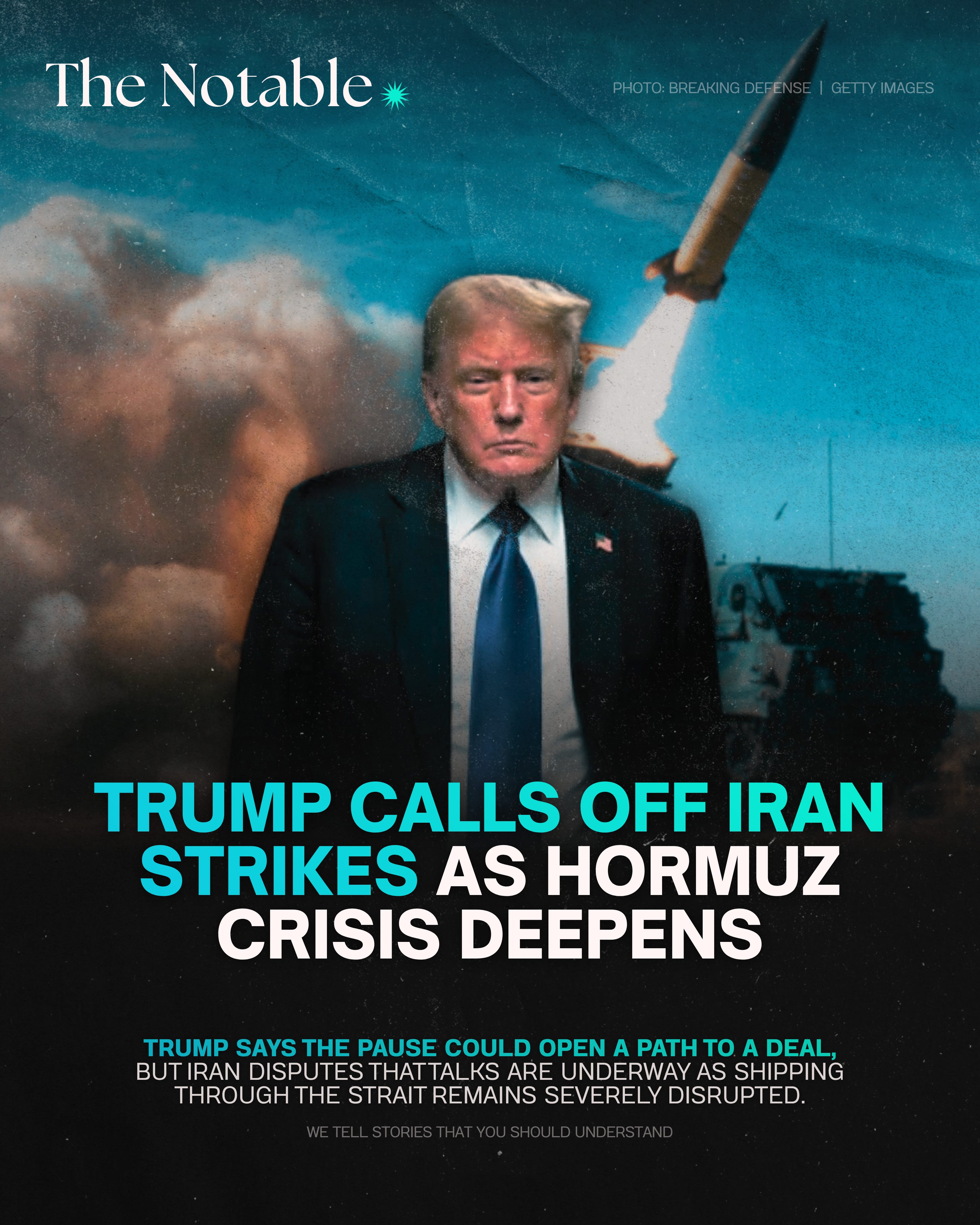
President Donald Trump has called off planned major U.S. strikes against Iran, saying diplomatic progress has created an opportunity to pursue a deal rather than immediately expand the war.
Trump said Iran and other Middle Eastern countries had asked for additional time and claimed that the broad “perimeters” of an agreement had been established. Among the issues he identified were the reopening of the Strait of Hormuz and the elimination of Iran’s nuclear threat.
The decision temporarily reduces the immediate prospect of another major U.S. attack on Iranian infrastructure.
But it does not amount to a confirmed ceasefire or peace agreement.
That distinction matters.
Iran has rejected key elements of Washington’s account. Tehran says there are currently no direct negotiations with the United States, while Iranian officials have described separate discussions with Oman focused on managing maritime traffic through the Strait of Hormuz.
The result is an unusual diplomatic situation: Washington is describing an opening for negotiations while Tehran is disputing that a U.S.-Iran negotiating process is actually underway.
Hormuz Is the Pressure Point
The Strait of Hormuz sits at the center of the crisis because its importance extends far beyond the countries fighting around it.
The narrow waterway connects the Persian Gulf with the Gulf of Oman and the wider Indian Ocean. A substantial share of the world’s oil and liquefied natural gas normally passes through it.
When shipping through Hormuz is threatened, the consequences move quickly from the battlefield into energy markets, insurance costs, freight rates and global supply chains.
That is already happening.
Attacks and security threats have sharply reduced commercial traffic. Tankers and LNG carriers have faced danger around the waterway, while some vessels have remained offshore rather than risk transit.
There have been isolated signs of movement. A QatarEnergy-controlled LNG vessel managed to exit Hormuz in late July, marking a limited reopening of maritime traffic.
But individual vessels moving through the waterway should not be confused with a full restoration of normal commercial navigation.
For markets, the question is not whether one ship can pass.
It is whether hundreds of vessels can reliably pass without facing attack, interception or prohibitive insurance and security costs.
How the Crisis Reached This Point
The current standoff is the product of months of military escalation and failed attempts to establish a durable political framework.
An earlier ceasefire temporarily reduced the intensity of fighting, but the pause did not produce a lasting settlement. Military operations resumed, and the conflict increasingly extended into the maritime sphere.
A major diplomatic framework followed in June.
The United States and Iran signed an Islamabad Memorandum of Understanding that sought to establish an immediate end to military operations and create a framework for negotiating a broader settlement. The arrangement also addressed freedom of navigation through Hormuz.
The framework contemplated negotiations over a 60-day period, with the possibility of extending the process by mutual agreement.
But the diplomatic structure proved vulnerable to renewed military confrontation.
The Gulf Was Pulled Into the Conflict
The conflict has also become increasingly difficult to contain geographically.
Iranian attacks and interceptions have affected countries including Bahrain and Kuwait, while other Gulf states have faced threats to military and critical infrastructure.
That creates a second strategic problem for Washington.
The United States is not operating in a vacuum. Its regional partners are exposed to Iranian retaliation, particularly if American forces launch another major attack against Iranian territory.
Gulf governments therefore have a strong interest in preventing the conflict from widening further.
Saudi Crown Prince Mohammed bin Salman has been among the regional figures urging restraint as Washington weighs its next move.
For the Gulf states, the issue is not simply whether Iran’s nuclear program is contained.
It is whether another escalation could turn their territory, energy infrastructure and shipping lanes into the next battlefield.
Iran’s Position Is Critical
Tehran’s response to Trump’s announcement is one of the biggest uncertainties surrounding the current pause.
Iran has rejected the suggestion that it asked Washington to delay its strikes and has criticized parts of Trump’s description of the diplomatic process.
Iranian officials have also maintained that their forces remain on high alert and that Tehran is prepared to respond if attacked.
At the same time, Iranian Foreign Minister Abbas Araghchi has been involved in regional diplomatic efforts, including discussions with Oman.
That suggests Iran is not rejecting diplomacy altogether.
Instead, Tehran appears to be separating regional mediation and maritime arrangements from the broader question of direct negotiations with Washington.
That distinction is important because reopening Hormuz does not automatically resolve the larger dispute.
The nuclear issue, sanctions, military deployments and the question of future U.S. strikes remain unresolved.
Oil Markets Are Already Responding
The economic consequences have become one of the clearest indicators of how fragile the situation is.
Oil prices rose sharply during the escalation as traders priced in the possibility of prolonged disruption around Hormuz.
Then, after Trump announced that the United States would hold off on another major attack, prices moved sharply lower as markets interpreted the announcement as a possible path toward de-escalation.
Brent crude fell more than 5% on August 3.
The movement illustrates how closely energy markets are now tied to diplomatic signals from Washington and Tehran.
But lower oil prices do not mean the underlying risk has disappeared.
Markets are effectively pricing expectations about what happens next.
If commercial shipping resumes reliably, the pressure on energy supplies could ease. If fighting returns and Hormuz becomes even more restricted, the opposite could happen quickly.
Why This Pause Is Different
The immediate significance of Trump’s decision is therefore not that the Iran conflict is ending.
It is that Washington has temporarily chosen diplomacy over another major escalation at a moment when the economic and regional costs of the conflict are becoming harder to contain.
That calculation matters.
A renewed U.S. attack could trigger another Iranian response against American forces, Israel, Gulf states or maritime traffic. It could further restrict Hormuz and send another shock through energy markets.
For Washington, diplomacy offers a way to test whether the pressure created by the military campaign can produce concessions without immediately paying the cost of another escalation.
For Tehran, the challenge is different.
Iran must decide whether engagement can secure relief from military pressure and sanctions without requiring concessions it considers unacceptable.
Neither side has demonstrated that it is ready to make that trade.
What Happens Next
The next stage will depend on whether the current diplomatic opening becomes an actual negotiating process.
Three developments will be particularly important.
First, whether direct U.S.-Iran talks actually take place. Trump has indicated that negotiations are expected, while Iranian officials say there are currently no such talks. Closing that gap would be the first sign that the diplomatic track is becoming real.
Second, whether commercial traffic through Hormuz normalizes. A handful of ships passing through the waterway is not enough. The real test will be whether major energy exporters and international shipping companies can resume regular operations.
Third, whether the military pause holds. The history of this conflict provides little reason for complacency. Previous diplomatic openings have been followed by renewed attacks.
The Strait of Hormuz therefore remains the clearest measure of whether the crisis is actually de-escalating.
A Pause, Not a Settlement
The most important fact about the current moment is also the easiest to lose amid competing claims from Washington and Tehran.
The United States has stepped back from another major strike. But the underlying conflict has not been resolved.
Trump says diplomacy has created a path toward a deal. Iran says direct negotiations are not currently taking place. Oman and other regional actors are attempting to keep maritime traffic moving. Meanwhile, the Strait of Hormuz remains under severe pressure.
That leaves the world in a precarious middle ground.
The next few days will reveal whether Trump’s decision represents the beginning of a genuine diplomatic process or simply another pause between rounds of escalation.
For the global economy, the answer may be measured first not in diplomatic statements, but in whether ships can safely move through Hormuz again.