


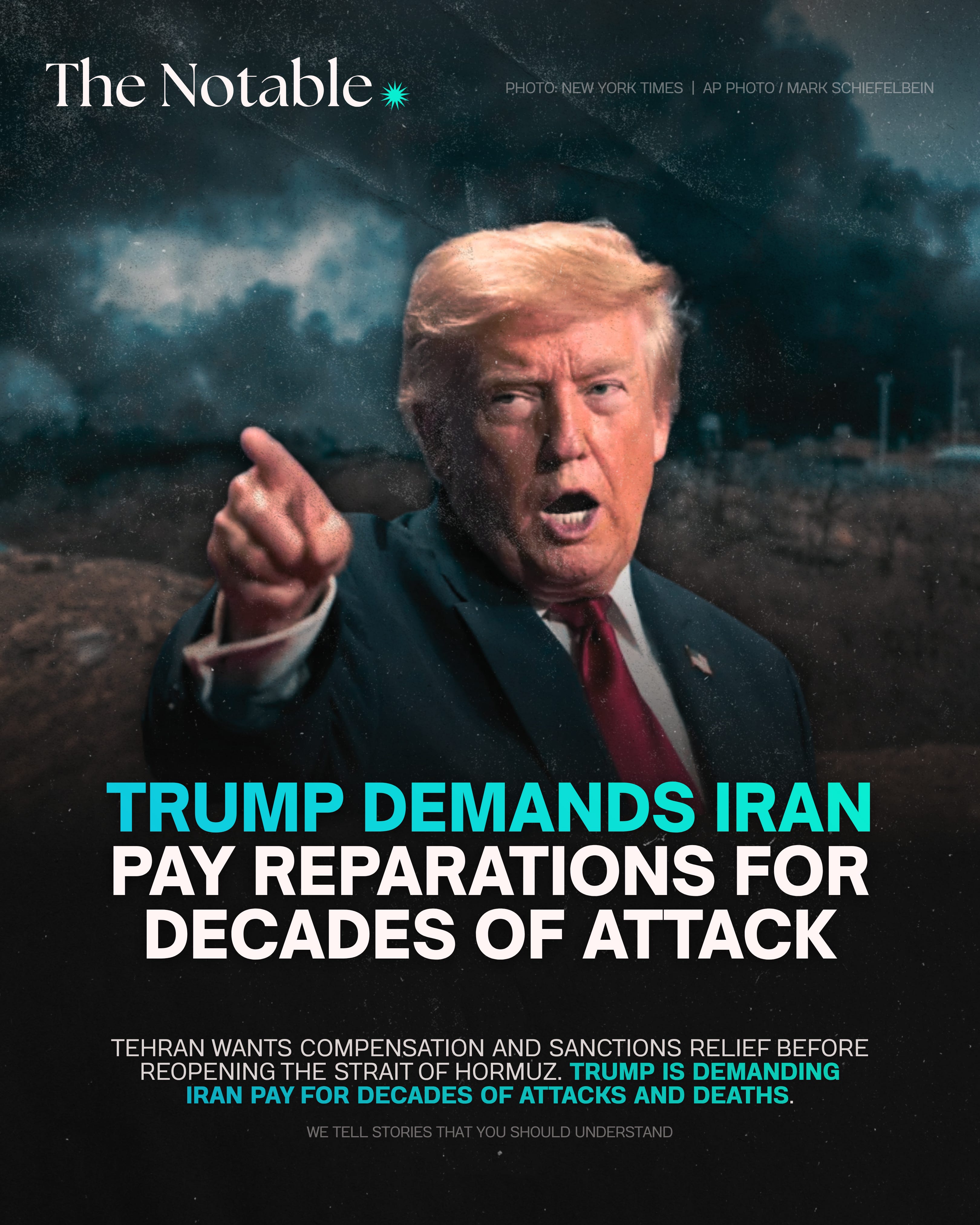
The confrontation between Washington and Tehran has entered a new phase, with both sides now demanding financial compensation as part of a wider dispute over the future of the Strait of Hormuz.
Iran wants compensation, sanctions relief, access to frozen assets and an end to the U.S. blockade and military pressure before fully reopening the strategic waterway. President Donald Trump has responded by demanding that Iran compensate victims of attacks and conflicts associated with the Iranian regime and its allies over several decades.
The result is a negotiation increasingly centered not only on security and nuclear issues, but on who owes whom.
A New Demand From Washington
Trump’s reparations demand emerged after Iran linked the reopening of the Strait of Hormuz to broader concessions from the United States.
The U.S. president has argued that Iran should pay for deaths and damage associated with attacks and conflicts stretching back roughly 50 years. He has pointed to Americans killed in attacks involving Iran or Iranian-backed groups, as well as victims of Iranian actions across the Middle East.
That represents a significant expansion of the negotiating agenda.
Compensation was already a contentious issue for Tehran. Trump’s response effectively turns the issue around: if Iran wants compensation for the damage caused by the war, Washington says Iran should also face claims for the damage attributed to its own actions.
What Iran Wants
Iran has sought several concessions from Washington before agreeing to fully reopen the Strait of Hormuz.
Among them are compensation for war damage, relief from U.S. sanctions, the release of Iranian assets frozen abroad and an end to the U.S. blockade and military threats.
The demands are connected. Tehran wants the economic and security pressure imposed on Iran to be addressed as part of any broader arrangement governing the waterway.
Iran’s position also reflects the leverage it possesses over Hormuz.
The strait is not simply another shipping route. It is one of the world’s most important energy chokepoints.
The $300 Billion Question
One figure requires particular care.
Reports have referred to a $300 billion reconstruction and development fund, but it should not be described simply as Iran demanding $300 billion in direct reparations from the United States.
Earlier negotiations reportedly involved a much larger Iranian war-damage compensation demand. Washington rejected that proposal, after which a separate $300 billion reconstruction and investment framework emerged.
The proposed fund was envisioned as a broader investment mechanism involving international companies and investors. It was distinct from the separate questions of sanctions relief, frozen Iranian assets and direct compensation.
That distinction matters because the financial dispute is considerably more complicated than a single $300 billion payment.
Trump’s 52,000 Claim
Trump has also cited the deaths of Iranian protesters as part of his argument against Tehran.
He claimed that the Iranian government had killed 52,000 protesters in recent months.
That number should not be treated as an established death toll.
Reporting cited by Reuters indicates that the figure is substantially higher than estimates from rights-monitoring groups. The U.S.-based Human Rights Activists News Agency, for example, had reported thousands of deaths, including thousands of protesters, but nowhere near Trump’s 52,000 figure.
The distinction is important. Trump’s claim is a presidential allegation, not an independently verified casualty figure.
For a credible account of the negotiations, the number should therefore be attributed directly to Trump rather than presented as fact.
The History Behind Trump’s Claim
Trump’s broader argument draws on a long history of conflict between Iran and the United States and attacks attributed to Iranian-backed organizations.
One of the most consequential examples was the 1983 Beirut Marine barracks bombing, which killed 241 U.S. service members. The United States has long attributed the attack to Hezbollah, an organization backed by Iran.
Iranian-backed groups have also been accused by Washington of killing American personnel during the Iraq War and of supporting armed organizations across Lebanon, Syria, Iraq and Yemen.
But historical attribution is not always straightforward.
For example, Trump has referenced the 2000 USS Cole bombing in discussions about compensation. That attack killed 17 U.S. sailors, but it was attributed to al-Qaeda, not Iran.
That distinction illustrates why any reparations framework based on decades of conflict would be legally and politically complicated.
Hormuz Is the Real Leverage
Behind the compensation dispute lies the central strategic issue: the Strait of Hormuz.
The waterway connects the Persian Gulf with the Gulf of Oman and the wider Indian Ocean. Before the current disruption, roughly one-fifth of globally traded oil passed through the strait.
That makes Hormuz disproportionately important to the global economy.
Iran does not need to control every barrel of oil passing through the waterway to exert influence. The possibility of prolonged disruption alone can affect shipping costs, insurance premiums, energy prices and market expectations.
That leverage is precisely why reopening Hormuz has become intertwined with the wider U.S.-Iran confrontation.
A Deal Has Become Harder
There had been signs of movement toward an arrangement involving Iran, the United States and Oman.
Iran and Oman reached an understanding over the geographic coordinates of a potential shipping route through Hormuz. But Tehran made clear that an agreement on navigation alone would not automatically mean the waterway would fully reopen.
Iran continues to link the issue to broader U.S. concessions.
Trump’s new reparations demand adds another obstacle.
Instead of negotiating over a limited set of issues, Washington and Tehran are now bringing war damage, sanctions, frozen assets, military pressure, historical attacks and regional conflicts into the same diplomatic equation.
Each side is effectively presenting its own list of grievances and costs.
Why Oil Markets Are Watching
The consequences extend far beyond Washington and Tehran.
When hopes for a Hormuz agreement weakened, oil prices responded. Brent crude rose roughly 5% on August 10, reflecting renewed concern over the possibility of prolonged disruption.
The logic is straightforward.
If significant volumes of energy exports remain constrained, global buyers have fewer reliable supply options. That can raise prices, increase transportation costs and eventually feed into inflation.
The impact would not necessarily be confined to oil-producing or Middle Eastern economies. Asian economies are particularly exposed to disruptions in Gulf energy flows, while higher global energy prices can affect everything from transportation to manufacturing.
Hormuz is therefore not simply an Iranian-American bargaining chip.
It is a pressure point for the global economy.
The Bigger Shift
The most important development may be the transformation of the negotiations themselves.
The dispute is no longer confined to the traditional questions of Iran’s nuclear program, sanctions and military security.
Washington and Tehran are now arguing over the financial cost of the conflict itself.
Iran wants compensation and economic relief.
Trump wants Iran to compensate those harmed by decades of Iranian actions.
That creates a potentially circular negotiation in which each side’s demand becomes the justification for the other’s counter-demand.
And because the Strait of Hormuz is tied to the discussion, the consequences of diplomatic failure extend beyond the negotiating table.
What Comes Next
The immediate question is whether the United States and Iran can separate the practical issue of reopening Hormuz from the much larger dispute over compensation and the legacy of decades of conflict.
A durable agreement would likely require compromises on several fronts: shipping security, sanctions, frozen assets, military pressure and financial claims.
But the more demands that become conditions for reopening the strait, the harder a settlement becomes.
For now, Hormuz remains both the immediate economic risk and Iran’s most powerful source of leverage.
Trump’s reparations demand shows that Washington is prepared to use the same logic in reverse.
The result is an increasingly difficult negotiation in which neither side is simply asking what it will give up.
Both are asking what the other side owes.