


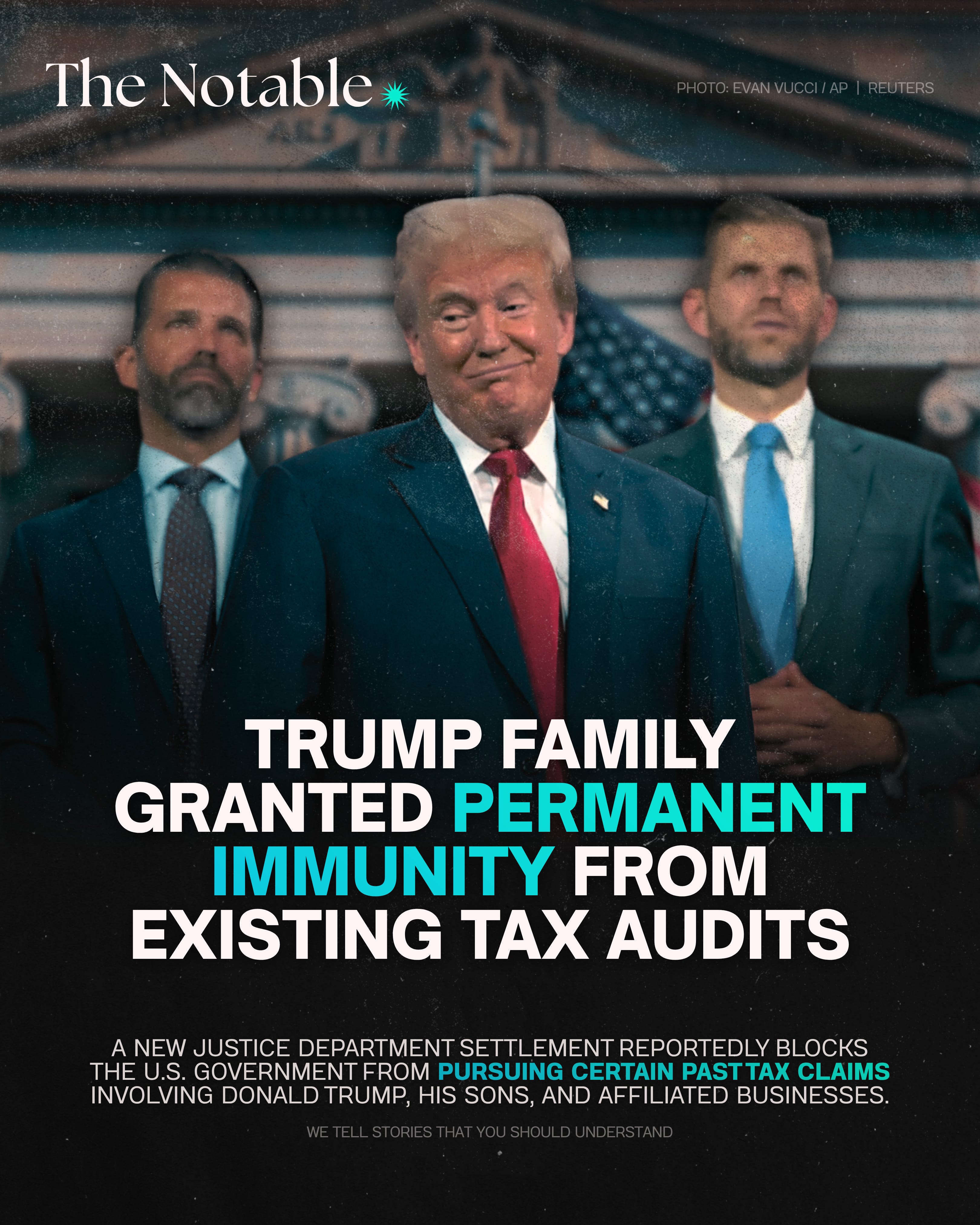
A new Justice Department settlement involving President Donald Trump is triggering growing legal and political controversy after reports revealed the U.S. government may now be permanently blocked from pursuing certain existing tax audits and past tax claims involving Trump, his sons, and affiliated businesses.
According to reporting from Reuters, the Financial Times, and Al Jazeera, the agreement includes language stating the government is “forever barred and precluded” from reopening or continuing certain tax-related matters tied to returns filed before May 18, 2026.
The development is already being described by critics and legal analysts as one of the most extraordinary legal protections ever granted to a sitting American president and his family.
The Settlement That Changed Everything
The controversy stems from a broader legal settlement tied to Trump’s lawsuit against the Internal Revenue Service and the Treasury Department earlier this year.
In January, Donald Trump, Donald Trump Jr., Eric Trump, and the Trump Organization filed a multibillion-dollar lawsuit against the federal government following the leak of Trump’s confidential tax records by former IRS contractor Charles Littlejohn.
Littlejohn had previously been convicted after disclosing tax information connected to Trump and several wealthy Americans to media organizations.
Trump’s legal team argued the leak caused major political, financial, and reputational damage, framing it as a politically motivated abuse of government power.
This week, the Justice Department reached a settlement with Trump.
But attention quickly shifted toward one specific clause inside the agreement.
According to Reuters, the settlement prevents the U.S. government from pursuing certain existing tax matters tied to previously filed returns involving Trump-linked entities.
The wording reportedly applies not only to Donald Trump himself, but also to Donald Trump Jr., Eric Trump, and affiliated business organizations connected to the Trump family.
Why The Language Matters
The phrase generating the most controversy is the reported legal language stating the government is “forever barred and precluded” from pursuing covered claims.
That wording immediately triggered accusations that the administration had effectively granted permanent tax immunity to the president and his family.
However, the actual scope appears narrower than some viral headlines suggest.
Current reporting indicates the agreement specifically covers existing audits, pending claims, and tax matters connected to previously filed returns before May 18, 2026.
There is currently no confirmed evidence the agreement prevents future audits on future tax filings or shields Trump from all future tax enforcement indefinitely.
Still, legal experts say the arrangement remains highly unusual.
Presidents are traditionally subject to mandatory IRS audit procedures while in office, partly to maintain public trust and accountability.
Critics argue the settlement could create the perception that a president now operates under a separate enforcement standard from ordinary Americans.
Political And Legal Backlash Intensifies
The reaction in Washington has been immediate.
Democratic lawmakers and watchdog groups are already questioning whether the executive branch has the authority to negotiate this type of protection through a federal settlement.
Some legal scholars argue the agreement may face constitutional challenges, particularly surrounding separation of powers and potential conflicts of interest.
Others warn the precedent could fundamentally reshape expectations around presidential accountability and federal oversight.
Supporters of the agreement argue the settlement must be viewed within the context of the original tax leak, which they describe as a politically motivated violation of Trump’s rights.
They contend the government is compensating for damages caused by the unauthorized disclosure of confidential tax information.
But critics argue the scale and permanence of the protection goes far beyond compensation.
The broader settlement has already become politically explosive because it arrives amid growing debates over executive authority, institutional trust, and whether powerful political figures are increasingly operating outside traditional legal norms.
The Bigger Picture
Beyond the legal details, the controversy reflects something larger unfolding in American politics.
The United States is entering an era where battles over institutions, enforcement power, and political legitimacy are becoming central to governance itself.
Questions that once seemed unthinkable are now becoming mainstream political disputes:
Can a sitting president negotiate protections against federal oversight?
How much power should the executive branch have over agencies meant to operate independently?
And what happens when public trust in neutral enforcement begins to erode?
Those questions are now moving from theory into reality.
The Trump tax audit settlement may ultimately become more than just another legal controversy.
It could become a defining test of how far presidential power can extend inside America’s institutional system.