


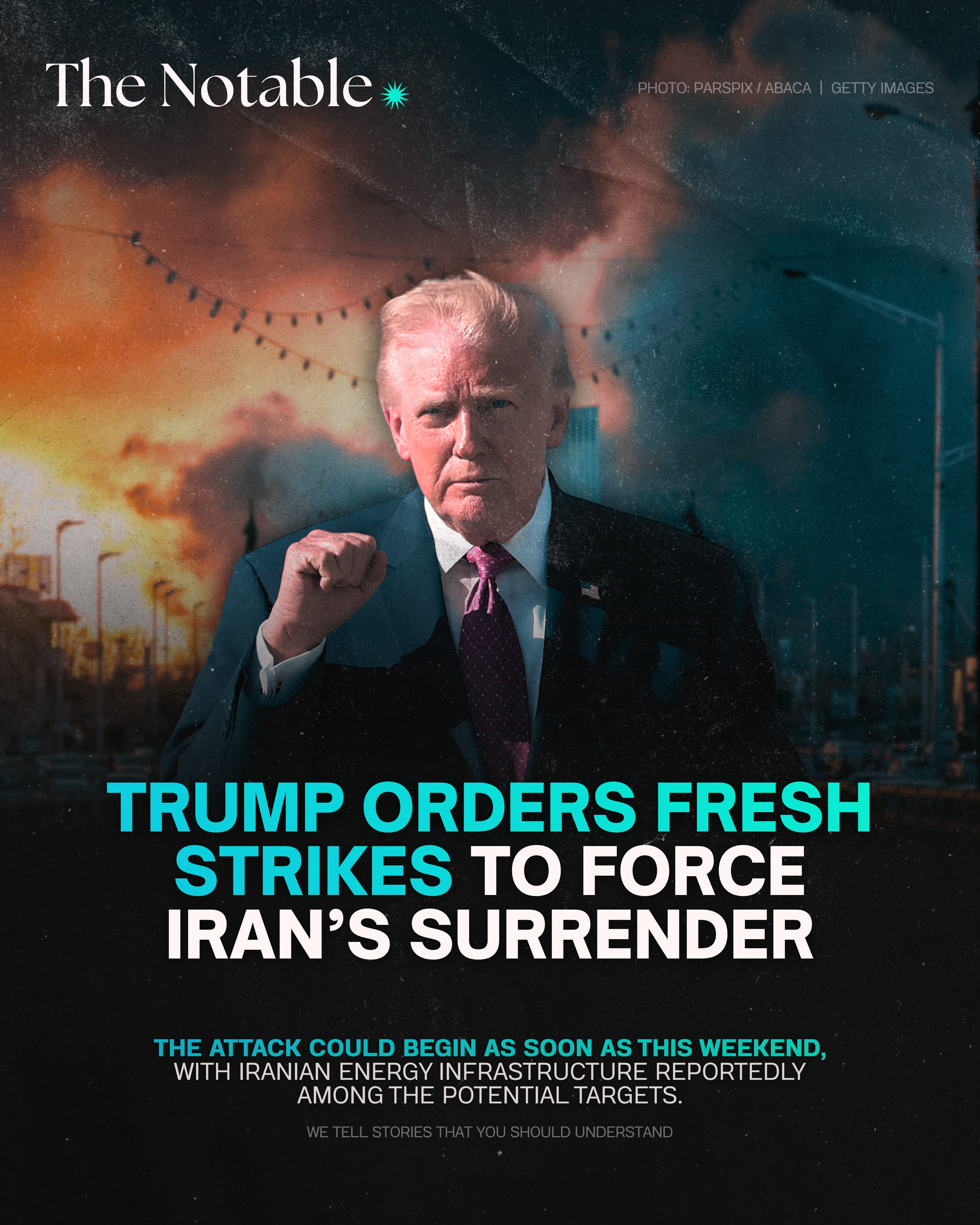
President Donald Trump is preparing to escalate the U.S. war with Iran again, with a new round of strikes potentially beginning as soon as this weekend.
The Wall Street Journal reported that Trump has ordered a fresh military campaign against Iran that could last several days. The objective, according to the report, is to increase military pressure on Tehran and force Iran toward an agreement on U.S. terms.
CBS News, meanwhile, reported that the United States and Israel are preparing potential attacks against Iranian energy infrastructure, including power plants and refineries. Reuters independently confirmed the CBS reporting.
But one distinction is important: the precise timing and scope of the strikes were not yet final as of Friday. CBS reported that no final decision had been made, while the White House was signaling that Trump was weighing another attack.
That leaves the possibility of further diplomacy open, but the direction is unmistakable. After months of fighting and repeated attempts to negotiate, Washington is once again moving toward escalation.
From military targets to energy infrastructure
The potential targets represent one of the most consequential elements of the new plan.
CBS reported that U.S. and Israeli planners were considering strikes against Iranian energy infrastructure, including power plants and refineries. Reuters likewise reported that the planned campaign would target energy-related facilities.
That would carry consequences beyond Iran’s military capabilities.
Energy infrastructure is fundamental to the functioning of a modern state. Attacking it can disrupt electricity, transportation, industry, fuel supplies and economic activity, while also putting pressure on the government and civilian population.
The prospect of such attacks therefore raises the stakes of the conflict considerably.
It also creates a dangerous feedback loop: Washington wants greater pressure on Tehran, while Tehran has incentives to retaliate against the infrastructure and energy networks of the United States and its regional partners.
Why Trump is escalating again
Trump’s position has increasingly centered on the belief that military pressure can force Iran into accepting a settlement.
The Wall Street Journal reported that Trump’s confidence in diplomacy has deteriorated and that he believes stronger military action may be necessary to bring Tehran back to negotiations. Trump has also continued to insist that Iran cannot be permitted to develop a nuclear weapon.
The administration’s strategy is therefore becoming clearer: use military force not simply to destroy Iranian military capabilities, but to increase the economic and strategic cost of continuing the war until Tehran accepts Washington’s demands.
That approach carries an obvious risk.
Pressure can produce concessions. It can also produce retaliation.
The war has already spread beyond Iran
The potential new campaign comes after a series of escalations across the region.
Iran recently attacked U.S. forces in the Middle East, including an attempted surprise missile attack on American troops. The United States subsequently carried out additional strikes against Iranian targets.
The conflict has also increasingly affected commercial shipping and energy infrastructure around the Persian Gulf.
On July 31, Iran claimed to have prevented several vessels from leaving the Strait of Hormuz. Oil prices rose as markets reacted to the possibility of further disruption.
The Strait is particularly important because roughly one-fifth of global oil shipments normally pass through it. Any sustained disruption therefore has implications well beyond the countries directly involved in the war.
This is why another attack on Iran’s energy system could quickly become an international economic problem.
The Strait of Hormuz is the pressure point
The geography of the conflict makes the Strait of Hormuz central to what happens next.
Iran sits on the northern side of the waterway, while Oman and the United Arab Emirates sit along its southern approaches. The strait connects the Persian Gulf with the Gulf of Oman and the wider Indian Ocean.
For years, its strategic importance has rested on a simple fact: a huge share of the world’s energy supply moves through a relatively narrow maritime corridor.
The current conflict has already reduced shipping through the waterway and increased the risk premium attached to oil. Reuters reported that Brent crude had risen sharply during July amid the renewed conflict, with traders increasingly focused on the possibility of prolonged disruption.
A new U.S.-Israeli campaign against Iranian energy infrastructure could therefore produce two simultaneous effects.
It could weaken Iran’s ability to sustain the war.
But it could also give Tehran greater incentive to disrupt the energy routes that connect the Gulf to the global economy.
Iran’s response could determine the next phase
Iran has repeatedly signaled that attacks on its infrastructure will not necessarily remain unanswered.
That creates several potential escalation pathways.
Iran could retaliate against U.S. military bases across the Middle East. It could target Israeli infrastructure. It could increase attacks on commercial shipping. Or it could seek to intensify pressure around the Strait of Hormuz.
Each option would widen the consequences of the conflict.
The central danger is therefore not simply another round of U.S. strikes. It is the possibility of a cycle in which each side responds to the other’s attempt to impose costs with an even broader attack.
Five months of war, and diplomacy is still unresolved
The latest escalation comes as the war enters its sixth month.
The conflict began on February 28 and has evolved far beyond the short military campaign that many initially expected. The United States and Israel have repeatedly attacked Iranian targets, while Iran has continued launching attacks against U.S. and regional targets.
Diplomatic efforts have continued alongside the fighting, but they have repeatedly struggled to produce a durable settlement.
That contradiction now defines the conflict.
Washington continues to speak about negotiations while simultaneously preparing additional military action.
For Trump, the logic is that military pressure can produce diplomatic leverage.
For Iran, another attack may reinforce the perception that concessions will not end the threat.
The result is a war in which diplomacy and escalation are operating simultaneously.
What happens next
The immediate question is whether the United States and Israel actually launch the reported campaign this weekend.
The second is what they target.
If the operation remains focused on military and nuclear-related facilities, it would represent another major escalation within the existing framework of the war.
If the campaign expands substantially into power generation, refining and other energy infrastructure, the conflict would enter a more consequential phase.
The third question is Iran’s response.
Any retaliation against U.S. bases, Israel, Gulf energy infrastructure or commercial shipping could quickly transform the next phase of the war from another round of U.S.-Iran fighting into a broader regional crisis.
And then there is the global economy.
Oil prices, shipping through the Strait of Hormuz and the security of Gulf energy infrastructure will be among the clearest indicators of whether this latest escalation remains contained or begins to reshape markets far beyond the Middle East.
The bigger picture
The most important development is not simply that Trump is preparing to strike Iran again.
It is that after five months of war, military pressure is increasingly being directed toward the infrastructure that allows Iran’s economy and society to function.
That changes the nature of the conflict.
The United States is attempting to make the cost of resistance unbearable enough to force Tehran toward an agreement. Iran, meanwhile, has shown that it can retaliate in ways that threaten U.S. forces, Israel, regional infrastructure and one of the world’s most important energy corridors.
The next few days will therefore reveal whether Trump’s strategy produces the leverage Washington wants, or whether another escalation simply creates the conditions for a larger war.
For now, the critical fact is this:
The war is entering its sixth month, diplomacy remains unresolved, and Washington is preparing to raise the stakes again.