


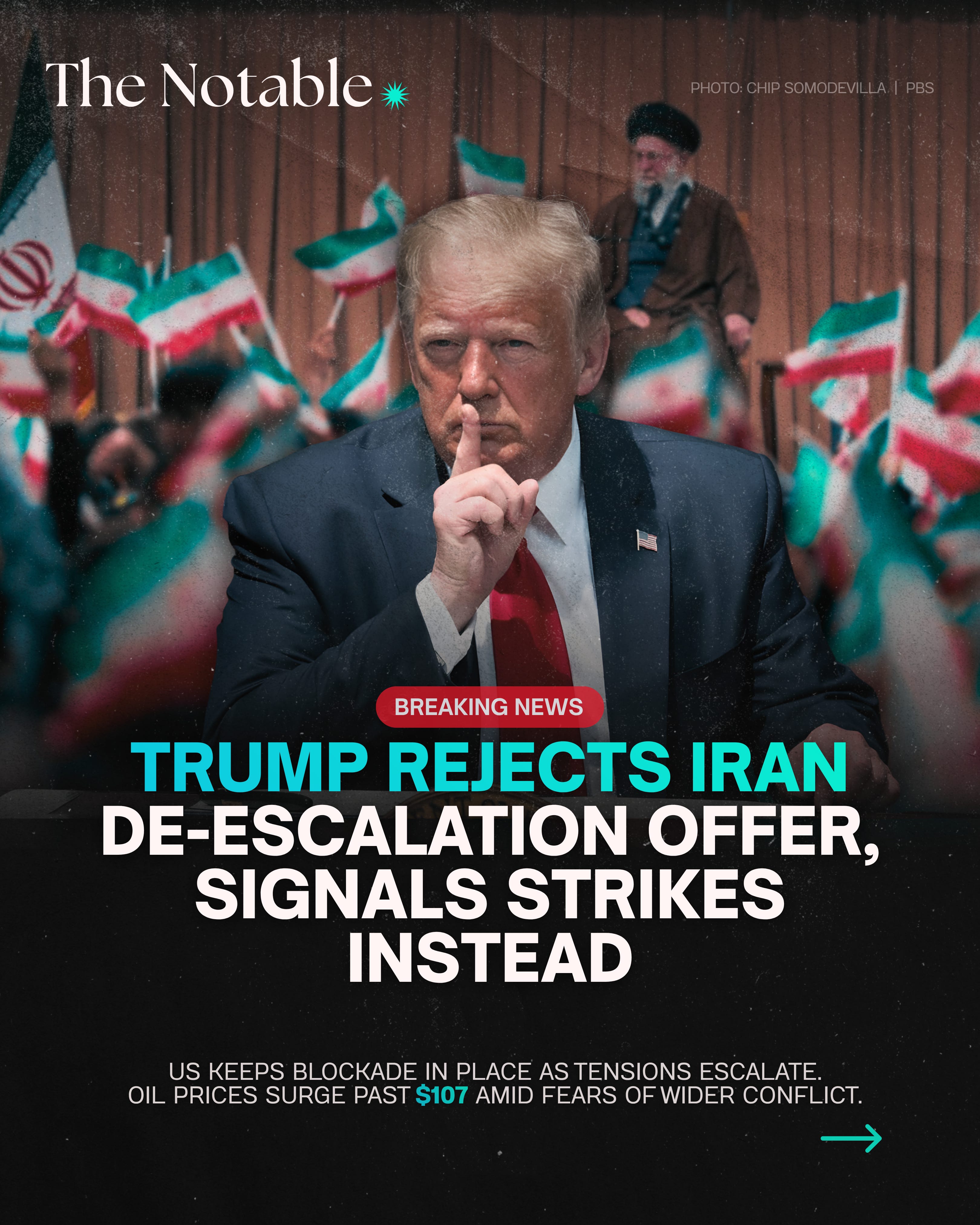
The United States has rejected Iran’s latest proposal to ease tensions in the Gulf, choosing instead to maintain a naval blockade and prepare for possible military action. The decision marks a sharp escalation in an already fragile standoff, with immediate consequences now spreading beyond the region into global energy markets.
At the center of the dispute is the Strait of Hormuz, one of the world’s most critical energy chokepoints. Roughly a fifth of global oil supply passes through the narrow corridor each day. Any disruption there is not contained. It transmits instantly into prices, expectations, and risk.
Iran had proposed reopening the strait and easing maritime tensions as a first step toward renewed negotiations. The offer was structured as a sequence. De-escalation first, then talks on broader issues including its nuclear program.
President Donald Trump rejected that sequencing.
Instead, Washington is holding to a pressure-first strategy. The naval blockade imposed in mid-April remains in place, sharply limiting Iran’s ability to export oil. US officials have also prepared contingency plans for what has been described as a “short and powerful” wave of strikes targeting Iranian infrastructure, should negotiations fail to resume on American terms.
This is not an accidental escalation. It reflects a deliberate strategic choice.
The administration’s approach rests on a simple premise. Economic strangulation can force concessions faster than open-ended diplomacy. By cutting off oil exports, the US is targeting the core of Iran’s revenue base, attempting to compress the country’s economic capacity until negotiation becomes unavoidable.
Iran, for its part, is pursuing the inverse logic. It is seeking relief first, arguing that negotiations under sustained economic pressure are structurally unbalanced and unlikely to produce durable outcomes.
The result is a deadlock defined not by disagreement over goals, but by disagreement over sequence.
That deadlock is now colliding with global markets.
Oil prices surged past $107 per barrel following news of the rejection and the continued blockade. The move reflects more than immediate supply concerns. It signals rising risk premiums tied to uncertainty around one of the most sensitive nodes in the global energy system.
The economic consequences are already building and could intensify.
Higher oil prices feed directly into transport costs, manufacturing inputs, and consumer energy bills. For import-dependent economies, particularly across Asia, this creates a layered effect. Inflation pressures rise. Central banks face renewed constraints. Growth expectations weaken. Financial markets begin to price in instability.
These are first-order effects.
The second-order effects tend to be slower but more persistent. Supply chains adjust unevenly. Energy-intensive sectors compress margins. Governments face fiscal pressure as subsidies and support measures expand. Over time, the shock diffuses across the system, amplifying far beyond the initial disruption.
This is why the Strait of Hormuz matters. Not only as a geographic chokepoint, but as a systemic one.
What happens there does not stay there.
The current moment sits in a narrow window between coercion and escalation. The United States is betting that sustained pressure will force Iran back to the negotiating table under more favorable terms. Iran is betting that the costs of that pressure, both regionally and globally, will eventually force a recalibration.
If neither side adjusts, the prepared military option moves closer to activation.
And at that point, the nature of the crisis changes. It shifts from controlled pressure to active confrontation, with consequences that are harder to contain and far more difficult to reverse.
For now, the strategy is still economic.
But the margin for that strategy to succeed without escalation is narrowing.