


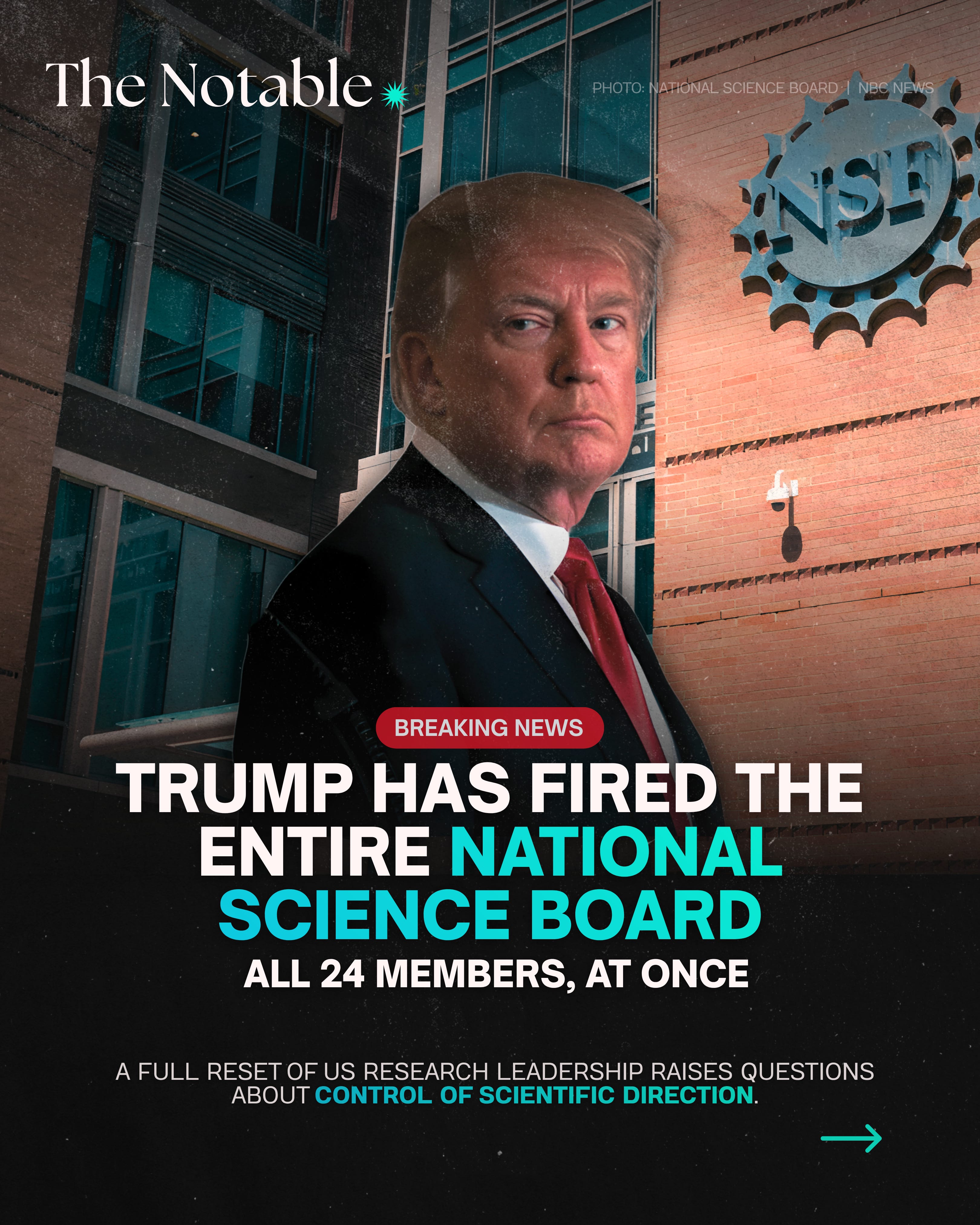
On April 25, 2026, the Trump administration dismissed all 24 members of the National Science Board in a single move, abruptly removing the body responsible for guiding the direction of federal scientific research in the United States.
The decision, delivered through a brief notice from the Presidential Personnel Office, came without a detailed public explanation. But its implications are significant. The board oversees the National Science Foundation, one of the most important institutions in the US research ecosystem, responsible for distributing billions of dollars annually across fields ranging from artificial intelligence and biotechnology to engineering and climate science.
This was not a routine transition.
The National Science Board was designed to provide continuity across administrations. Its members are appointed for staggered six-year terms, ensuring that no single president can fully reshape the body at once. That structure has now been broken. Some of those dismissed had only recently begun their terms, meaning the entire board has effectively been reset in a single decision.
At a functional level, the move leaves the National Science Foundation without its full governing advisory body at a time when research funding and priorities are already under pressure. At a strategic level, it raises deeper questions about who controls the direction of American science.
The board does not conduct research itself. But it plays a central role in deciding what gets funded, what gets prioritized, and how the United States positions itself in emerging fields. From early-stage breakthroughs to long-term technological infrastructure, many of the foundations of modern innovation pass through the systems it helps shape.
This is why the decision has drawn concern from scientists and policymakers. Critics argue that removing the entire board at once risks politicizing decisions that have historically been guided by independent expertise. Supporters, on the other hand, frame it as a necessary reset, allowing the administration to realign research priorities with its broader national agenda.
The move does not stand in isolation.
Since returning to office, the Trump administration has taken a more interventionist approach toward scientific and research institutions. This has included proposed funding reductions, leadership changes, and structural adjustments across parts of the federal research system. The dismissal of the National Science Board fits within that broader pattern, suggesting a more centralized approach to how scientific direction is set.
What remains unclear is how quickly the board will be rebuilt and what criteria will guide new appointments. That uncertainty matters. The composition of the board will influence how research funding is allocated, which technologies are accelerated, and how the United States competes globally in science and innovation.
At its core, this is not simply a personnel decision.
It is a shift in control over one of the most important systems shaping the future.
The direction of science is never neutral. It reflects priorities, incentives, and choices about what problems to solve and what futures to build.
With the National Science Board now cleared, those choices are about to be made again.