


For decades, one of the defining assumptions of Middle East politics has been that no American president could seriously pursue an agreement with Iran while openly dismissing Israeli objections.
President Donald Trump may have just challenged that assumption.
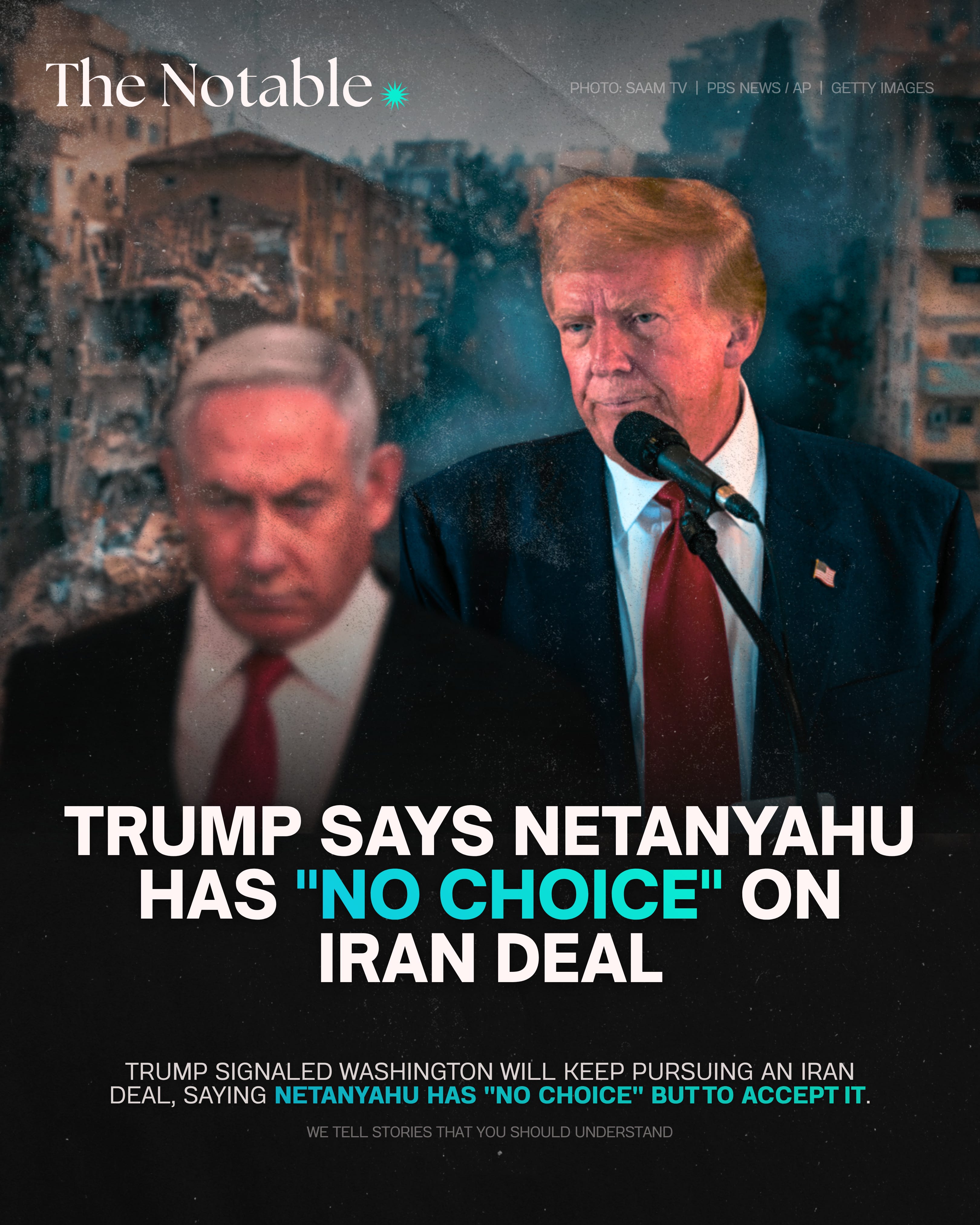
In remarks that immediately reverberated across Washington, Jerusalem, and Tehran, Trump declared that Israeli Prime Minister Benjamin Netanyahu would have “no choice” but to accept a potential U.S. agreement with Iran if one is reached.
“I call the shots. I call all the shots. He doesn’t call the shots,” Trump told the Financial Times.
The comments came at a particularly volatile moment.
Just days after Israel and Iran exchanged military strikes once again, many observers expected the latest escalation to derail ongoing diplomatic efforts between Washington and Tehran. Instead, Trump signaled the opposite. He insisted that the attacks would not affect negotiations and said he still believes a deal is within reach.
The statement is remarkable not only because of what it says about Iran, but because of what it reveals about a growing strategic divide between Washington and Jerusalem.
A Region Sliding Back Toward Conflict
To understand the significance of Trump’s comments, it is important to understand what has happened over the past week.
Following months of regional instability, the United States had been working to contain violence along Israel’s northern border and prevent a broader regional war.
In early June, Washington helped broker a partial ceasefire between Israel and Hezbollah in Lebanon. Under the arrangement, Israel agreed to limit strikes in Beirut’s southern suburbs while Hezbollah would reduce attacks into northern Israel.
The agreement never fully held.
Hezbollah rejected parts of the deal and continued demanding a complete Israeli withdrawal from contested areas. Israeli operations in southern Lebanon also continued, keeping tensions high.
The situation escalated dramatically when Israeli forces reportedly struck Beirut’s Dahiya district, a Hezbollah stronghold. Iran responded by launching ballistic missiles toward northern Israel, marking another direct military exchange between the two regional rivals.
Although Israeli air defenses intercepted the missiles and casualties were avoided, the episode demonstrated how quickly the region can move from fragile calm to dangerous escalation.
Markets immediately took notice. Oil prices climbed as traders began pricing in the possibility of wider conflict across the Middle East.
Historically, these kinds of exchanges would have severely complicated diplomatic negotiations.
Instead, Trump doubled down.
Trump’s Diplomatic Gamble
The Trump administration appears convinced that a diplomatic breakthrough with Iran remains possible despite the violence.
According to recent reporting, U.S. and Iranian negotiators have been discussing a broader arrangement that could reduce regional tensions and potentially address several long-standing disputes between the two countries.
While the precise terms remain unclear, negotiations reportedly involve issues ranging from sanctions relief to maritime security and broader regional stability.
Trump has repeatedly argued that continued escalation serves nobody’s interests.
Reports indicate he personally pressured Netanyahu not to retaliate further following Iran’s missile launch, believing additional military action could jeopardize negotiations that Washington views as strategically important.
That context makes his latest remarks particularly significant.
Trump was not merely expressing confidence in diplomacy.
He was asserting that American diplomatic priorities should take precedence over Israeli preferences.
For years, Israeli leaders have argued that Iran’s nuclear ambitions and regional influence represent an existential threat. Netanyahu has consistently advocated a harder line toward Tehran and has often opposed diplomatic agreements he believes leave Iran with too much room to maneuver.
Trump’s comments suggest that if a deal is reached, Washington may expect Israel to accept it regardless of those objections.
A Shift in the U.S.-Israel Relationship?
The United States and Israel remain close allies, but alliances are rarely free from disagreements.
What makes this episode unusual is how publicly those disagreements are being aired.
American presidents have often disagreed with Israeli leaders behind closed doors. Publicly declaring that Israel’s prime minister “doesn’t call the shots” is far less common.
The statement reflects a broader reality of international politics.
While Israel is one of America’s most important regional partners, U.S. presidents ultimately pursue what they believe are American strategic interests. Trump’s message appears designed to remind both allies and adversaries that Washington intends to remain the primary decision-maker in any negotiations involving Iran.
That message is likely aimed at multiple audiences simultaneously.
It signals to Tehran that Washington remains committed to negotiations.
It signals to Israel that military escalation should not dictate U.S. diplomacy.
And it signals to global markets that the White House still believes a diplomatic outcome is achievable.
Why Iran Matters So Much
The negotiations are not occurring in a vacuum.
Iran sits at the center of some of the world’s most important geopolitical fault lines.
The country influences conflicts stretching from Lebanon and Syria to Iraq and the Persian Gulf. It also occupies a critical position near the Strait of Hormuz, one of the world’s most important energy chokepoints.
Any confrontation involving Iran has the potential to affect global oil markets, international shipping, and regional security architecture.
That is why even limited exchanges between Israel and Iran attract global attention.
For Washington, a successful agreement could reduce the risk of a larger regional war and help stabilize a strategically important region.
For Israel, however, the concern is that diplomacy could leave Iran stronger or provide Tehran with additional economic breathing room without fundamentally changing its behavior.
These competing perspectives have shaped Middle East politics for years.
Trump’s comments suggest those tensions are once again becoming visible.
What Happens Next?
The immediate question is whether negotiations can survive continued military exchanges between Israel and Iran.
Trump insists they can.
But diplomacy becomes increasingly difficult when missiles are flying, ceasefires are collapsing, and domestic political pressures are mounting on all sides.
Iran continues to demand concessions.
Israel remains deeply skeptical of any agreement that it believes falls short of its security requirements.
And Washington is attempting to keep both diplomacy and deterrence alive at the same time.
For now, Trump’s message is clear.
Despite the latest escalation, the United States intends to continue pursuing an agreement with Iran. And if such a deal emerges, Trump is signaling that Washington expects its allies to follow its lead.
Whether that confidence produces a diplomatic breakthrough or a deeper confrontation remains one of the most important geopolitical questions facing the Middle East today.