


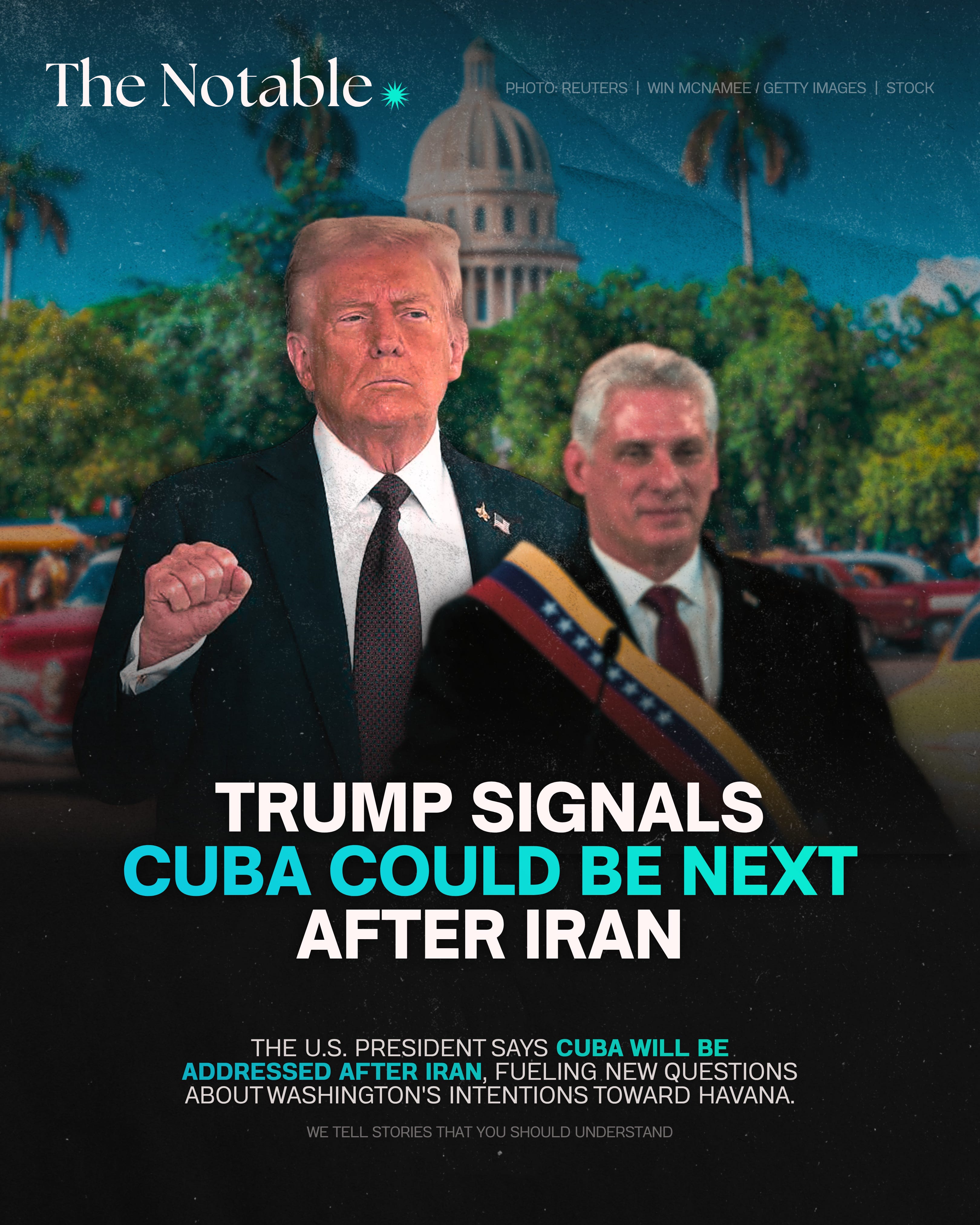
President Donald Trump has suggested that Cuba could become a major focus of U.S. policy after Iran, raising fresh questions about Washington’s intentions toward one of its longest-standing geopolitical adversaries.
The comments come amid a broader escalation in pressure on Havana, including new sanctions targeting senior Cuban officials and state-linked entities. While no military action has been announced, Trump’s remarks have fueled speculation about whether the administration is preparing a more aggressive strategy toward the island.
A New Target After Iran?
Speaking about foreign policy priorities, Trump indicated that the United States would address Iran first before turning its attention to Cuba.
The remarks are part of a pattern that has emerged over recent months. Trump has repeatedly linked the two countries in public statements, portraying both governments as hostile regimes that challenge American interests.
In some appearances, he has gone even further, suggesting that political change in Cuba may be inevitable. Such comments have been interpreted by many observers as an endorsement of eventual regime change, though the administration has not announced any formal policy pursuing that objective.
For now, Washington’s actions remain focused on economic and political pressure rather than military measures.
Sanctions Are Already Expanding
The rhetoric coincides with a new round of sanctions imposed by the United States against the Cuban government.
The measures target Cuban President Miguel Díaz-Canel, members of the Castro family, and several entities connected to the Cuban state. The sanctions are part of a broader effort by Washington to increase pressure on Havana at a time when the island is already facing severe economic challenges.
Cuba has struggled with inflation, shortages of basic goods, recurring power outages, and a continuing exodus of citizens seeking opportunities abroad.
Officials in Havana have blamed many of these difficulties on decades of U.S. sanctions, while Washington argues that Cuba’s economic problems stem primarily from the structure of its political and economic system.
Why Cuba Matters
Relations between the United States and Cuba have remained tense for more than six decades.
The modern conflict dates back to the 1959 Cuban Revolution, which brought Fidel Castro to power and transformed the island into a communist state aligned with the Soviet Union. The relationship deteriorated rapidly, leading to the U.S. trade embargo, the Bay of Pigs invasion, and the Cuban Missile Crisis, one of the most dangerous confrontations of the Cold War.
Although diplomatic relations were partially restored during the Obama administration, many restrictions returned during Trump’s first term. His administration rolled back several normalization efforts and adopted a significantly tougher approach toward Havana.
The latest comments suggest that Cuba remains firmly within Trump’s strategic worldview.
The Domestic Political Dimension
Cuba policy is not only a foreign policy issue. It is also an important domestic political issue, particularly in Florida.
Many Cuban-American voters support a hardline approach toward the Cuban government, making the issue politically significant in one of the country’s most influential states.
As a result, strong rhetoric toward Havana has often carried both international and domestic political implications.
Trump’s latest remarks are likely to resonate with supporters who favor a more confrontational stance toward communist governments.
What Happens Next?
The key question is whether Trump’s comments represent political messaging or an early indication of a broader strategic shift.
At present, there is no official announcement of military action, nor has the administration outlined a plan to forcibly remove Cuba’s government.
What is clear is that pressure on Havana is increasing. New sanctions, increasingly aggressive rhetoric, and the repeated linking of Cuba to Iran suggest that the administration views the island as a higher-priority challenge than it has in years.
For now, the immediate battle remains economic and diplomatic.
But Trump’s comments have opened a larger conversation about what Washington’s next chapter with Cuba could look like, and whether one of the Western Hemisphere’s longest-running geopolitical rivalries is entering a new phase.