


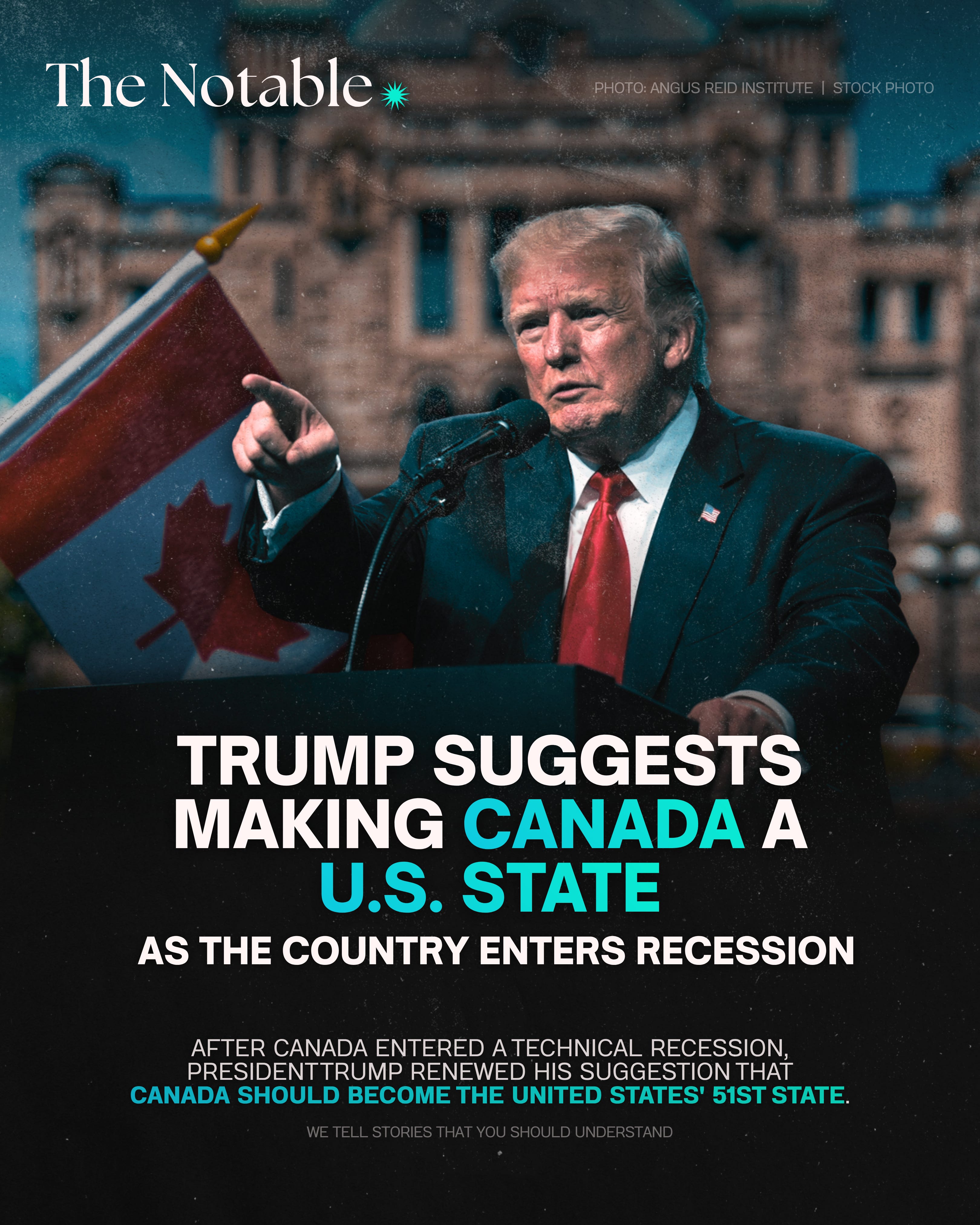
Canada has officially entered a technical recession. Within hours, President Donald Trump revived one of his most controversial ideas: that Canada should become part of the United States.
The comment, posted on Truth Social as simply “51st State,” came after new economic data showed Canada’s economy contracted for a second consecutive quarter. While Trump has floated the idea before, the timing of the remark immediately drew attention across North America.
Canadian leaders were quick to reject it. But the episode highlights something larger than a provocative social media post. It reveals how economic weakness, political narratives, and geopolitical leverage are increasingly becoming intertwined.
Canada’s Economy Has Entered a Recession
Statistics Canada reported that the country’s economy shrank for a second consecutive quarter, meeting the commonly accepted definition of a technical recession.
The downturn follows months of economic pressure driven by weaker growth, trade uncertainty, and slowing business activity. While some economists caution against reading too much into a technical recession alone, the data represents a significant political and economic moment for the Canadian government.
Economic slowdowns are never just about numbers. They shape public confidence, influence elections, and alter a country’s negotiating position abroad.
That broader context helps explain why Trump’s response generated headlines.
Trump’s “51st State” Comment Returns
Shortly after the recession data became public, Trump posted “51st State” on social media.
The statement was brief, but its meaning was clear. Trump was reviving his long-running suggestion that Canada would be better off as part of the United States.
Importantly, there is no formal proposal, no annexation process, and no indication that either government is considering such a move. The comment was political rhetoric rather than a policy announcement.
Still, rhetoric matters, especially when it comes from the President of the United States.
For supporters, the remark fits Trump’s habit of using provocative language to dominate political conversations. For critics, it represents an unnecessary escalation in relations with one of America’s closest allies.
Canada Pushes Back
The reaction from Canadian officials was swift.
Ontario Premier Doug Ford rejected the suggestion outright, declaring that Canada would never become the 51st state.
Prime Minister Mark Carney took a more restrained approach, dismissing the comment and signaling that his government would not respond to every statement made on social media.
The responses reflect a broader consensus within Canadian politics. Regardless of ideological differences, there is little support for any notion of political integration with the United States.
The issue is not whether Canada will become a U.S. state. It will not.
The real question is why this narrative keeps returning.
The Bigger Story
Viewed in isolation, Trump’s comment may appear to be little more than political theater.
Viewed in context, it speaks to something deeper.
Canada and the United States are navigating a period of growing economic and political tension. Trade disputes, tariff disagreements, supply chain concerns, and debates about economic sovereignty have increasingly shaped the relationship between the two countries.
At the same time, Canada has been exploring ways to reduce its economic dependence on the United States, while Washington continues to use its economic weight as a strategic tool.
Against that backdrop, Trump’s “51st state” rhetoric functions less as a realistic proposal and more as a symbol of American dominance within the North American economic system.
The message is not that Canada will join the United States.
The message is that economic strength creates influence, while economic weakness can create vulnerability.
What Happens Next
Canada’s recession does not fundamentally change the balance of power in North America. Nor does Trump’s comment signal a major policy shift.
But the episode serves as a reminder of how quickly economic developments can become political narratives.
As trade negotiations continue and both countries confront slowing growth, the economic relationship between Canada and the United States is likely to remain under scrutiny.
The immediate controversy will fade.
The underlying questions about economic dependence, political leverage, and North America’s future are far more likely to endure.