


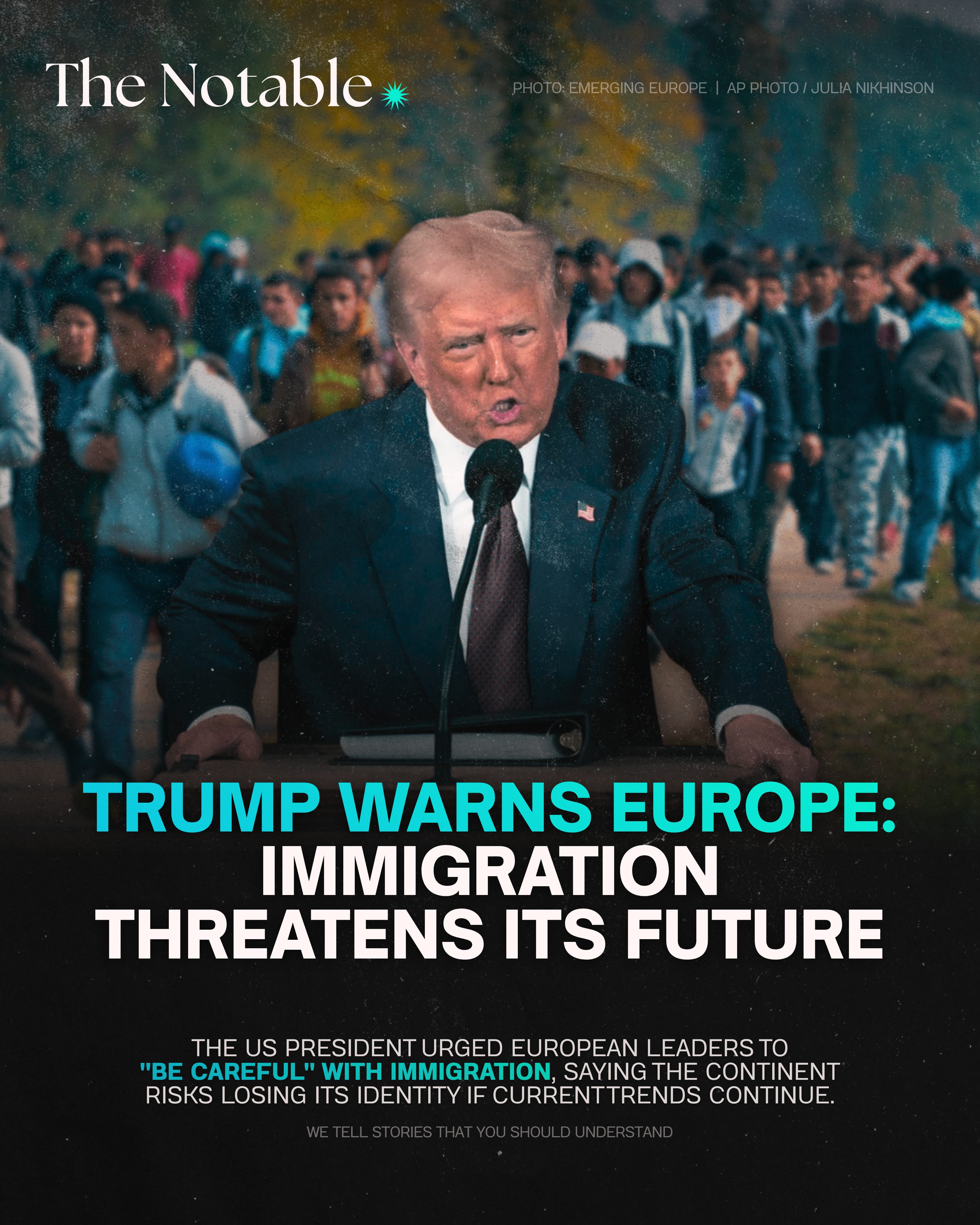
Europe has spent years debating immigration. At the NATO summit in Ankara on Wednesday, that debate became part of the alliance’s highest-level political conversation after President Donald Trump issued a stark warning to European leaders, arguing that current migration trends could fundamentally change the continent’s future.
Although the comments did not announce any new US policy, they quickly became one of the most widely discussed moments of the summit, underscoring how immigration has become intertwined with questions of security, identity, and the future of the transatlantic relationship.
Trump warns Europe over immigration
Speaking to reporters on the sidelines of the NATO summit, Trump urged European governments to take a tougher approach to immigration.
“They have to be very careful with their immigration policy,” he said.
He argued that some parts of Europe were “no longer recognizable” before delivering his strongest warning:
“You better get your act together, or you’re not going to have a Europe anymore.”
The remarks were directed broadly at European governments rather than any single country and came alongside criticism of Europe’s energy policies and defense priorities.
Unlike formal summit announcements on military spending or alliance strategy, Trump’s comments represented political messaging rather than a new policy initiative. He did not announce sanctions, new immigration measures, or any NATO proposal related to migration.
A familiar message on a larger stage
Trump’s warning did not mark a departure from his long-held views.
Immigration has remained one of the defining themes of his political career, both domestically and internationally. Since returning to office, he has repeatedly argued that European governments have failed to control their borders and that large-scale migration threatens public safety, social cohesion, and national identity.
He has delivered similar warnings in previous meetings with European leaders, but making the remarks during a NATO summit elevated the issue beyond domestic politics. The alliance is primarily focused on collective defense, yet Trump’s comments highlighted his broader view that national security extends beyond military capabilities to include border control, energy policy, and internal political stability.
Immigration remains a defining issue across Europe
Trump’s remarks come as immigration continues to reshape politics across much of Europe.
Over the past several years, many European governments have tightened asylum rules, strengthened border controls, and expanded efforts to curb irregular migration. Rising migrant arrivals, combined with housing pressures, economic concerns, and integration challenges, have fueled political debate in countries across the continent.
The issue has also contributed to the growing influence of political parties advocating stricter immigration policies. In several European elections, migration has emerged as one of the most important issues for voters, influencing coalition negotiations and government agendas.
Supporters of stricter immigration controls argue that governments must regain control of their borders and ensure immigration systems remain sustainable. Critics, meanwhile, contend that migration is a complex issue driven by conflict, economic inequality, and demographic trends, requiring coordinated international solutions rather than rhetorical warnings.
Beyond defense spending
The immigration remarks formed part of a broader critique of Europe delivered by Trump during the summit.
In addition to migration, he criticized European energy policies, particularly investments in wind power, while reiterating long-standing complaints that European allies should shoulder a greater share of the burden for their own security.
Taken together, the comments reflected a broader strategic message. Trump’s vision of the transatlantic relationship extends beyond NATO spending targets to encompass domestic governance, economic policy, and immigration. Rather than treating these issues separately, he presented them as interconnected elements of national strength.
What happens next
Trump’s remarks are unlikely to produce immediate policy changes within NATO, whose mandate does not extend to setting immigration policy for member states.
However, they are expected to reinforce ongoing political debates across Europe, where governments continue to face pressure over asylum systems, border management, and migration levels.
The comments also illustrate a widening philosophical divide within the Western alliance. While NATO remains united on collective defense, its members increasingly differ on broader questions of identity, sovereignty, and the role immigration should play in shaping Europe’s future.
Whether Trump’s warning influences policy or simply intensifies an already polarized debate, it reflects a political reality that extends well beyond this week’s summit: immigration is no longer viewed solely as a domestic issue. Increasingly, it has become a central question in discussions about security, governance, and the future direction of Europe itself.