


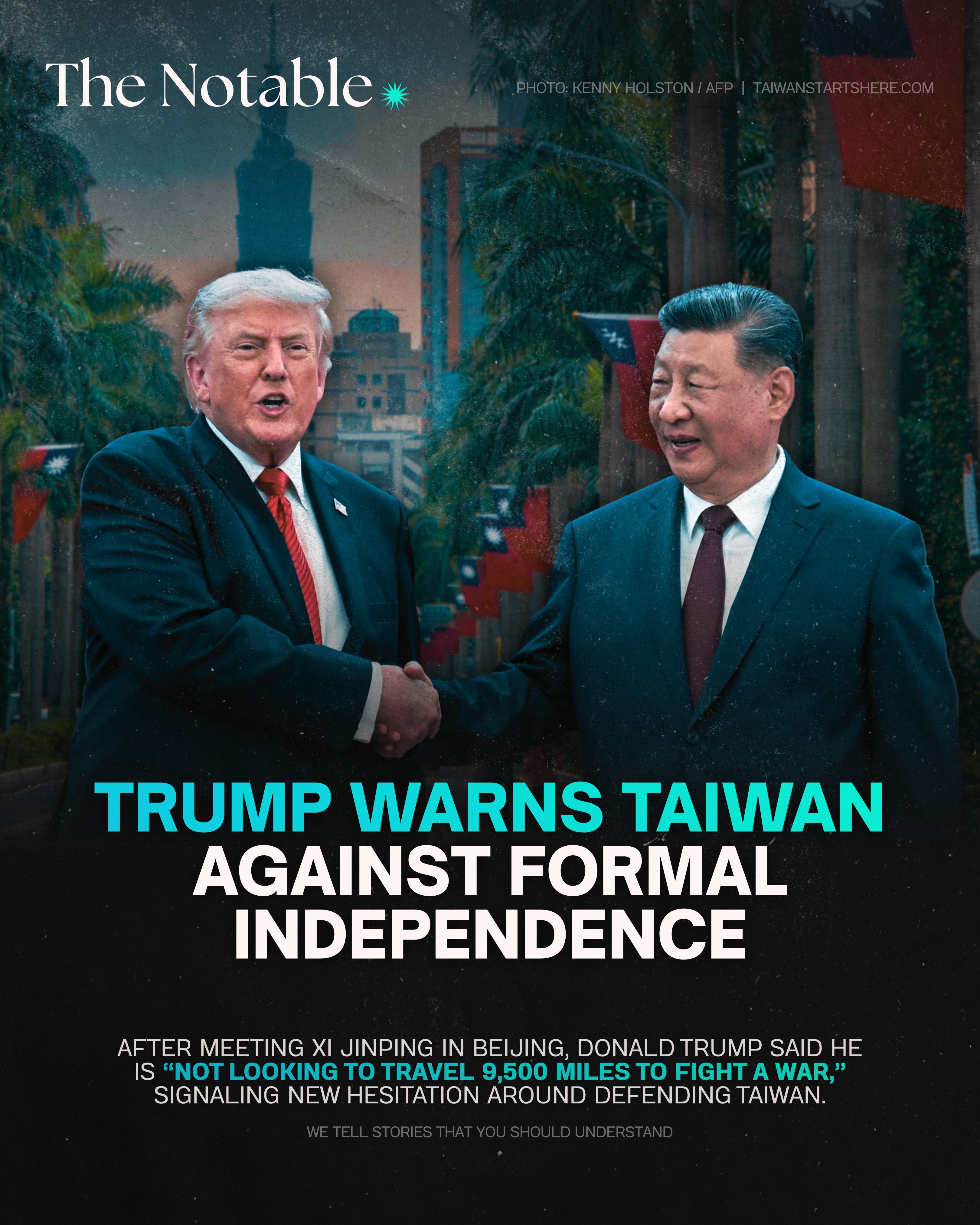
Donald Trump has delivered one of the clearest public signals yet that a future U.S. administration under his leadership may take a more restrained approach toward defending Taiwan.
After meeting Chinese President Xi Jinping in Beijing this week, Trump publicly discouraged Taiwan from moving toward formal independence and questioned whether the United States should be willing to fight a war over the island.
“I’m not looking to travel 9,500 miles to fight a war,” Trump said in a Fox News interview after the summit.
The remark immediately reverberated across Washington and Asia.
For decades, the question at the center of Taiwan policy has never been whether the island matters strategically. It does. Taiwan sits at the heart of global semiconductor production, regional security architecture, and the broader balance of power between the United States and China.
The real question has always been this:
Would America actually fight to defend it?
Trump’s comments have now pushed that question back into the center of global politics.
A Carefully Balanced System Is Being Tested
Taiwan occupies one of the most delicate positions in international politics.
The island governs itself democratically, holds elections, maintains its own military, and functions independently from Beijing in almost every practical sense. But it has never formally declared legal independence from China.
That ambiguity is intentional.
China considers Taiwan part of its territory and has repeatedly warned that any formal declaration of independence could justify military action under Beijing’s Anti-Secession Law.
At the same time, the United States has spent decades supporting Taiwan militarily while avoiding formal recognition of the island as an independent state. This approach became known as “strategic ambiguity.”
The system was designed to deter both sides simultaneously:
Deter China from invading Taiwan
Deter Taiwan from formally declaring independence
For years, that balance helped prevent war.
But the system has become increasingly unstable.
China has dramatically expanded military exercises around Taiwan in recent years, intensified pressure campaigns against the island, and accelerated preparations that many analysts believe could support a future blockade or invasion scenario.
Meanwhile, Washington has steadily deepened security cooperation with Taipei.
Trump’s latest remarks now introduce a new layer of uncertainty into that equation.
Xi’s Warning Appears To Have Shaped The Conversation
According to reports surrounding the Beijing summit, Xi Jinping warned Trump that Taiwan independence remains the most dangerous issue in U.S.-China relations.
Chinese officials have long framed “Taiwan separatism” as the core trigger for conflict in the region. Trump’s public comments afterward appeared to partially echo that framing by suggesting that Taiwanese independence could drag America into an unnecessary war.
Importantly, Trump later insisted official U.S. policy toward Taiwan has not changed.
Formally, that remains true.
Washington still follows the “One China” policy, does not officially recognize Taiwan as a sovereign state, and continues supporting the island through arms sales and defense cooperation under the Taiwan Relations Act.
But rhetoric matters in geopolitics.
Especially when it concerns deterrence.
Taiwan’s security depends heavily on China believing the United States may intervene militarily if Beijing attacks. Any signal that weakens that perception can shift strategic calculations in both Beijing and Taipei.
That is why Trump’s remarks are receiving such close scrutiny internationally.
The Deeper Question Is About America’s Global Commitments
Trump’s comments also fit into a broader worldview he has expressed for years.
He has consistently questioned the costs of American military commitments overseas, criticized allies for relying too heavily on U.S. protection, and framed foreign policy through burden-sharing and transactional calculations.
Taiwan now appears to be entering that same framework.
His statement was not simply about Taiwan itself. It reflected a larger question increasingly shaping American politics:
How much risk should the United States accept to defend distant partners abroad?
That debate is becoming more urgent as tensions rise simultaneously across Europe, the Middle East, and Asia.
For allies throughout the Indo-Pacific, Trump’s remarks may therefore carry implications far beyond Taiwan.
Countries like Japan, South Korea, and the Philippines rely heavily on the credibility of American deterrence in the region. Any perception that Washington may hesitate in a future crisis could force regional governments to reconsider their own long-term security strategies.
At its core, Taiwan represents far more than a territorial dispute.
For China, reunification with Taiwan is tied to nationalism, regime legitimacy, and Xi Jinping’s vision of national rejuvenation.
For the United States, Taiwan increasingly symbolizes the broader struggle over regional order, democratic alliances, and the future balance of power in Asia.
That is why even small shifts in language matter.
Trump did not announce a formal policy reversal.
But he did publicly introduce greater doubt about America’s willingness to fight for Taiwan. In a region built on deterrence and strategic signaling, that alone is significant.
And as tensions between Washington and Beijing continue rising, the world may increasingly discover that the most important geopolitical questions are no longer theoretical.
They are becoming immediate.