


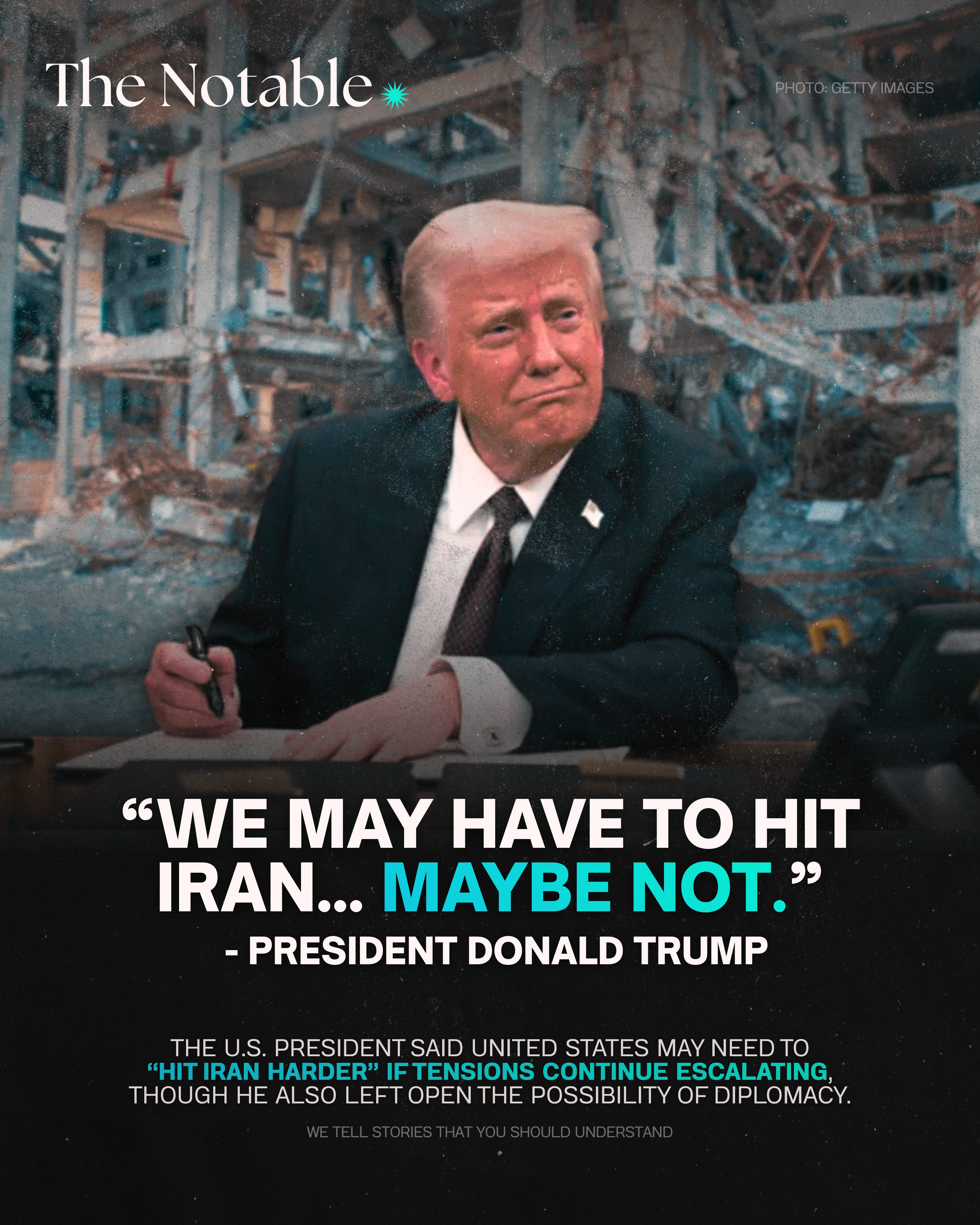
President Donald Trump has once again placed the possibility of direct U.S. military action against Iran back at the center of global attention.
Speaking at the U.S. Coast Guard Academy, Trump said the United States may “have to hit Iran harder... maybe not,” signaling that Washington is still weighing both military escalation and diplomacy as tensions with Tehran continue rising.
The remarks come at a particularly volatile moment in the Middle East, where fears of a wider regional conflict have intensified amid stalled negotiations, military planning, and growing uncertainty over Iran’s nuclear ambitions.
A Deliberately Ambiguous Message
Trump’s statement was striking not only because of the threat itself, but because of the ambiguity surrounding it.
“We may have to hit Iran harder. Maybe not,” he said during public remarks, while also insisting that the United States still prefers a diplomatic outcome.
The comments followed reports that Trump had recently paused a planned military strike on Iran that was allegedly close to approval earlier this week. According to multiple reports, the administration temporarily held back military action while negotiations continued behind the scenes.
At the same time, White House officials have reportedly continued reviewing military options in case diplomacy collapses.
The result is a familiar but dangerous pattern: escalating rhetoric paired with strategic uncertainty.
The Nuclear Issue Remains Central
Trump continues to frame the crisis around one core objective: preventing Iran from obtaining a nuclear weapon.
For years, Iran’s nuclear program has remained one of the most contentious issues in global geopolitics. Washington and its allies accuse Tehran of advancing capabilities that could eventually allow it to produce a nuclear weapon, while Iranian officials insist their program is for civilian energy purposes.
The issue has become even more sensitive as regional tensions have expanded beyond diplomacy into direct military confrontation, proxy warfare, and threats of retaliation across the Middle East.
Trump’s latest remarks suggest the administration is attempting to increase pressure on Tehran without fully committing to another military strike.
But the uncertainty itself carries risks.
A Region Already Under Pressure
The Middle East is already operating under heightened instability.
Iran has warned that additional U.S. military action could trigger retaliation not only against American forces, but also against countries aligned with Washington. Regional actors are increasingly preparing for the possibility that a localized confrontation could spiral into a broader conflict involving multiple states and armed groups.
Energy markets are also watching closely.
Any major escalation involving Iran raises concerns about disruptions in the Strait of Hormuz, one of the world’s most strategically important oil transit routes. Even limited military conflict in the region can quickly affect global energy prices, shipping security, and investor confidence.
That is why Trump’s remarks matter beyond domestic politics or campaign rhetoric.
Global markets, allied governments, and military planners are all trying to interpret whether the administration is signaling genuine preparation for escalation or simply attempting to increase negotiating leverage.
Pressure, Deterrence, And Strategic Signaling
The broader strategy appears to rely heavily on uncertainty.
By publicly threatening possible strikes while simultaneously discussing diplomacy, Trump is attempting to maximize pressure on Iran without fully locking the United States into immediate military action.
Supporters argue that unpredictability strengthens deterrence and gives Washington leverage during negotiations.
Critics argue the opposite: that unclear signaling increases the risk of miscalculation, especially in an already fragile region where multiple actors are operating under high tension.
The concern is not only whether the United States intends to strike Iran again.
It is whether all sides involved believe conflict is becoming more likely.
What Happens Next
For now, negotiations remain active, and no new U.S. military operation has been officially announced.
But Trump’s latest comments make clear that military escalation remains a real possibility if talks fail or if Washington believes Iran is moving closer toward nuclear weapons capability.
The coming days may determine whether the current crisis moves back toward diplomacy or closer toward direct confrontation.
And increasingly, the uncertainty itself is becoming part of the strategy.