


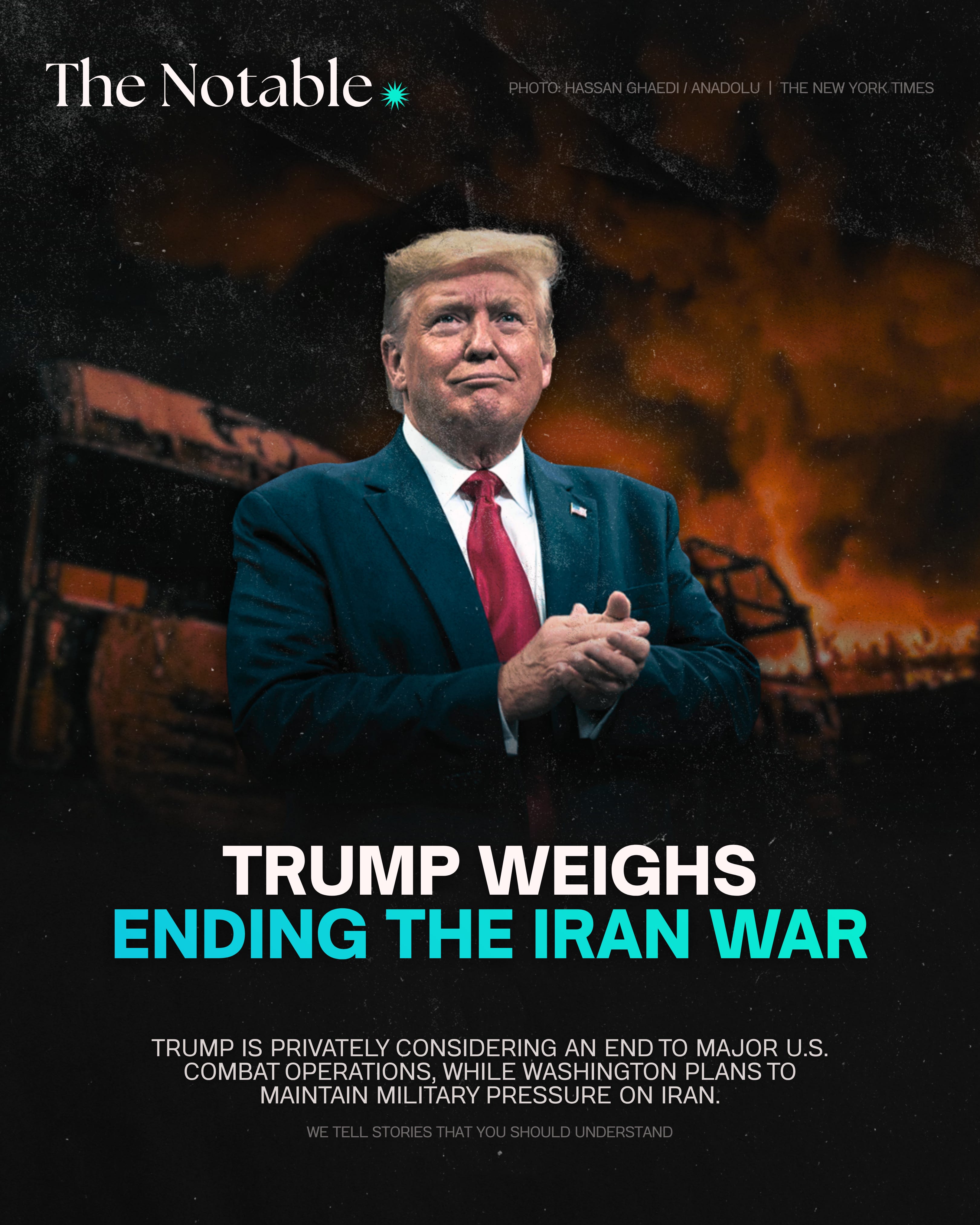
President Donald Trump is privately considering whether to declare the U.S.-Iran war over, according to reporting by The Wall Street Journal. Trump has discussed the possibility with senior aides and reportedly favors an approach that would formally end the major combat phase while maintaining intense economic pressure on Tehran.
The strategy would mark a significant shift in how Washington approaches the conflict. Rather than sustaining a large-scale bombing campaign indefinitely, Trump would seek to use sanctions, economic isolation and continued military leverage to pressure Iran into making concessions over its nuclear program.
The objective, according to the reporting, is not simply to stop fighting. Trump believes economic pressure could eventually force Iran to dismantle its nuclear capabilities or contribute to the collapse of the Islamic Republic.
That makes the meaning of an “end” to the war considerably more complicated. The United States could stop describing the conflict as an active war while continuing to confront Iran through economic coercion and the threat of renewed military action.
The Timing Is Striking
Trump’s reported deliberations come as fighting has intensified again.
On September 1 and 2, the United States conducted another major series of strikes against Iranian military infrastructure, including air-defense systems, radar installations, maritime assets, mine-laying capabilities and communications sites. Trump said the attacks were partly a response to Iranian efforts to threaten U.S. forces and maritime traffic around the Strait of Hormuz.
Iran responded with missile and drone attacks against U.S.-linked targets across the region, producing the most significant exchange of fire between Washington and Tehran since July.
The renewed fighting has therefore arrived at precisely the moment Trump is considering whether to declare the broader conflict over.
A War That Has Lasted Seven Months
The current conflict began on February 28, 2026, when the United States and Israel launched a major military campaign against Iran.
The initial objective was to severely damage Iran’s nuclear and military infrastructure. The conflict subsequently expanded into a prolonged confrontation involving missile attacks, strikes on military facilities, threats to shipping and the struggle for control of the Strait of Hormuz.
After months of fighting, neither side has achieved a clean political resolution.
Iran’s military capabilities have been severely damaged, but Tehran remains capable of launching missiles and drones and threatening U.S. interests and regional infrastructure. Reuters reported in August that the conflict had reached what analysts described as a costly stalemate rather than a decisive Iranian capitulation.
The result is an unusual situation: Washington has inflicted significant damage on Iran but still has not secured the political outcome it originally sought.
The Pentagon Is Preparing for 2027
Perhaps the clearest indication that the war is not simply disappearing is what the U.S. military is doing.
Defense Secretary Pete Hegseth is extending U.S. military deployments in the Middle East into 2027, according to The Wall Street Journal. Approximately 50,000 American servicemembers and 19 warships remain in the region, alongside air-defense units and fighter aircraft.
The extended deployments give Trump options.
If Iran escalates, U.S. forces remain positioned to respond. If negotiations become possible, the military presence gives Washington leverage. And if Trump declares the war over, the same forces can underpin the economic-pressure strategy without requiring an immediate American withdrawal.
But the deployment extensions also reveal the difficulty of calling the conflict finished.
A war can be politically declared over while the military posture required to fight it remains in place.
The Political Pressure Is Growing
The domestic political environment is another important factor.
Reuters reports that senior Trump aides are concerned that continued fighting could damage Republicans in the November midterm elections. Advisers are pushing to keep the conflict from escalating further before the election, even as Iranian and American forces continue exchanging strikes.
The political risks are significant.
A Reuters/Ipsos poll released August 31 found Trump’s approval rating at 33%, while dissatisfaction over the Iran war and economic pressures were weighing on his standing. Only a minority of Americans supported the war, according to the polling cited by Reuters.
The conflict is also affecting the cost of energy. Disruption around the Strait of Hormuz has pushed oil prices higher, adding another layer of economic pressure on American households.
For the Trump administration, therefore, the question is no longer purely military.
It is increasingly political and economic as well.
Iran Remains Under Severe Pressure
Washington has been moving aggressively to make economic pressure a central component of the campaign.
The United States has targeted Iran’s oil exports, shipping networks and other economic lifelines in an effort to isolate the Iranian government. At the same time, the U.S. naval presence around the Strait of Hormuz has complicated Iran’s ability to move oil and has created significant pressure on the country’s economy.
Reuters reported September 2 that Iran’s oil exports had fallen dramatically amid the U.S. blockade, while inflation and economic disruption were intensifying inside the country.
Iran is therefore confronting pressure on multiple fronts: damaged military infrastructure, constrained oil revenues, disrupted trade and the continued possibility of additional U.S. strikes.
But pressure has not yet produced capitulation.
Iran has continued to retaliate, and Tehran still has the ability to impose costs on the United States and its regional partners.
The Nuclear Question Remains Unresolved
At the center of the confrontation is Iran’s nuclear program.
Trump’s reported strategy assumes that military pressure and economic isolation can eventually force Tehran to accept far-reaching restrictions on its nuclear capabilities.
But that outcome remains uncertain.
Destroying facilities is not the same as permanently eliminating nuclear knowledge, infrastructure or political determination. Even after extensive strikes, the United States must determine whether Iran can rebuild, conceal elements of its program or continue nuclear-related activities elsewhere.
That is one reason the administration’s military presence remains important.
Washington wants the ability to enforce whatever settlement eventually emerges, while Tehran has strong incentives to preserve bargaining power.
Ending the War May Not End the Conflict
This is the central distinction emerging from the latest reporting.
Trump may be considering an end to the war as a military campaign, not an end to the U.S.-Iran confrontation.
Under that model, the United States would move from sustained offensive operations toward economic warfare, sanctions and diplomatic pressure, while maintaining enough military power in the region to respond if Iran attacks or refuses Washington’s demands.
The Pentagon’s decision to extend deployments into 2027 reinforces that interpretation.
It would represent a transition from an active war to a heavily militarized pressure campaign.
What Comes Next
The immediate question is whether Trump will formally declare the war over and what conditions he will attach to such a declaration.
Three things will matter most.
First, whether Iran reduces its attacks or continues retaliating against U.S. forces and regional partners.
Second, whether economic pressure produces meaningful concessions from Tehran, particularly over its nuclear program.
Third, whether Washington’s military presence actually begins to decline or remains at wartime levels despite a formal declaration that the conflict has ended.
The distinction could prove consequential.
If Trump declares victory while maintaining economic and military pressure, he could gain a political off-ramp without surrendering leverage over Iran. But if Tehran refuses to concede and attacks continue, the United States could find itself in a conflict that has been declared over politically while remaining very much alive militarily.
The Bigger Picture
Trump’s reported consideration of ending the Iran war does not necessarily mean Washington is abandoning its campaign against Tehran.
It may signal something more strategic: a shift from trying to defeat Iran through continued military operations toward trying to force Iran to change through economic isolation backed by overwhelming military power.
That strategy could reduce the immediate costs of the war while preserving American leverage.
But the fundamental problem remains unresolved.
Iran has been badly damaged, yet it has not surrendered. The United States may want the war to end, but it is keeping the forces necessary to continue it.
For now, the most important question is not simply whether Trump declares the war over.
It is what Washington intends to do after declaring it over.