


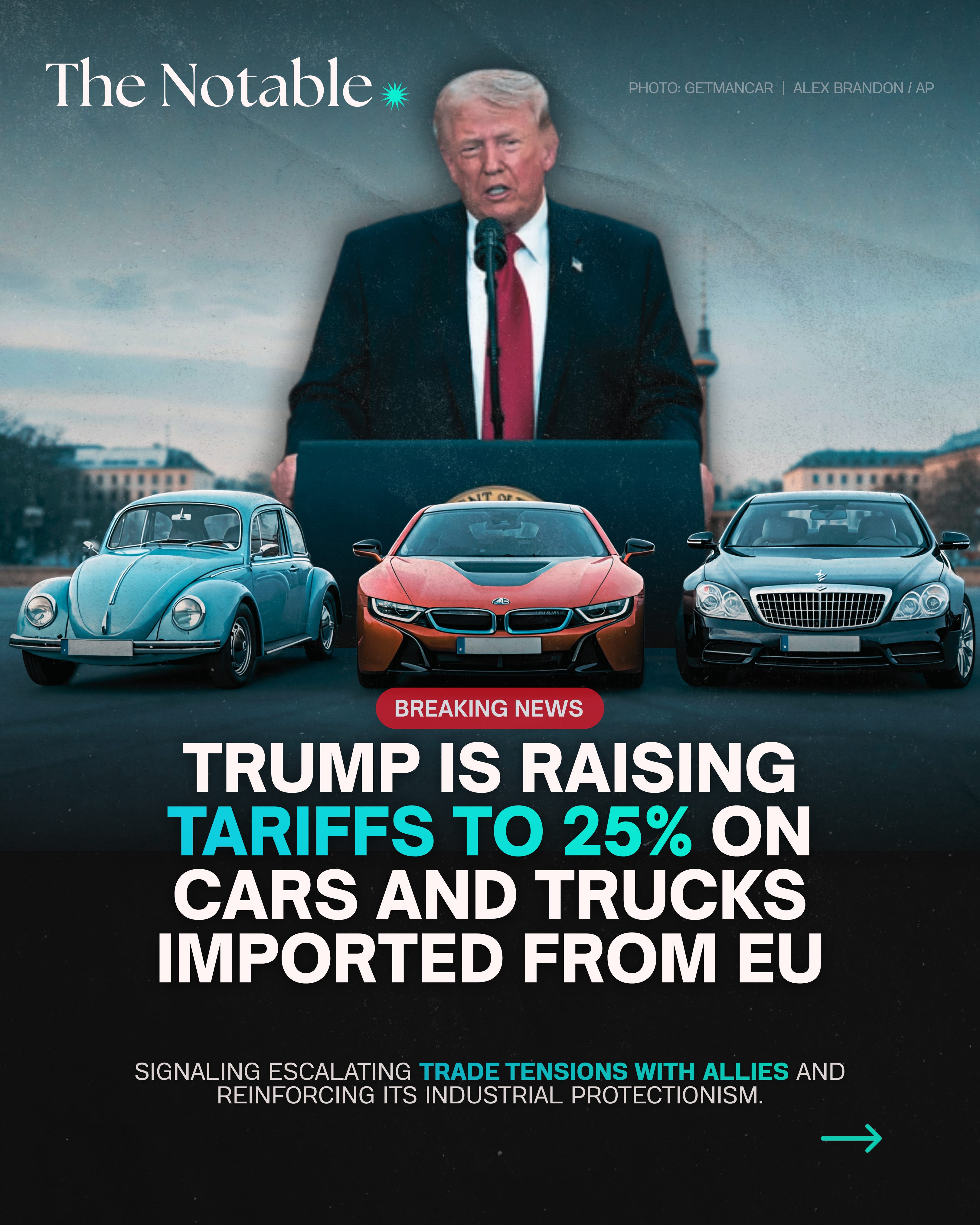
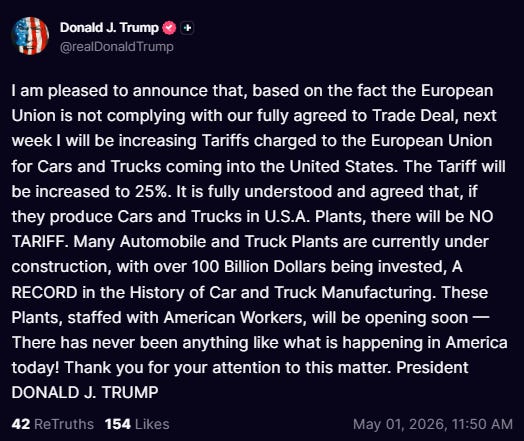
The United States is preparing to impose 25% tariffs on cars and trucks imported from the European Union. President Donald Trump framed the move as a response to what he described as European non-compliance with a trade agreement. He coupled the announcement with a clear condition: manufacturers that move production to the United States would avoid the tariffs entirely.
On the surface, this is a dispute over autos. In reality, it is a continuation of a broader shift in how the United States is using its economic power.
Tariffs have long been part of Trump’s economic playbook. During his first presidency, he threatened similar measures against European automakers and imposed tariffs on steel and aluminum, triggering retaliation from the European Union. What is different now is not the instrument, but the context.
The global economy has become more fragmented. Supply chains are being restructured. Industrial policy has returned as a central tool of state power. In this environment, tariffs are no longer just about protecting domestic industries. They are being used to actively reshape where production happens.
This latest move fits that pattern. The policy is not only punitive. It is directional. It is designed to push European manufacturers to build inside the United States rather than export into it.
The strategic target: Europe’s industrial core
The decision lands directly on one of Europe’s most important economic pillars. The auto industry, particularly in Germany, is deeply tied to exports. Brands like BMW, Mercedes-Benz, and Volkswagen depend heavily on access to the U.S. market.
A 25% tariff significantly alters that equation. It raises the cost of exporting vehicles into the United States and compresses margins for European manufacturers. In practical terms, it forces a choice: absorb the cost, pass it on to consumers, or relocate production.
None of those options are neutral. All of them carry consequences for investment, employment, and long-term industrial strategy.
For the U.S., the immediate effect is likely to be higher prices for imported European vehicles. But the policy is not primarily about short-term consumer outcomes. It is about long-term industrial positioning.
By tying market access to domestic production, the United States is attempting to convert its consumer market into leverage. The logic is straightforward. If companies want access to American demand, they should also contribute to American manufacturing.
This approach aligns with a broader policy direction seen in recent years. Programs like the CHIPS Act and the Inflation Reduction Act have already signaled a willingness to use state power to direct investment into domestic industries. The tariff policy extends that logic into trade.
A fracture among allies
What makes this development more consequential is who it targets.
The European Union is not an adversary in the traditional sense. It is a long-standing ally. Yet the tone and structure of the policy reflect a more transactional approach to relationships. Economic alignment is no longer assumed. It is negotiated, and increasingly, enforced.
This creates a new layer of tension within the Western bloc. Trade disputes between the U.S. and Europe are not new, but they are becoming more frequent and more structural. If the EU responds with retaliatory tariffs, which is likely, the dispute could widen beyond autos into other sectors.
At that point, the issue is no longer a single policy decision. It becomes a cycle.
A central justification for the tariffs is Trump’s claim that the European Union did not comply with a “fully agreed” trade deal. However, there is no widely recognized public agreement that clearly fits that description in the context of autos.
This ambiguity matters. If the claim is accurate, it suggests a breakdown in a specific negotiation. If not, it indicates that the tariffs are being used primarily as leverage rather than enforcement.
In both cases, the outcome is the same. The United States is willing to act unilaterally to reshape the terms of trade.
This moment reflects a broader transformation in the global economic system.
For decades, trade was built on the assumption of gradual liberalization. Tariffs would fall. Markets would integrate. Production would follow efficiency. That model is now under strain.
Governments are reasserting control over supply chains. Strategic sectors are being protected. Economic policy is increasingly tied to national security and political priorities.
The result is a system that is less predictable, more fragmented, and more competitive.
What comes next
The immediate next step is Europe’s response. The European Commission will have to decide whether to retaliate, negotiate, or attempt to de-escalate. Germany, given its exposure, will play a central role in shaping that response.
At the same time, global manufacturers will begin recalculating. Investment decisions that once depended primarily on cost and efficiency will now be influenced more heavily by political risk and market access conditions.
This is how structural shifts take hold. Not through a single decision, but through a series of incentives that gradually change behavior.
It is tempting to see this as another episode in a long-running trade dispute. But that framing understates what is happening.
The United States is redefining how it uses its market power. Access is no longer just an economic question. It is a strategic one.
And for the rest of the world, the message is becoming clearer. The era of open, frictionless trade is giving way to something more conditional, more political, and more contested.