


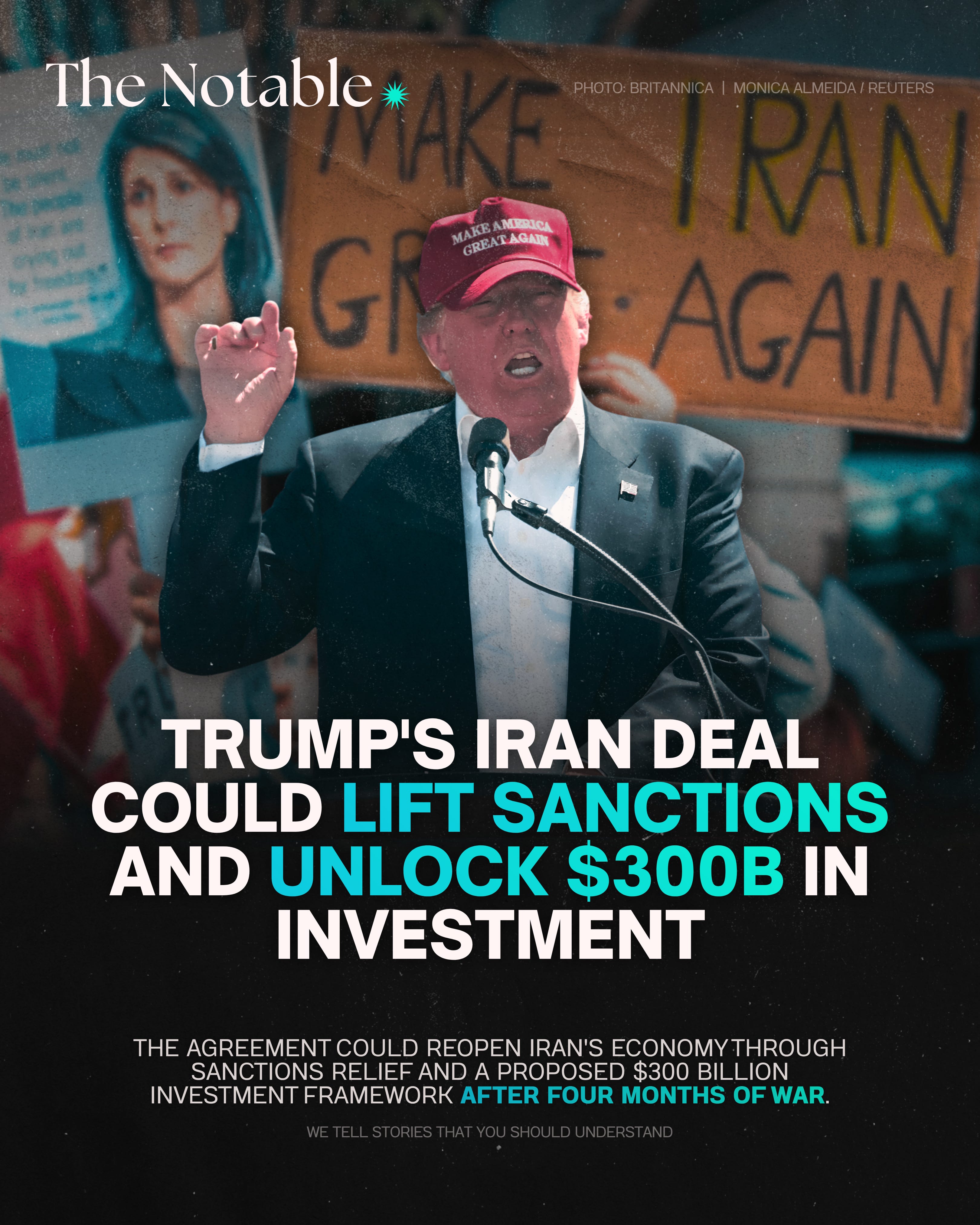
The agreement signals one of the most dramatic geopolitical reversals of Trump’s presidency.
Just months after the United States and Iran found themselves on opposite sides of a dangerous regional war, Washington and Tehran are now moving toward an economic framework that could fundamentally reshape Iran’s future.
According to details emerging from the recently reached U.S.-Iran peace agreement, the Trump administration is prepared to support a pathway toward lifting sanctions on Iran while backing a proposed $300 billion investment framework designed to help revive the country’s economy.
If implemented, the deal would represent one of the largest economic openings Iran has seen in decades. It would also mark a remarkable shift for President Donald Trump, whose first administration built its Iran policy around economic isolation, maximum pressure sanctions, and withdrawal from the Obama-era nuclear agreement.
The proposal highlights how quickly geopolitical realities can change when war, economic pressure, and strategic interests collide.
From War to Negotiation
The conflict that brought Washington and Tehran to the negotiating table began in late February and rapidly escalated into one of the most dangerous crises in the Middle East in recent years.
The war disrupted regional stability, threatened energy infrastructure, and raised fears that the Strait of Hormuz, one of the world’s most important shipping routes for oil and gas, could become a flashpoint for a wider conflict.
For global markets, the stakes were enormous.
Nearly a fifth of the world’s seaborne oil trade passes through the narrow waterway. Any prolonged disruption risked driving energy prices higher, fueling inflation, and increasing pressure on governments already grappling with economic uncertainty.
After months of military confrontation and diplomatic maneuvering, negotiators eventually produced a peace framework intended to end hostilities and establish a foundation for broader normalization.
What initially appeared to be a ceasefire discussion has now evolved into something much larger.
The Economic Heart of the Deal
The most significant aspect of the agreement is not military.
It is economic.
Reports indicate that the framework would eventually allow the lifting of U.S. sanctions that have constrained Iran’s economy for years. The agreement would also permit Iran to restore oil exports and regain access to portions of frozen assets held abroad.
But the most striking provision is the proposed $300 billion investment framework.
According to available reporting, the initiative would not be funded directly by U.S. taxpayers. Instead, it would function as an investment vehicle backed by private capital and international partners interested in participating in Iran’s economic recovery.
The goal is straightforward: reconnect Iran to global markets, encourage investment, rebuild damaged sectors of the economy, and create incentives for long-term stability.
For a country that has spent years under sanctions and economic restrictions, the implications could be transformative.
Iran possesses one of the largest populations and economies in the Middle East, significant industrial capacity, vast energy reserves, and a strategic location linking Asia, the Middle East, and Europe.
Economic reintegration could unlock opportunities that have remained largely inaccessible under years of sanctions.
A Major Strategic Reversal
The political significance of the agreement extends far beyond economics.
Trump rose to power as a fierce critic of previous efforts to engage Iran diplomatically. During his first term, he withdrew from the Joint Comprehensive Plan of Action, reimposed sanctions, and pursued a strategy intended to economically isolate Tehran.
For years, “maximum pressure” defined Washington’s approach.
Now, the administration is supporting a framework that could eventually provide sanctions relief and facilitate hundreds of billions of dollars in investment.
Supporters argue that the shift reflects strategic pragmatism rather than ideological change.
Their argument is simple: if economic incentives can secure peace, prevent future conflict, stabilize energy markets, and limit Iran’s nuclear ambitions, then engagement may be more effective than perpetual confrontation.
Critics view the agreement differently.
They argue that easing sanctions rewards a longtime adversary and risks undermining years of pressure designed to constrain Iranian influence across the region.
The debate is likely to become one of the defining foreign policy battles surrounding the agreement.
Why the Middle East Is Watching Closely
The implications extend well beyond Iran and the United States.
Regional powers will be watching closely to see whether economic normalization changes Iran’s behavior and alters the balance of power across the Middle East.
A more economically integrated Iran could increase trade, attract foreign investment, and strengthen its regional influence. It could also reshape relationships with Gulf states, energy markets, and neighboring economies.
For countries dependent on stable energy supplies, a reduction in tensions around the Strait of Hormuz would be a significant strategic benefit.
For investors, the possibility of renewed access to one of the region’s largest economies could create substantial opportunities.
For policymakers, the agreement represents a test of whether economic engagement can produce lasting security outcomes in one of the world’s most volatile regions.
What Happens Next
While the peace agreement has been reached, implementation remains the critical challenge.
Many provisions are expected to be tied to compliance mechanisms, inspections, and future negotiations. Questions remain about the exact timeline for sanctions relief, the structure of the investment framework, and the conditions Iran must satisfy before receiving the full benefits of the agreement.
In other words, the deal is not yet complete.
The broad direction is becoming clearer, but many of the most consequential details still need to be finalized.
What is already evident, however, is that the agreement represents more than the end of a war.
It signals a potential reordering of economic and geopolitical relationships that seemed unimaginable just months ago.
Whether the framework ultimately succeeds or fails, it has already revealed a recurring reality of international politics:
Countries may spend months fighting each other, but lasting peace often depends on economics, incentives, and the promise of a different future.
The most important story is not that the war ended.
It is that Washington appears willing to use economic integration rather than isolation as the mechanism for securing peace.
The proposed $300 billion investment framework suggests that the Trump administration increasingly sees economic incentives as a tool of strategic influence rather than simply a reward for compliance.
If the agreement survives implementation, it could become one of the most consequential examples of economic statecraft in the Middle East in decades.
And if it fails, it will reinforce the argument that some geopolitical rivalries cannot be resolved through investment and diplomacy alone.
Either way, the stakes extend far beyond Iran.