


A wartime escalation is now testing the limits of presidential power
The United States is confronting a rare and volatile convergence.
An escalating war with Iran is now colliding with a growing effort inside Washington to remove a sitting president from power.
At the center of it is a single statement, and what it implies.
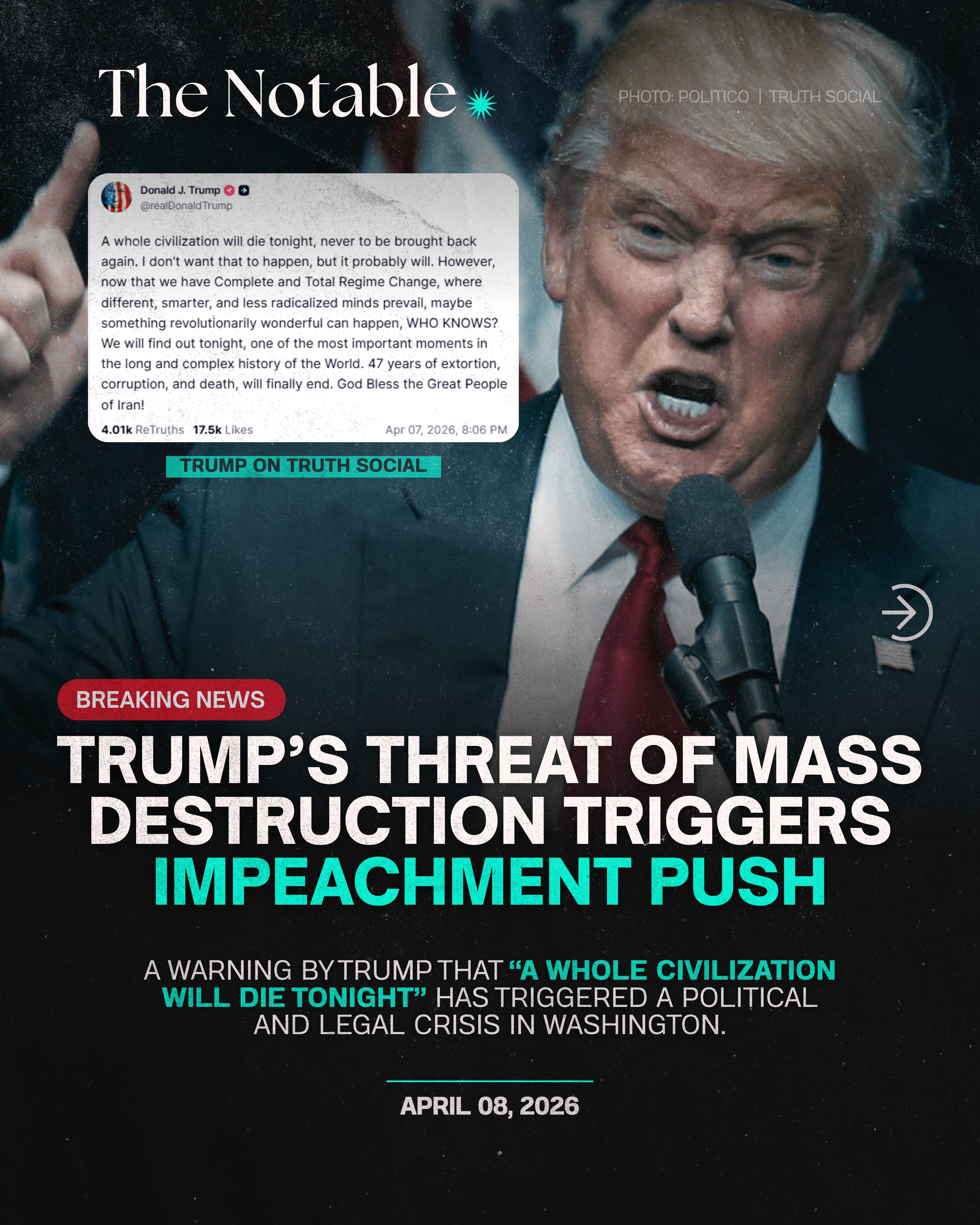
On April 7, President Donald Trump warned that “a whole civilization will die tonight” if Iran failed to comply with U.S. demands, including reopening the Strait of Hormuz. Posted on Truth Social, the message was not framed as speculation. It was delivered as a conditional outcome tied to immediate action.
Within hours, the reaction moved beyond politics.
It entered legal, military, and constitutional territory.
When rhetoric becomes signal
The U.S.–Iran conflict had already been intensifying.
Military operations were expanding, with increasing focus on strategic infrastructure and regional chokepoints. The Strait of Hormuz, critical to global oil flows, had become central to the confrontation.
But Trump’s statement marked a shift in kind, not just degree.
It introduced the possibility of destruction at a scale that moved beyond conventional military objectives. Not limited strikes. Not contained escalation. But language suggesting systemic collapse.
That distinction matters because in modern warfare, intent is not only judged by action, but by signal.
And a president’s public signal carries weight across multiple systems at once: military planning, allied coordination, and legal accountability.
The response inside Washington
In the immediate aftermath, a group of lawmakers began to act.
At least 24 members of Congress have expressed support for either impeaching the president or invoking the 25th Amendment to transfer power to the vice president. The arguments vary in framing, but converge on a common concern: that the president’s statements may indicate willingness to authorize actions that risk large-scale civilian harm.
This is not just a political disagreement.
It is a question of boundaries.
Legal experts have raised concerns about the implications under international humanitarian law, particularly regarding the targeting of civilian infrastructure and proportionality in armed conflict. Military officials, more quietly, are confronting what such signals mean for operational clarity and chain-of-command discipline.
When political rhetoric begins to shape perceived intent, the consequences extend beyond Washington.
A different kind of impeachment moment
The United States has impeached presidents before.
But this moment does not fit the familiar pattern.
Previous impeachment efforts were rooted in domestic conduct, tied to questions of legality, ethics, or abuse of office within the political system. This situation is unfolding in parallel with an active international conflict, where decisions carry immediate external consequences.
That changes the nature of the risk.
Removing a president during wartime introduces its own instability. It raises questions about continuity, credibility, and control at a moment when clarity is most needed.
And yet, the calls are emerging anyway.
That alone signals the level of concern inside parts of the system.
The structural constraint problem
At the center of this moment is a structural tension.
The U.S. system provides mechanisms to check presidential power. Impeachment. The 25th Amendment. Congressional oversight.
But these mechanisms are inherently slow.
They were designed for deliberation, not immediacy.
War operates on a different clock.
Decisions can unfold in hours. Consequences can follow immediately. The gap between executive action and institutional response becomes critical under those conditions.
This is where the current crisis sits.
Not in whether constraints exist, but in whether they can function in real time.
What is likely, and what is not
Despite the escalation in rhetoric and response, removal remains unlikely in the near term.
Impeachment would require not just a House majority, but Senate conviction, which depends on bipartisan support that is not currently evident. The 25th Amendment would require coordinated action from within the administration itself, an even higher threshold.
The system, in other words, is under pressure but not yet in motion.
For now, the presidency remains intact, even as scrutiny intensifies.
What comes next
Two variables will shape the next phase.
The first is external: whether the conflict with Iran escalates further, particularly in ways that validate or operationalize the threat implied in the president’s statement.
The second is internal: whether resistance emerges within the administration, the military, or Congress at a level that shifts the balance from concern to action.
Until one of those changes, the situation remains suspended.
The deeper question
This moment is not ultimately about a single statement.
It is about a system being tested under stress.
Specifically, whether democratic institutions can meaningfully constrain executive power during the most time-sensitive and high-risk conditions a state can face.
War compresses time.
The Constitution expands it.
What happens when those two realities collide is no longer theoretical.
It is now playing out in real time.