


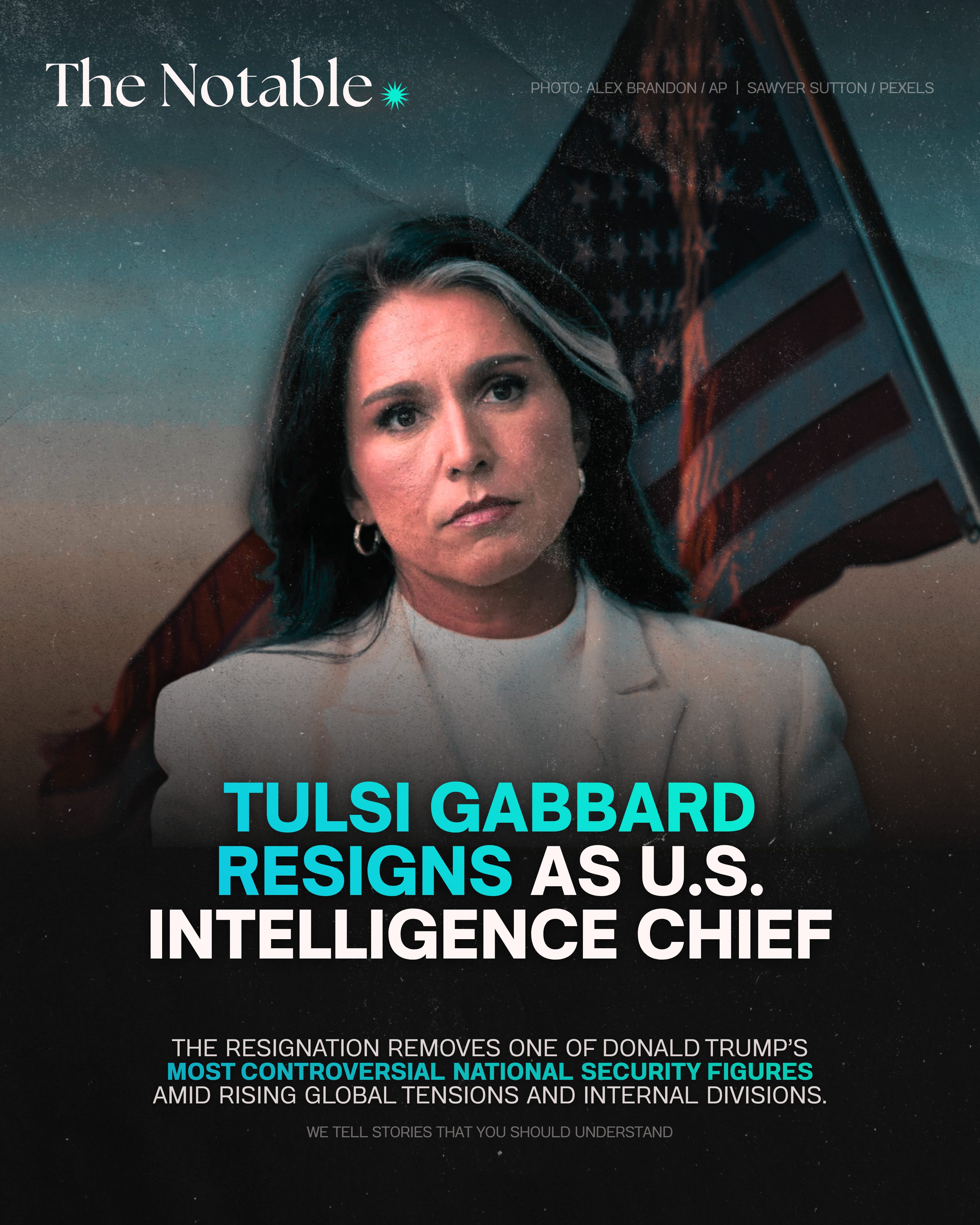
Tulsi Gabbard has resigned as Director of National Intelligence, abruptly ending one of the most controversial and politically unusual tenures in modern American intelligence history.
The resignation, confirmed on May 22, comes at a critical moment for the Trump administration as Washington navigates rising tensions with Iran, intensifying competition with China and Russia, and growing internal divisions over U.S. foreign policy.
Gabbard said she would step down effective June 30 after her husband, Abraham Williams, was diagnosed with a rare form of bone cancer. President Donald Trump publicly praised her service following the announcement and confirmed that Principal Deputy DNI Aaron Lukas would assume the role on an acting basis.
But behind the official explanation, multiple reports suggest a more complicated political story.
According to Reuters and other major outlets, Gabbard had increasingly fallen out of favor inside parts of the administration and was reportedly sidelined from key national security discussions in recent months. Some officials viewed the resignation less as a voluntary departure and more as a managed exit amid mounting internal friction.
That distinction matters because Gabbard was never a conventional intelligence chief.
From Democratic Candidate to Trump Intelligence Director
Few political figures in Washington have undergone a transformation as dramatic as Tulsi Gabbard’s.
Once a Democratic congresswoman from Hawaii and a 2020 presidential candidate, Gabbard built her early political identity around anti-interventionism, criticism of the U.S. foreign policy establishment, and skepticism toward America’s intelligence institutions after the Iraq War era.
Over time, she moved steadily away from the Democratic Party and toward Donald Trump’s political orbit.
By the time Trump selected her to lead the Office of the Director of National Intelligence in 2025, Gabbard had become one of the administration’s most prominent “America First” national security voices.
Her appointment immediately triggered bipartisan concern.
Critics argued that her past statements on Russia, Syria, Edward Snowden, and intelligence agencies made her an unusually risky choice to oversee the U.S. intelligence community. Supporters, however, viewed her as someone willing to challenge what they believed had become a politicized and unaccountable national security bureaucracy.
That ideological divide would define her tenure.
A Turbulent Tenure Inside the Intelligence Community
As DNI, Gabbard oversaw the coordination of America’s intelligence agencies during a period of growing global instability.
Her tenure quickly became associated with aggressive declassification campaigns, confrontations with former intelligence officials, and broader efforts by the Trump administration to reshape national security institutions around anti-establishment priorities.
Supporters framed those moves as overdue reforms.
Critics described them as an attempt to politicize intelligence operations and weaken institutional independence.
The controversy surrounding Gabbard was amplified by her increasingly visible role inside Trump’s political movement, where she became both a media surrogate and a symbol of the administration’s attempt to challenge traditional foreign policy consensus in Washington.
But by early 2026, reports began emerging that her influence inside the administration was fading.
Several outlets reported that key national security decisions, particularly regarding Iran and broader Middle East strategy, were increasingly being handled by other factions inside Trump’s circle.
That internal divide reflected a larger struggle unfolding inside the administration itself.
The Battle Inside Trump’s Foreign Policy Team
At the center of the conflict is a fundamental disagreement over America’s role in the world.
One faction inside the administration favors a more restrained “America First” approach focused on avoiding major military entanglements abroad. Gabbard was widely associated with this camp.
Another faction has pushed for a more assertive posture toward adversaries such as Iran, China, and Russia, particularly as geopolitical tensions continue to rise.
The disagreement has become increasingly visible in recent months as crises involving Iran escalated and debates intensified over military deterrence, intelligence priorities, and America’s global commitments.
Gabbard’s departure may signal that the balance of power inside the administration is shifting away from some of the more anti-interventionist voices that once held influence.
That shift could carry consequences beyond Washington personnel politics.
Why This Matters
The Director of National Intelligence is one of the most powerful positions inside the U.S. national security apparatus.
The office coordinates intelligence across the CIA, NSA, FBI, and other agencies while shaping how threats are assessed and presented to policymakers.
Leadership changes at that level matter most during periods of geopolitical uncertainty.
And this resignation arrives during exactly such a moment.
The United States is simultaneously managing:
Escalating tensions with Iran
Intensifying strategic rivalry with China
Continued confrontation with Russia
Growing instability across global security systems
Against that backdrop, Gabbard’s resignation is not simply another Cabinet departure.
It reflects deeper fractures inside the Trump administration over how America should use power in an increasingly unstable world.
What happens next may reveal which faction ultimately defines U.S. foreign policy in the years ahead.