


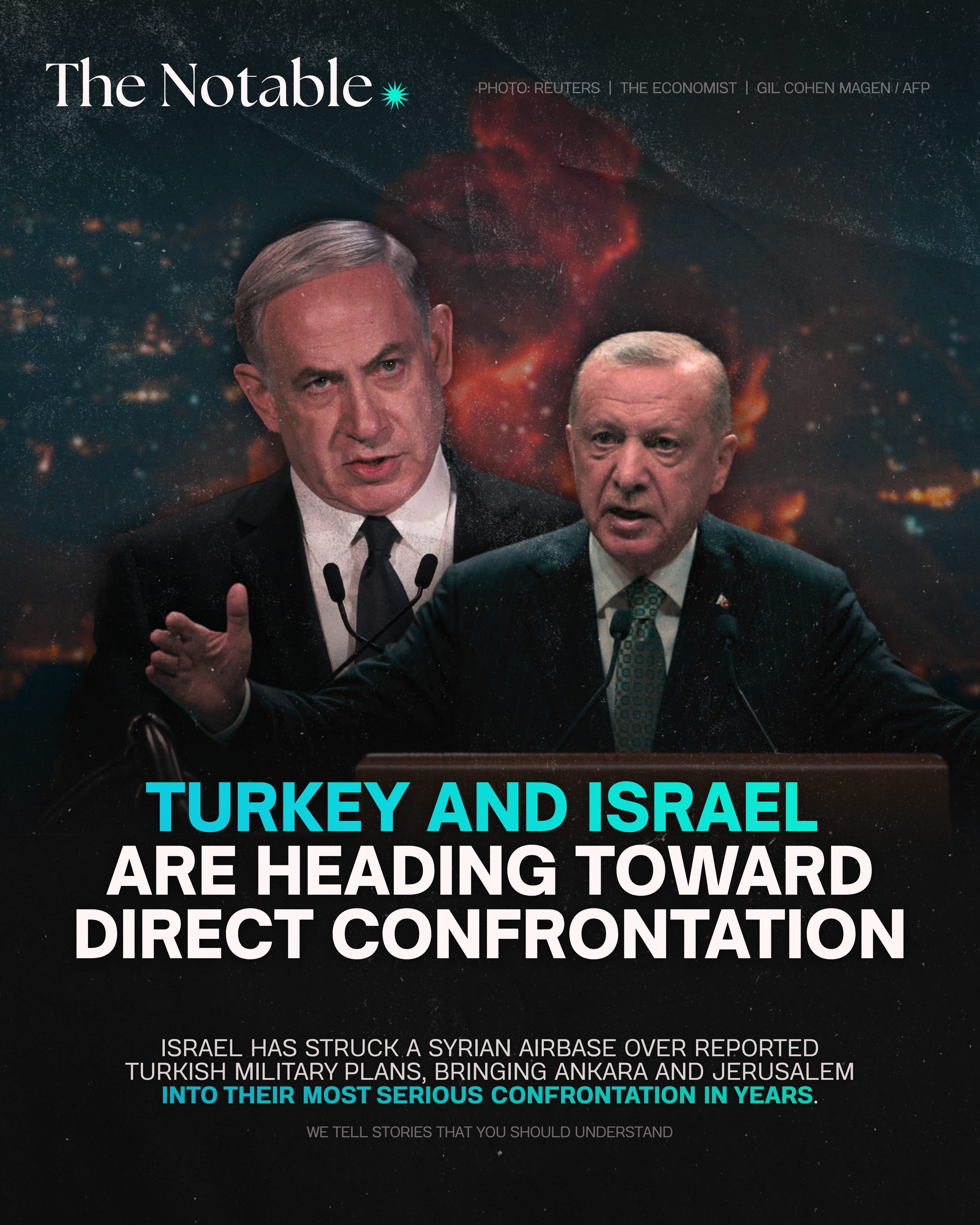
Turkey and Israel have spent years on opposite sides of the region’s major political disputes, particularly over Gaza and the Palestinian issue. But their rivalry has now entered a more dangerous phase.
The immediate flashpoint is Syria, where Israel carried out airstrikes against a Syrian military airbase after concluding that Turkey was moving toward a greater military role there. Ankara condemned the attack. Israeli officials have issued increasingly direct warnings to Turkish President Recep Tayyip Erdoğan. Washington is now trying to create a mechanism to prevent the two countries from accidentally colliding militarily.
There is still no indication that Turkey and Israel are preparing for a direct war. But the strategic conditions for confrontation are becoming harder to ignore.
The Strike That Changed the Equation
On August 18, Israel carried out eight airstrikes against Abu al-Duhur airbase in northwestern Syria, damaging the runway and other military infrastructure. No casualties were reported. The base, which had been largely inactive since Syria’s civil war, has been undergoing rehabilitation.
Israel’s justification was significant.
According to Israeli officials, Damascus was close to allowing Turkish forces to deploy at the facility, which Israel viewed as a violation of an existing security status quo and a potential threat to Israeli security. Israel had reportedly warned the Syrian government against allowing such a deployment.
The strike therefore carried a message beyond Syria.
It was also a warning to Ankara: Israel is prepared to use military force to prevent what it considers an unacceptable Turkish military foothold in Syria.
But Turkey Says the Israeli Premise Is Wrong
Ankara has rejected Israel’s characterization of events.
Turkey has denied that Turkish troops were present at Abu al-Duhur when Israel attacked and rejected claims that it was preparing to establish a permanent military base there. Ankara has instead emphasized its support for Syria’s territorial integrity, reconstruction and development of its military capabilities.
The Syrian government has likewise said there were no plans for a permanent Turkish military presence at the base.
Syrian Foreign Minister Asaad al-Shaibani said Turkish military officials had visited the facility for training-related purposes, but that this did not amount to plans for a permanent Turkish base. Syrian officials have also insisted that the facility would remain under Syrian sovereignty.
There is therefore an important distinction in the current crisis.
Israel says a Turkish military expansion was imminent. Turkey and Syria say there was no permanent deployment planned.
That disagreement is at the heart of the confrontation.
The Intelligence Conversation Before the Strike
One of the most revealing developments came from a Reuters report published after the attack.
On August 14, four days before the airstrike, Mossad chief Roman Gofman spoke with Syrian Foreign Minister Asaad al-Shaibani. According to people familiar with the matter, the conversation included Turkey’s military role in Syria and possible Turkish deployments.
The timing matters.
The call was one of the highest-level known contacts between Israel and Syria’s post-Assad government. It also demonstrates that Israel’s concerns about Turkey’s role were being discussed with Damascus immediately before the airstrikes.
Whatever the precise Turkish plans were, Israel was clearly treating Ankara’s expanding role in Syria as a strategic issue rather than a routine bilateral matter.
Why Turkey Matters So Much in Post-Assad Syria
The roots of the dispute go back to the collapse of Bashar al-Assad’s government in December 2024.
Turkey emerged as one of the most important external powers supporting Syria’s new leadership under President Ahmed al-Sharaa. Ankara has supported reconstruction and military cooperation and has sought to help the new Syrian state rebuild its institutions and security forces.
That gives Turkey an enormous stake in what Syria becomes.
For Ankara, a stable and functioning Syrian state can serve several objectives: protecting Turkish security interests along the border, limiting instability, supporting reconstruction and expanding Turkish influence across a country that has historically been strategically important to Turkey.
Israel sees the situation differently.
The Israeli government remains deeply concerned about the emergence of military capabilities inside Syria that could eventually threaten Israel. Since Assad’s removal, Israel has repeatedly used military force inside Syria and has sought to prevent the new government from rebuilding strategic military capabilities.
The result is a collision of strategic priorities.
Turkey wants to help build Syria’s security architecture. Israel wants to retain the ability to prevent Syria from becoming a security threat.
Syria Is Becoming the New Turkey-Israel Fault Line
For years, the largest source of tension between Ankara and Jerusalem was Gaza.
President Erdoğan has been among Israel’s most outspoken regional critics, while Turkey has strongly supported Palestinian causes and opposed Israel’s military campaign in Gaza.
That confrontation remains active.
On August 20, Turkey, Egypt and Qatar condemned recent Israeli strikes in Gaza and warned that continued military action could undermine efforts to end the conflict.
But Syria introduces something different.
Gaza is primarily a political and diplomatic confrontation.
Syria can become a military confrontation.
Both Turkey and Israel have security interests inside the country. Both possess sophisticated militaries. Both have relationships with Syrian actors. And both are operating in an environment where misidentifying another country’s intentions could have immediate consequences.
That makes Syria considerably more dangerous as a point of friction.
Netanyahu Is Drawing a Red Line
Israeli Prime Minister Benjamin Netanyahu has made clear that Israel does not intend to accept a Turkish military entrenchment in Syria.
Israeli Defense Minister Israel Katz has been even more direct.
Following the airstrike, Katz accused Erdoğan of dragging Turkey into “dangerous adventures in Syria” and warned the Turkish leader against testing Israel’s determination to defend itself.
The language represents a significant escalation.
Turkey is not a small regional actor. It is a NATO member with one of the largest militaries in the alliance.
That does not mean NATO would become involved in a Turkey-Israel confrontation. NATO’s collective-defense provisions do not automatically turn every conflict involving a member into a NATO operation.
But the presence of two heavily armed states, one of them a NATO member and both closely connected to Washington, raises the strategic stakes considerably.
Washington Is Now Trying to Prevent a Collision
The United States has moved quickly to contain the dispute.
U.S. special envoy for Syria Tom Barrack said Washington was working to establish a formal deconfliction mechanism involving Turkey, Israel and Syria. The objective is straightforward: create channels through which the three countries can communicate their military movements and intentions before misunderstandings turn into military incidents.
The need for such a mechanism is itself revealing.
The United States is not treating the dispute as an ordinary diplomatic disagreement. Washington is concerned that competing military activities inside Syria could produce an unintended confrontation.
The United States also has relationships with all sides.
Turkey is a longstanding U.S. ally and NATO member. Israel is one of Washington’s closest strategic partners. The new Syrian government is simultaneously trying to establish itself as a legitimate regional actor.
Washington therefore has an interest in preventing the Syrian transition from becoming a new regional war.
The Bigger Contest Is About Who Shapes Syria
The airbase is important, but it is not the entire story.
The deeper competition is over the future security architecture of post-Assad Syria.
Turkey wants influence over Syria’s reconstruction and security institutions. Israel wants guarantees that Syrian territory cannot be transformed into a platform for threats against Israel. The Syrian government wants to rebuild sovereignty over its territory without becoming dependent on any single outside power.
Those objectives do not naturally align.
And Syria is not operating in isolation.
Turkey has also expanded its regional security relationships. Earlier this month, Ankara joined Saudi Arabia and Pakistan in a new mutual-defense agreement, adding another layer to the broader regional security environment. That pact should not automatically be interpreted as an anti-Israel alliance, but it illustrates Turkey’s growing role in regional security affairs.
For Israel, Turkey’s growing regional influence is increasingly difficult to separate from the Syrian question.
What Makes the Current Moment Dangerous
The most immediate danger is not necessarily a deliberate decision by either government to start a war.
It is miscalculation.
Imagine a situation in which Turkish personnel begin operating at a Syrian facility, Israel believes the deployment violates its red lines, and Israeli forces conduct another strike. Turkey could then face domestic and strategic pressure to respond.
Alternatively, Turkey could expand its military presence in Syria without establishing a formal permanent base. Israel could interpret that expansion as the beginning of a larger strategic foothold and act preemptively.
Each step could then create pressure for the next.
That is precisely why Washington is trying to establish direct military communication channels.
Gaza Still Matters
It would be a mistake to treat the Syria confrontation as completely separate from Gaza.
Turkey’s relationship with Israel has deteriorated dramatically over the Gaza war. Ankara has repeatedly condemned Israel’s military campaign, supported Palestinian causes and positioned itself as an important diplomatic actor in efforts to end the conflict.
Israel, meanwhile, views Turkey’s support for Hamas and Erdoğan’s broader regional posture with deep suspicion.
The Gaza conflict therefore provides the political foundation for the deterioration in bilateral relations.
Syria is where that political rivalry is increasingly acquiring a military dimension.
What Happens Next
The next phase will depend heavily on what Turkey actually does in Syria.
The most important question is whether Ankara proceeds with a larger military role at Syrian facilities, including airbases and air-defense infrastructure. A permanent Turkish presence would almost certainly attract greater Israeli scrutiny.
The second question is whether Israel conducts additional strikes.
The third is whether the U.S.-backed deconfliction mechanism can actually work. A communications channel can reduce the risk of accidental confrontation, but it cannot resolve the underlying strategic disagreement over Turkey’s role in Syria.
And there is a fourth question that is broader than either government:
Can post-Assad Syria become a functioning sovereign state without becoming the battlefield for competing regional powers?
That may ultimately determine whether the current Turkey-Israel confrontation remains contained or becomes a much larger regional problem.
The Bottom Line
Turkey and Israel are not at war.
But the relationship has entered a more dangerous phase.
The August 18 strike on Abu al-Duhur demonstrated that Israel is prepared to use military force when it believes Turkey’s role in Syria crosses its security red lines. Turkey’s response shows that Ankara is equally determined to defend its growing relationship with Syria and reject Israeli attempts to dictate the limits of Turkish involvement.
The immediate dispute is about one Syrian airbase.
The deeper struggle is about who gets to shape the Middle East emerging after Assad.
And Syria may now be the place where the strategic rivalry between Turkey and Israel moves from political confrontation toward direct military friction.