


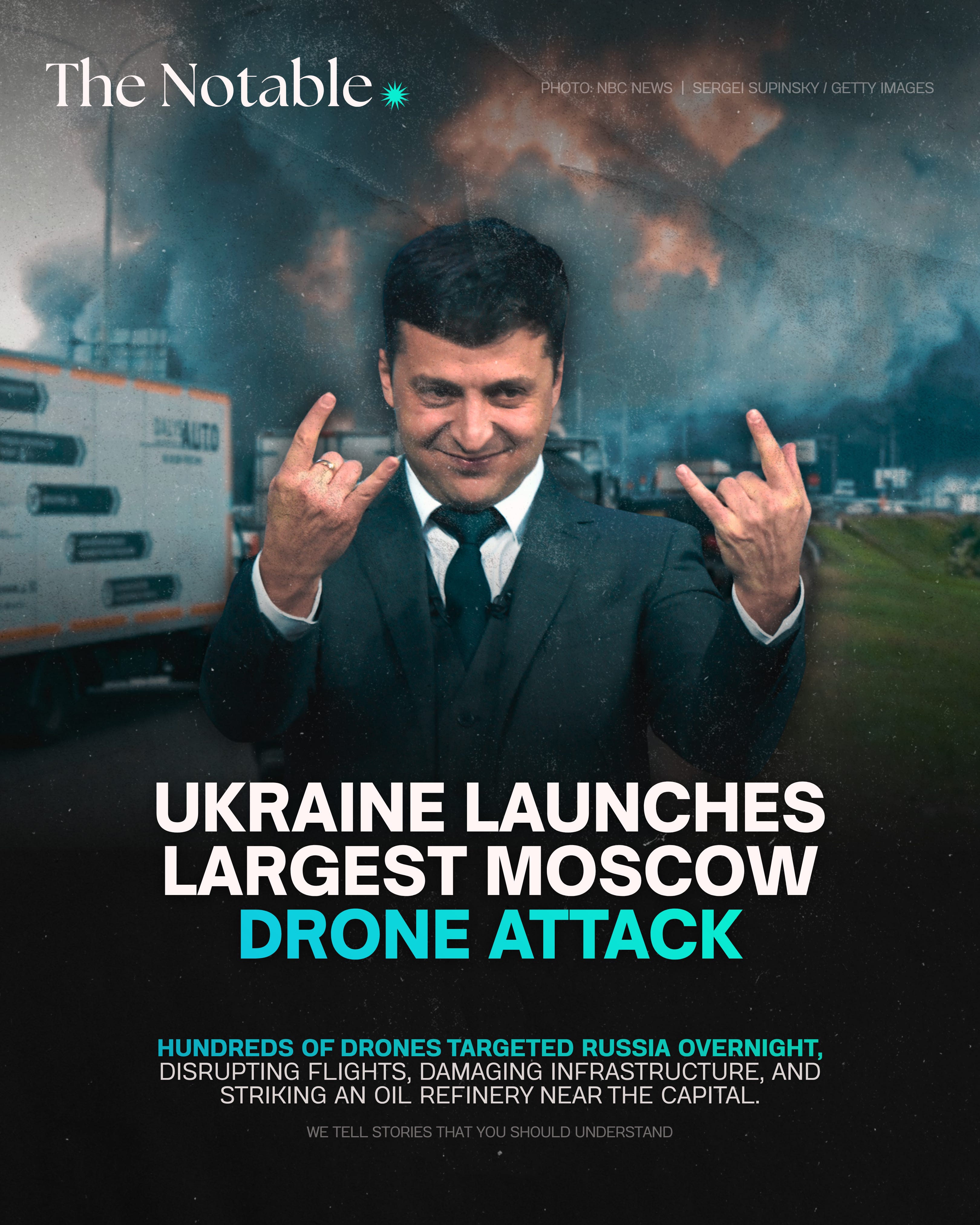
Russia’s capital faced one of the most significant attacks of the war this week as Ukraine launched a massive overnight drone operation targeting Moscow and strategic infrastructure across Russia.
Russian officials said air defenses intercepted 194 drones headed toward Moscow and 555 drones nationwide, making it one of the largest Ukrainian drone attacks since the full-scale invasion began in 2022. Despite those interceptions, several drones appear to have reached their targets, causing fires, damaging infrastructure, and temporarily disrupting air traffic at some of Moscow’s busiest airports.
The attack marks another milestone in Ukraine’s evolving strategy: bringing the costs of the war directly into Russia’s heartland.
A Night of Explosions
Residents across Moscow reported hearing explosions as Russian air-defense systems engaged incoming drones throughout the night.
Authorities temporarily suspended flights at multiple airports serving the capital, while emergency services responded to fires and damage in several locations. Regional officials reported injuries, though the full extent of the damage remains unclear.
One target stood out above all others.
Ukraine’s drones struck the Kapotnya oil refinery, one of the most important fuel facilities serving Moscow. Videos circulating online appeared to show large explosions followed by thick plumes of smoke rising from the refinery complex.
The facility is considered strategically significant because it supplies a substantial share of the capital’s gasoline and diesel needs. Located just kilometers from central Moscow, the refinery represents both an economic asset and a symbol of Russia’s ability to sustain military and civilian operations during wartime.
Ukraine’s Expanding Reach
When Russia launched its full-scale invasion more than four years ago, Moscow appeared largely insulated from direct attack.
That reality has gradually changed.
Over the past two years, Ukraine has developed an increasingly sophisticated long-range drone capability, allowing it to strike hundreds and sometimes thousands of kilometers beyond the front lines.
Initially, these operations focused primarily on military airfields and ammunition depots. More recently, Kyiv has increasingly targeted oil refineries, fuel storage facilities, logistics hubs, and transportation infrastructure.
The goal is not simply symbolic.
Ukraine views Russia’s energy sector as a critical source of state revenue and military support. By repeatedly targeting refineries and fuel facilities, Kyiv hopes to raise the economic costs of the war while forcing Moscow to divert resources toward protecting assets far from the battlefield.
The attack on Kapotnya fits squarely within that strategy.
Pressure on Russia’s Air Defenses
The scale of the operation is almost as important as the targets themselves.
Russian authorities claim hundreds of drones were intercepted before reaching Moscow and other regions. Even if those figures are accurate, the sheer volume of the attack highlights a growing challenge for Russia’s air-defense network.
Modern air-defense systems are highly effective against limited attacks, but large drone swarms can create a different problem. They force defenders to track dozens or even hundreds of simultaneous threats while expending expensive interceptors against relatively cheap unmanned aircraft.
For Ukraine, saturation has become a strategy.
The objective is not necessarily for every drone to hit its target. Instead, overwhelming defenses increases the likelihood that at least some drones will penetrate protected areas and reach critical infrastructure.
The fact that strategic facilities near Moscow continue to be targeted suggests that Ukraine believes this approach is producing results.
A New Phase of the War
The attack also reflects a broader shift in the conflict.
For much of the war, Russia maintained the ability to strike deep into Ukraine while keeping much of its own territory relatively secure from large-scale retaliation. Long-range drones have begun to change that equation.
Although these attacks do not alter front-line positions directly, they complicate Russian military planning and create new security concerns for authorities responsible for defending major cities and economic infrastructure.
Each successful strike forces Moscow to allocate additional resources toward domestic defense, potentially reducing the resources available elsewhere.
That dynamic has become increasingly important as the war enters another prolonged phase with no clear political settlement in sight.
What Comes Next
Neither side appears prepared to reduce the intensity of long-range strikes.
Ukraine continues to expand its domestic drone production and has demonstrated a growing ability to conduct coordinated attacks deep inside Russian territory. Russia, meanwhile, continues to strengthen air defenses around major cities and strategic facilities while maintaining its own long-range attacks against Ukrainian infrastructure.
The result is a conflict that is becoming more geographically expansive and technologically driven.
The latest attack on Moscow is a reminder that the battlefield is no longer confined to the front lines. Increasingly, critical infrastructure, logistics networks, and economic assets far from the fighting are becoming central targets in a war that continues to evolve.
And as Ukraine demonstrates a growing ability to reach the Russian capital itself, Moscow’s sense of distance from the conflict may become harder to maintain.