


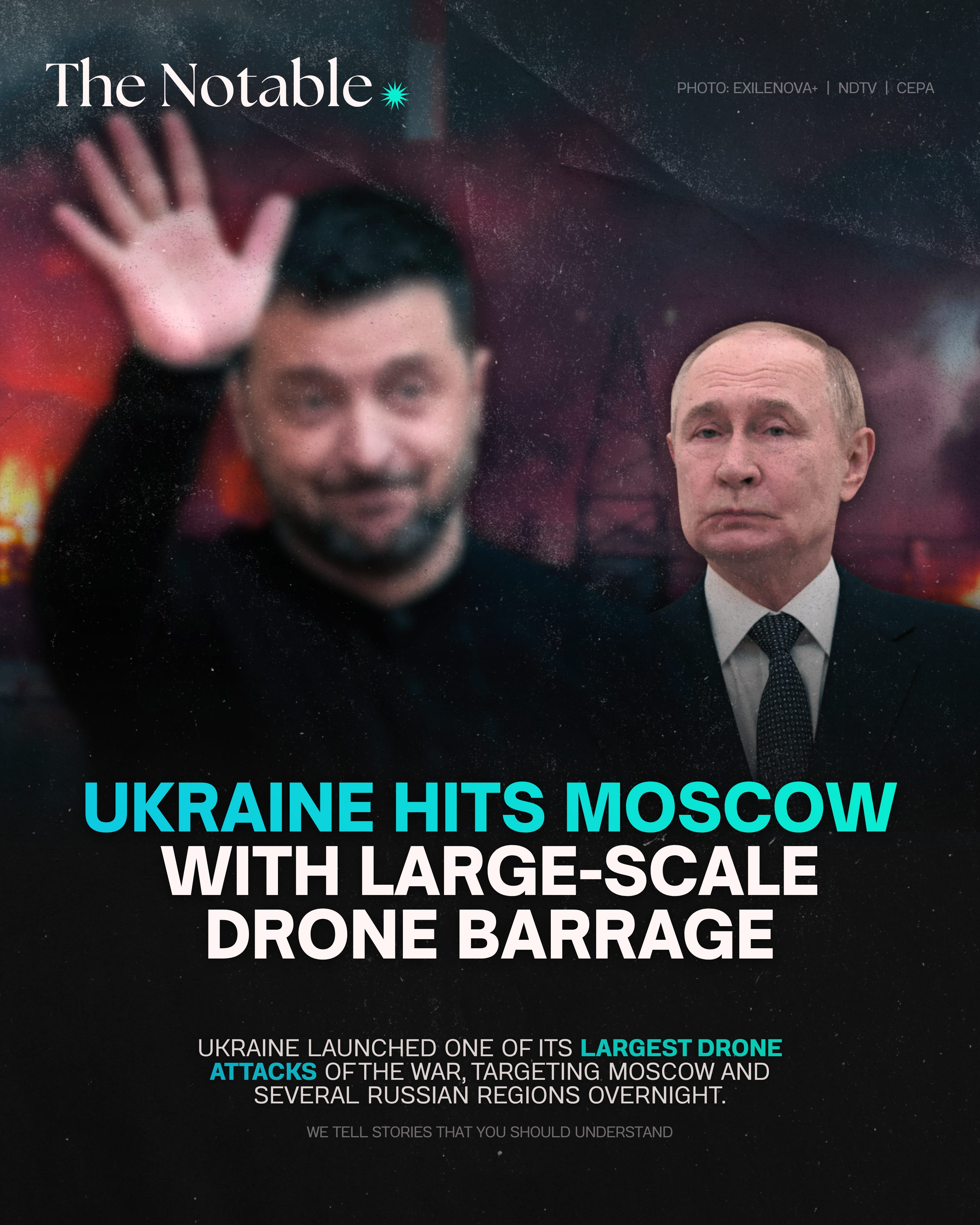
Ukraine launched one of its largest drone attacks on Russia since the war began, targeting Moscow and multiple Russian regions overnight in a major escalation of the conflict.
Russian officials said more than 550 Ukrainian drones were intercepted across the country, including around Moscow, Belgorod, Kursk, and Crimea. At least four people were reported killed, while airports around the Russian capital temporarily halted operations amid security concerns.
The Kremlin described it as the biggest attack on Moscow in more than a year.
The strike came after several days of intensified Russian bombardments against Ukrainian cities, including some of the largest drone and missile attacks Kyiv has faced since the start of the war. Ukrainian officials say Russia has increasingly relied on large-scale “swarm” attacks designed to overwhelm air defenses and exhaust interception systems.
President Volodymyr Zelensky publicly defended the latest operation, framing it as a direct response to Russia’s continued attacks on Ukrainian territory.
“Our responses to Russia’s prolongation of the war and its attacks on our cities and communities are entirely justified,” Zelensky wrote on X.
He added that Ukrainian long-range strikes had reached the Moscow region despite what he described as Russia’s highly concentrated air defense network around the capital.
The statement is notable because Ukraine has historically been cautious about openly acknowledging operations deep inside Russian territory. That posture appears to be changing.
Moscow Is No Longer Untouchable
For much of the war, the Kremlin attempted to keep the conflict psychologically distant from everyday Russian life, even as Ukrainian cities endured repeated missile and drone strikes.
But Ukraine’s growing long-range drone capabilities are beginning to challenge that separation.
While most of the drones were intercepted, the scale of the attack itself carries strategic significance. Penetrating airspace around Moscow is difficult. The region contains some of Russia’s densest air-defense infrastructure, designed to protect political leadership, military command centers, and critical state facilities.
Ukraine appears increasingly focused on exploiting the symbolic and economic vulnerabilities of that system.
Russian authorities said infrastructure sites were targeted during the attacks, while independent reports pointed to disruptions involving industrial and logistics facilities. Ukrainian officials have increasingly framed these operations as efforts to pressure Russia’s military-industrial base and raise the domestic cost of continuing the war.
A New Phase of Drone Warfare
The latest exchange also highlights how the war is entering a new technological phase dominated by mass drone warfare.
Hours after Ukraine’s strikes on Moscow, Ukraine’s air force said Russia launched another huge aerial assault involving 524 drones and 22 missiles targeting Ukrainian territory overnight. Ukrainian officials said hundreds were intercepted or electronically neutralized, though infrastructure damage and disruptions were still reported.
The scale is historically significant.
Earlier in the war, drone attacks involving dozens of drones were considered major escalations. Now both Russia and Ukraine are deploying hundreds in a single night.
The strategy is increasingly built around saturation:
overwhelm air defenses
force expensive interception responses
disrupt infrastructure
exhaust military logistics
create psychological pressure far from the battlefield
What began as a conventional invasion has evolved into an industrial-scale contest of production capacity, endurance, and technological adaptation.
The Escalation Cycle Is Accelerating
The sequence of events over the past several days reflects a rapidly tightening escalation cycle:
Russia launches massive attacks on Ukrainian cities
Ukraine retaliates deep inside Russian territory
Russia responds with even larger aerial bombardments
Neither side currently shows signs of stepping back.
Instead, the war is increasingly becoming defined by reciprocal long-range attacks aimed not only at military targets, but also at infrastructure, economic systems, and national morale.
And as drone production scales on both sides, the distance between the front line and civilian life continues to shrink.