


For much of the war, Russia’s vast geography functioned as strategic insulation.
Critical energy facilities deep inside the country operated far beyond the range of regular Ukrainian attacks, helping sustain both Russia’s economy and its military campaign in Ukraine. That assumption is now being tested with increasing frequency.
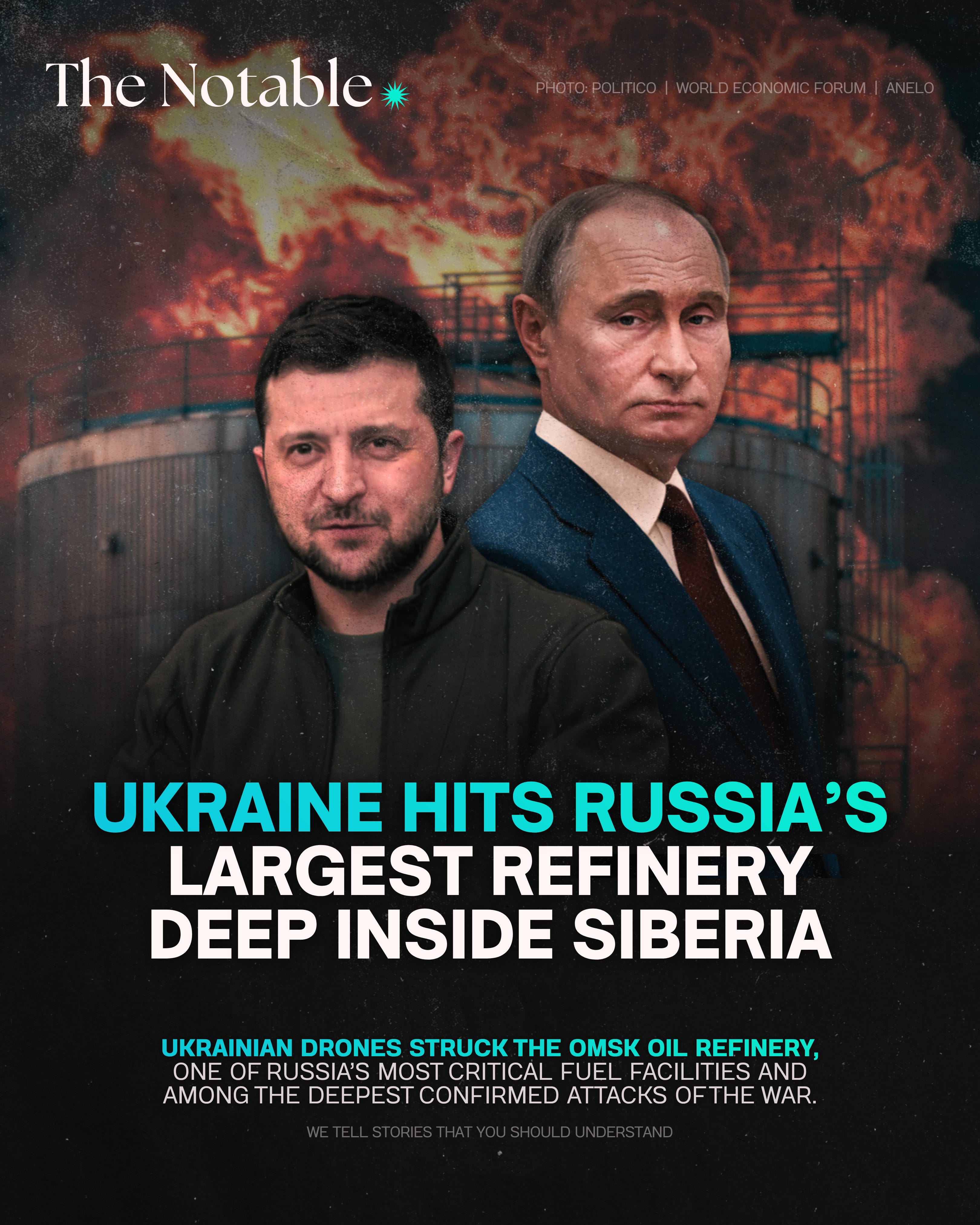
Ukraine has carried out one of its deepest and most strategically significant drone strikes of the war, targeting the Omsk oil refinery in western Siberia, Russia’s largest refinery and one of the country’s most important fuel hubs.
The refinery, operated by Gazprom Neft, processes roughly 460,000 barrels of oil per day and supplies fuel across large parts of Siberia, including aviation fuel and diesel linked to military logistics. Ukrainian officials said drones damaged a major refining unit at the facility, while Russian authorities confirmed the attack and a fire at the site but reported no casualties.
What makes the strike particularly notable is not only the refinery itself, but its location.
Omsk lies roughly 2,700 kilometers from Ukrainian-controlled territory near the Kazakhstan border. The attack therefore ranks among the deepest confirmed Ukrainian strikes inside Russia since the full-scale invasion began in 2022.
A New Geography of the War
The strike reflects a broader transformation underway in the conflict.
Unable to consistently match Russia in manpower or conventional firepower, Ukraine has increasingly turned toward long-range asymmetric warfare. Over the past year, Kyiv has expanded its campaign against Russian energy infrastructure, targeting refineries, fuel depots, pumping stations, export terminals, and logistics routes tied to the war effort.
The objective appears increasingly clear: raise the economic and operational cost of the war far beyond the front lines.
In recent months, Ukrainian drones have struck facilities in Moscow region, Bashkortostan, Krasnodar, Yaroslavl, and other areas previously considered relatively secure from direct attack. The campaign has gradually exposed vulnerabilities inside Russia’s energy system, one of the foundations of both state revenue and military supply.
The Omsk strike pushes that campaign into a new category.
Unlike facilities closer to western Russia, Omsk sits deep inside Siberia, far from the immediate theater of war. Hitting it demonstrates that Ukraine’s expanding drone capabilities are no longer confined to Russia’s European regions.
Why Omsk Matters
The Omsk refinery is not simply another industrial site.
It is Russia’s largest refinery by processing volume and one of the country’s most strategically important fuel centers. The facility produces gasoline, diesel, and aviation fuel distributed across Siberia and other regions. Analysts have long viewed the refinery as an important component of Russia’s domestic fuel stability.
Reports from Ukrainian sources indicate the strike targeted the refinery’s ELOU-AVT-11 processing unit, a critical part of the initial crude oil refining process. Damage to such systems can disrupt production chains across the facility, although the full extent of operational impact remains unclear.
Moscow has not publicly confirmed whether refinery output was affected.
Still, even temporary disruptions matter in the current context.
Russia has already faced mounting pressure on parts of its refining system after repeated Ukrainian strikes over the past year. Some regions have reported fuel shortages, while Russian authorities have periodically considered emergency measures to stabilize domestic fuel supplies. Long repair times for specialized refinery equipment also complicate recovery efforts after major attacks.
The Expanding Energy War
The Omsk strike did not occur in isolation.
At roughly the same time, Ukrainian operations reportedly targeted Russian fuel tanker logistics in the Sea of Azov as well as energy facilities in Russian-occupied Crimea. Localized blackouts were reported in parts of Crimea following the attacks.
Together, these operations point toward a broader Ukrainian strategy aimed at systematically pressuring Russia’s energy network from multiple directions simultaneously.
This carries both military and political implications.
Militarily, fuel infrastructure remains essential for sustaining troop movements, aviation operations, armored units, and logistics chains. Politically, repeated attacks deep inside Russian territory challenge the Kremlin’s narrative that the war remains geographically contained.
The attacks also create an expensive defensive dilemma for Moscow.
Russia may increasingly need to divert air defense systems away from the front lines and major cities toward protecting infrastructure scattered across an enormous territory. The wider Ukraine expands the map of potential targets, the more difficult and costly comprehensive defense becomes.
A War Increasingly Defined by Reach
The deeper pattern emerging from these strikes is not simply about damage.
It is about reach.
For much of the conflict, Russia maintained the advantage of strategic depth. Ukraine could strike border regions and occasionally targets closer to Moscow, but Siberia remained psychologically and operationally distant from the war.
That distance is shrinking.
Ukraine’s growing domestic drone industry, combined with longer-range strike capabilities, is gradually altering assumptions about what parts of Russia remain insulated from the conflict. Even where physical damage is limited, the symbolic impact can be significant.
The Omsk strike therefore represents more than another refinery attack.
It signals that the geography of vulnerability inside Russia is expanding.