


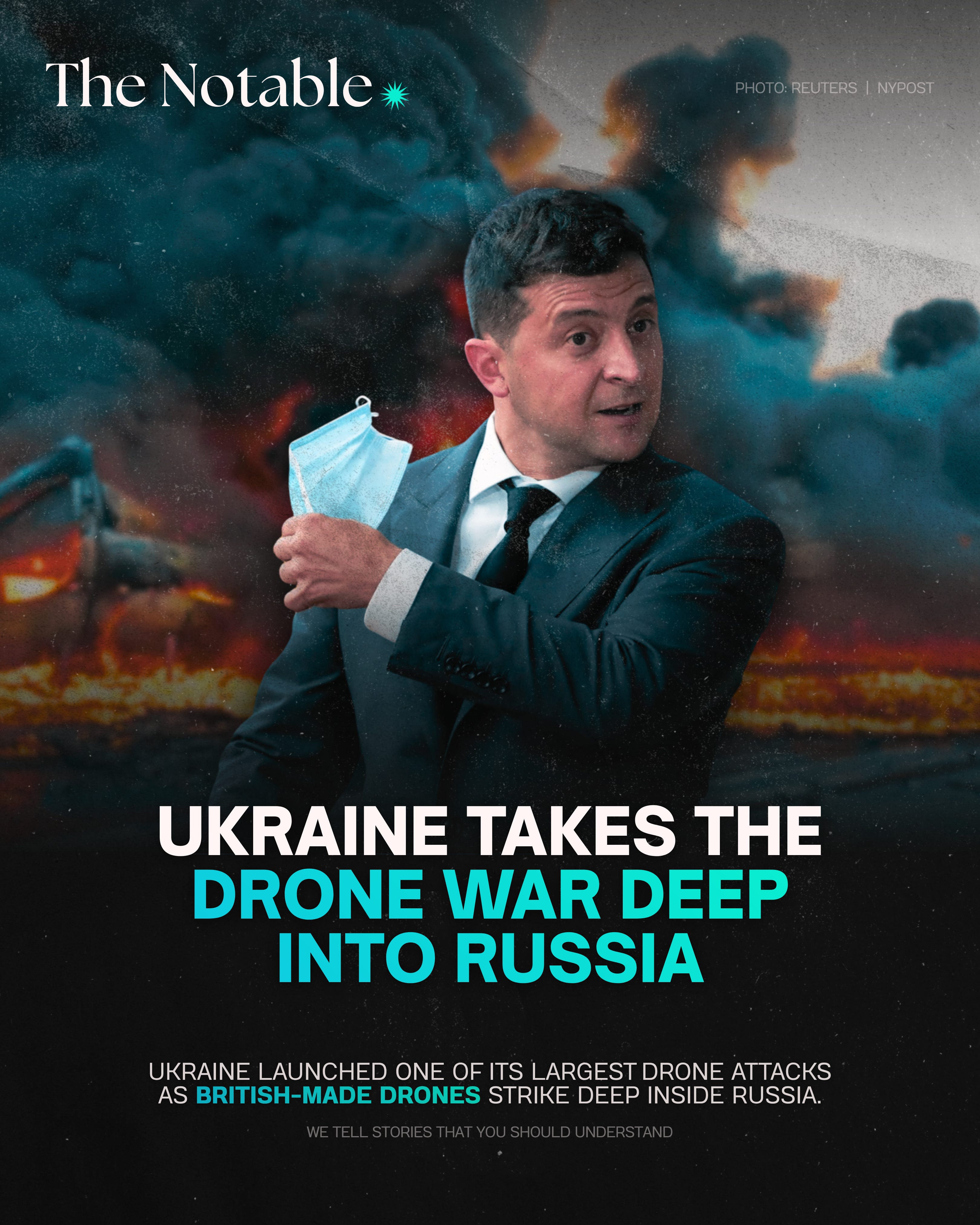
Ukraine has launched one of its largest drone offensives of the war, sending hundreds of drones toward Moscow and targets across Russia.
The attack came as new reporting revealed that British-made drones have been used by Ukraine in deep strikes against targets far inside Russian territory, adding another layer to the rapidly evolving long-range warfare between the two countries.
The development is significant not simply because of the number of drones involved, but because it points to a broader shift in how Ukraine is attempting to strike Russia: through increasingly scalable, lower-cost systems capable of reaching targets hundreds of kilometers behind the front line.
One of Ukraine’s Largest Drone Attacks
On the night of August 15–16, Russia reported a massive Ukrainian drone offensive across the country.
Russian authorities said their air defenses intercepted 822 Ukrainian drones, including roughly 200 over the Moscow region. The attacks were reported across multiple Russian regions, while Moscow and surrounding areas experienced significant disruption.
A warehouse belonging to Wildberries near Podolsk, south of Moscow, was damaged. Russian officials said an 83-year-old man was killed in the Moscow-region attacks.
The scale of the reported drone wave made it one of the largest aerial attacks Ukraine has conducted against Russia during the war.
The assault was not limited to Moscow. Ukrainian drones were reported over a broad geographic area, reflecting Kyiv’s increasingly ambitious effort to place pressure on Russian infrastructure far beyond the immediate battlefield.
British-Made Drones Enter the Picture
The large-scale attack came at almost exactly the same time that The Times reported that Ukraine has been using British-made drones for deep strikes inside mainland Russia for approximately six months.
According to Ukrainian military sources cited by the newspaper, British systems have been incorporated into Ukraine’s long-range strike campaign against Russian targets.
One of the systems identified is Nyan, a jet-powered one-way effector developed by Callen-Lenz, a British company that is part of BAE Systems.
BAE Systems describes Nyan as a system designed for deep-strike missions in highly contested environments. The platform is intended to penetrate defended areas and deliver effects against targets at significant range.
The Times reported that another British-made drone has also been used, although its manufacturer was not publicly identified for security reasons.
This distinction is important. The available reporting does not establish that British-made drones were responsible for every drone involved in the massive August 15–16 attack, nor does it mean this was the first time Ukraine had used British drones against Russia.
Rather, the significance is that British-made systems have reportedly become part of Ukraine’s broader deep-strike capability.
A Different Kind of Long-Range Warfare
Ukraine has spent much of the war developing long-range strike capabilities designed to compensate for its disadvantages in conventional firepower.
The objective is straightforward: if Russian forces can be supplied, equipped and sustained far from the front, Ukraine can attempt to disrupt those systems before they reach the battlefield.
That has increasingly meant targeting fuel facilities, logistics networks, industrial sites and other infrastructure inside Russia.
The emerging drone strategy offers one major advantage.
Scale.
A relatively expensive cruise missile is difficult to produce and deploy in very large numbers. Long-range attack drones can potentially be produced and launched at much greater scale, allowing Ukraine to overwhelm or saturate Russian air defenses.
That does not make drones a replacement for missiles. Rather, the two capabilities can complement each other.
Large numbers of drones can force Russia to expend air-defense resources, expose gaps in its defensive network and create opportunities for more sophisticated weapons to reach their targets.
The Nyan Factor
Nyan is particularly notable because it represents a newer generation of long-range one-way attack systems.
Unlike traditional aircraft, it is designed as a disposable strike platform. Its purpose is not to return to base after delivering its payload.
That makes the economics of the system fundamentally different from those of conventional combat aircraft or expensive precision missiles.
BAE Systems says the system was developed for operations where aircraft must penetrate heavily contested airspace. Its jet propulsion also distinguishes it from many of the slower, piston-powered drones that have become common in the war.
Independent defense reporting has previously indicated that Nyan had entered operational use in Ukraine, although details surrounding its deployment and exact combat role have remained limited.
The system’s reported use illustrates how the conflict has become an important testing ground for new forms of warfare.
Why Moscow Matters
Striking targets near Moscow has a significance beyond the physical damage caused by individual drones.
Russia has invested heavily in presenting the capital as a heavily protected center of political, military and economic power.
Repeated attacks demonstrate that geographical distance does not guarantee immunity.
Ukraine’s ability to launch drones hundreds of kilometers into Russian territory forces Moscow to divide its air-defense resources across a much larger area.
That creates a strategic dilemma.
Protecting the front requires air defenses. Protecting major cities requires air defenses. Protecting energy infrastructure, military factories, logistics hubs and government facilities requires them as well.
The deeper Ukraine can penetrate, the more difficult it becomes for Russia to protect everything simultaneously.
The Escalation Question
There is also a geopolitical dimension.
Russia has repeatedly warned that Western support for Ukrainian attacks on Russian territory could have consequences for the countries providing that assistance.
The reported use of British-made systems therefore adds another layer to an already sensitive question surrounding Western involvement in Ukraine’s long-range strike campaign.
Britain has been one of Ukraine’s most important European military supporters. British weapons and training have played a significant role throughout the conflict.
But there is a distinction between supplying Ukraine with defensive weapons and supporting a capability designed to strike deep inside Russia.
As Ukraine’s indigenous and Western-supported long-range capabilities expand, that distinction becomes increasingly difficult to separate.
Russia Is Also Escalating Its Air Campaign
The latest Ukrainian offensive should not be viewed in isolation.
Russia has continued conducting large-scale missile and drone attacks against Ukrainian cities and infrastructure.
The two sides are therefore increasingly fighting a war in which the front line is only one part of the battlefield.
Russia has greater depth in manpower, industrial capacity and missile production. Ukraine has sought to offset some of those advantages through innovation, precision strikes and the development of increasingly sophisticated unmanned systems.
The result is an expanding contest over infrastructure far from the trenches.
A New Phase in the Drone War
The most important development may therefore be less about any individual drone than about the changing economics and geography of the conflict.
Ukraine is demonstrating an ability to conduct increasingly large-scale attacks against targets deep inside Russia, while incorporating foreign-designed systems into its broader strike architecture.
The reported use of British-made drones suggests that Western technology is becoming integrated into this long-range campaign in ways that extend beyond traditional battlefield support.
At the same time, the scale of the latest attack shows that Ukraine’s drone strategy is moving toward mass deployment.
That creates a difficult problem for Russia.
Air defenses can intercept individual drones. But defending an enormous country against hundreds of incoming systems launched in coordinated waves is a fundamentally different challenge.
What Comes Next
The key question is whether Ukraine can sustain this level of long-range pressure.
The effectiveness of the campaign will depend on several factors: Ukraine’s ability to manufacture and acquire drones, the sophistication of Russian air defenses, the availability of targeting intelligence, and the willingness of Western partners to continue supporting Ukraine’s military-industrial capabilities.
For Moscow, the challenge is equally significant.
Russia must protect its military and economic infrastructure while continuing to sustain operations in Ukraine. Every additional layer of territory that must be defended increases the demands placed on its air-defense network.
For Britain and other Western supporters, the issue is becoming more politically sensitive as Western-designed systems are reportedly used in attacks deep inside Russia.
The war is therefore entering a phase in which distance itself is becoming less of a protection.
Ukraine cannot match Russia’s conventional military resources across every dimension. But through drones, domestic weapons production and Western technology, Kyiv is developing another way to impose costs on Russia: bringing the war deeper into the country that launched it.
The latest attack is a reminder that the geography of the Russia-Ukraine war is changing.
And the drone may be one of the weapons driving that change.