


For years, Crimea has been one of Russia’s most important strategic assets.
The peninsula serves as a military hub in the Black Sea, hosts Russia’s Black Sea Fleet, and stands as a symbol of Moscow’s control over territory seized from Ukraine in 2014. Since the full-scale invasion began in 2022, Crimea has also functioned as a critical logistical base supporting Russian operations in southern Ukraine.
Now, a growing fuel crisis suggests that Ukraine may be targeting one of Crimea’s greatest vulnerabilities: its dependence on a limited number of supply routes.
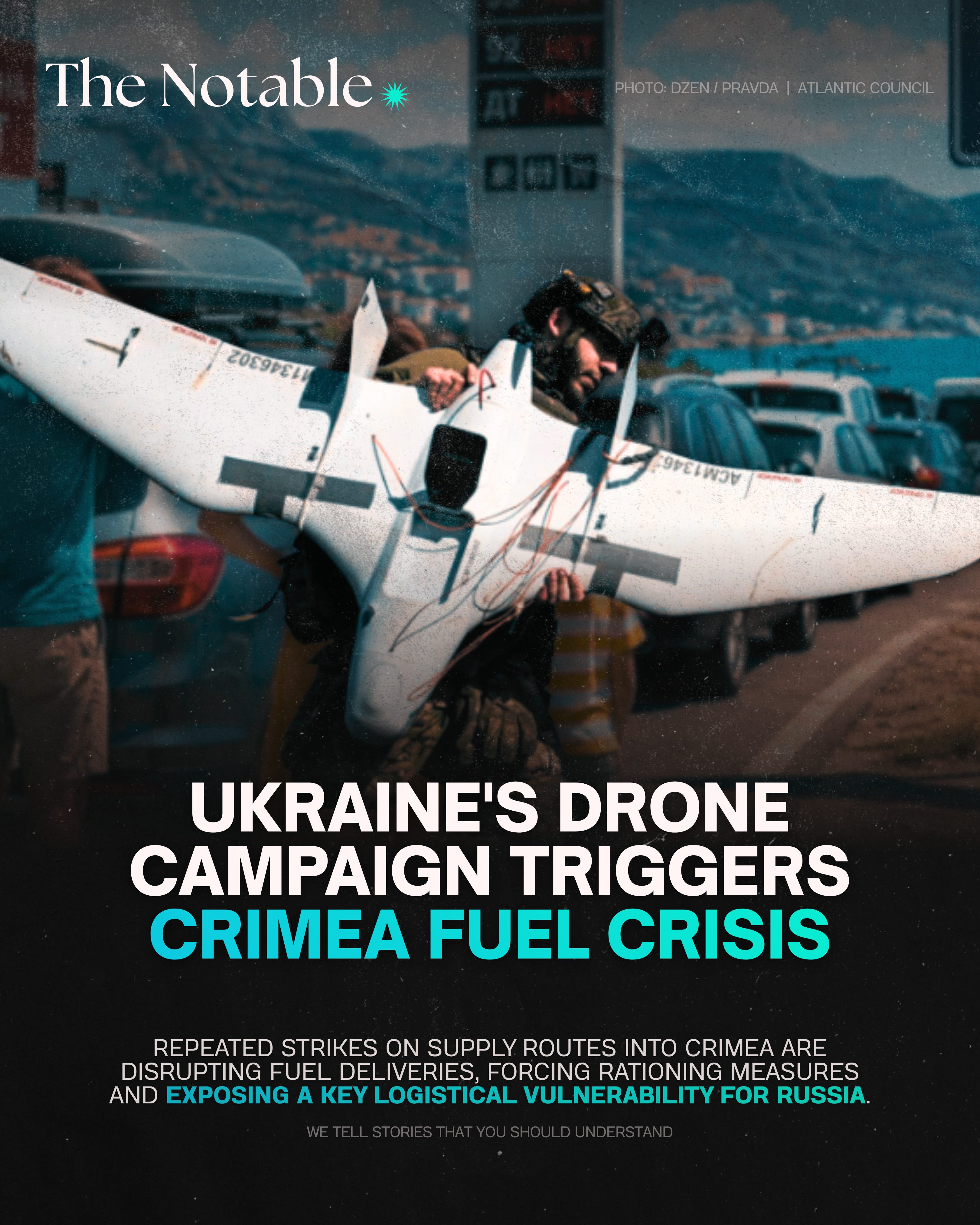
Recent Ukrainian drone strikes have disrupted transport corridors linking Crimea to mainland Russia and occupied southern Ukraine, creating fuel shortages across parts of the peninsula. Russian-installed authorities in Sevastopol have suspended fuel voucher distribution after expected tanker deliveries failed to arrive, while reports from the region describe long lines at gas stations and increasing concerns about supply disruptions.
At first glance, a fuel shortage may appear to be a local economic problem. In reality, it highlights a much larger shift in how Ukraine is prosecuting the war.
Beyond Refineries
For much of the conflict, Ukraine’s long-range drone campaign focused on Russia’s energy infrastructure.
Refineries, fuel depots, export terminals, and oil storage facilities became regular targets as Kyiv sought to reduce Russia’s energy revenues and complicate military logistics. These attacks forced Moscow to spend billions on air defenses, repairs, and emergency measures while creating periodic disruptions to fuel production.
But recent developments suggest Ukraine is increasingly pursuing a more sophisticated objective.
Rather than simply reducing fuel production, Ukrainian forces appear to be targeting the networks that move fuel where it is needed. Roads, rail connections, bridges, storage facilities, and logistical corridors are becoming just as important as refineries themselves.
The result is that even if Russia can still produce fuel, getting it to Crimea has become significantly more difficult.
That distinction matters.
Wars are often won or lost not only through battlefield victories but through the ability to sustain forces, transport supplies, and maintain functioning logistics. History repeatedly shows that armies depend as much on fuel, transportation, and supply chains as they do on weapons.
Ukraine appears increasingly focused on that reality.
Crimea’s Geographic Problem
Crimea’s strategic value has always come with a geographic disadvantage.
The peninsula is connected to surrounding territory through a limited number of transport links. This makes logistics more vulnerable than in many other regions of Russia.
When fuel deliveries are interrupted, alternatives are limited. Supplies must be rerouted through already strained networks, increasing delays and costs. A disruption that might be manageable elsewhere can quickly become a significant problem in Crimea because there are fewer backup options.
That vulnerability has become more apparent throughout the war.
The Kerch Bridge has repeatedly come under attack. Military facilities across the peninsula have been targeted. Air defense systems have been forced to respond to increasingly frequent drone incursions. Now, fuel distribution itself appears to be coming under pressure.
The shortages reported in Sevastopol are therefore not merely an isolated supply issue. They are a visible symptom of a larger logistical challenge.
Pressure Beyond Crimea
The situation is also unfolding against a broader backdrop of attacks on Russia’s energy sector.
Over the past year, Ukrainian drones have increasingly targeted refineries and energy facilities deep inside Russian territory. While Moscow has managed to keep much of its energy system functioning, the cumulative effect of repeated attacks has added pressure to fuel markets and distribution networks.
Russian officials have acknowledged that drone attacks are contributing to supply difficulties in affected regions, although authorities have also blamed panic buying and temporary logistical disruptions.
Regardless of the explanation, the combination of refinery attacks and transportation disruptions creates a more complex challenge than either problem alone.
Producing fuel is one thing.
Moving it efficiently across a vast country during wartime is another.
Why This Matters
The significance of the fuel crisis extends beyond shortages at gas stations.
Crimea occupies a unique place in Russia’s political and military strategy. It is both a strategic asset and a symbol. Maintaining stability on the peninsula has become a priority for the Kremlin because disruptions there carry consequences that extend beyond military operations.
Fuel shortages affect civilians, businesses, tourism, transportation, and emergency services. They also create visible reminders that the war is reaching areas Russia has long presented as secure.
For Ukraine, that may be part of the objective.
Every successful strike forces Russia to divert resources toward defense, repairs, and logistical adjustments. Over time, these costs accumulate.
The goal is not necessarily to create a single dramatic collapse. Instead, it is to steadily increase the burden of sustaining Russia’s war effort and its control over occupied territory.
What Comes Next
The immediate question is whether Russian authorities can stabilize fuel supplies before demand rises further during the summer season.
Longer term, the more important issue is whether Ukraine can sustain its campaign against Russia’s logistical networks.
The emerging story is no longer simply about drones hitting oil facilities. It is about a broader effort to challenge the systems that keep occupied territories functioning.
Crimea’s fuel shortages offer a glimpse of what that strategy looks like in practice.
And if the disruptions continue, they may become an increasingly important measure of how effectively Ukraine can turn logistical pressure into strategic leverage.