


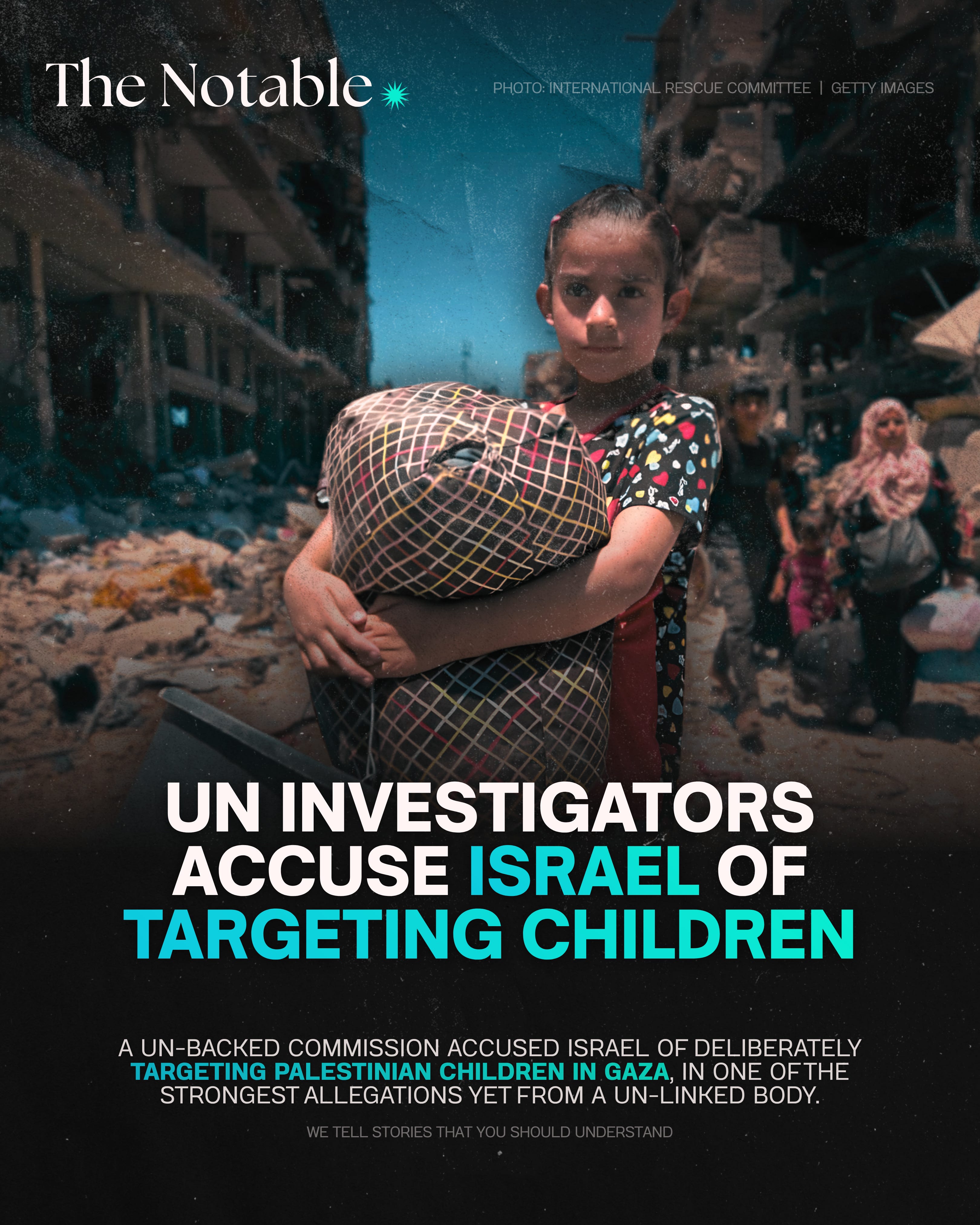
A new report from a UN-backed investigative commission has sharply escalated international accusations against Israel over the war in Gaza, alleging that Israeli forces deliberately targeted Palestinian children and committed acts that may amount to genocide under international law.
The findings, released by the UN Independent International Commission of Inquiry on the Occupied Palestinian Territory, including East Jerusalem, and Israel, represent one of the strongest allegations yet from a UN-linked body since the war began after Hamas’ October 7, 2023 attack on Israel.
The report places children at the center of the case.
And that matters politically, legally, and globally.
The Report
The commission’s report, titled “The essence of childhood has been destroyed”, examines the impact of the war on Palestinian children in Gaza and the West Bank since October 2023.
According to investigators, Israeli military operations caused widespread death, trauma, displacement, and long-term harm to children through attacks on residential areas, shelters, schools, hospitals, and neonatal facilities.
The commission alleged that Israeli forces:
deliberately targeted children
used heavy munitions in densely populated civilian areas
destroyed infrastructure necessary for children’s survival
contributed to conditions that severely damaged child health and development
The report stated that some actions may constitute genocidal acts under the Genocide Convention.
Official UN release:
https://www.un.org/unispal/document/uncoi-press-release-23jun26/
Full report document:
https://www.un.org/unispal/wp-content/uploads/2026/06/a-hrc-62-crp-2.pdf
Inside the Findings
The report goes far beyond broad casualty numbers.
Investigators attempted to build a legal and structural case around what they described as the systematic destruction of childhood conditions in Gaza.
One major focus was attacks affecting infants and newborns.
The commission cited damage to hospitals, maternity wards, neonatal intensive care units, and medical supply systems that it says severely reduced survival conditions for premature babies and critically ill children. The report argues that the collapse of Gaza’s healthcare infrastructure had particularly devastating consequences for infants dependent on electricity, incubators, medicine, and specialized treatment.
Investigators also highlighted repeated strikes on schools and shelters where displaced families had gathered. According to the report, children were killed or injured inside locations that had become central civilian refuge sites during Israeli military operations.
The commission further examined:
mass displacement of children
malnutrition and starvation risks
psychological trauma
collapse of educational systems
destruction of sanitation and healthcare infrastructure
The report argued that these conditions collectively created what investigators described as an “unlivable environment” for children in Gaza.
Another significant element of the report is the issue of intent.
Under international law, genocide requires not only mass harm, but evidence of intent to destroy a protected group in whole or in part.
The commission argued that patterns of attacks, repeated strikes on civilian infrastructure, and statements from some Israeli officials contributed to evidence suggesting genocidal intent.
That remains one of the most legally and politically contested aspects of the entire debate.
Why This Is Significant
The most important development is not simply the accusation itself.
It is the institutional language now being used.
Earlier in the war, most international debate focused on:
civilian casualties
proportionality
humanitarian access
rules of engagement
Now, increasingly, parts of the international system are framing the conflict through the language of genocide.
That is a major escalation.
While genocide allegations against Israel have circulated for months among activists, legal scholars, and some governments, the terminology is now appearing more frequently inside UN-linked investigations, international legal filings, and human rights reports.
The focus on children intensifies the political impact even further.
Children occupy a uniquely powerful space in international law and global public opinion. Allegations involving deliberate harm to minors often reshape how wars are morally understood by international audiences.
What the UN Actually Said
One important distinction has become blurred across social media.
The United Nations as a whole has not formally declared Gaza a “genocide zone,” nor has any international court issued a final ruling declaring Israel guilty of genocide.
The findings come specifically from:
the UN Independent International Commission of Inquiry on the Occupied Palestinian Territory
The commission is mandated by the UN Human Rights Council, but it is not equivalent to:
the UN Security Council
the UN General Assembly
the International Court of Justice
That distinction matters legally and diplomatically.
Still, the report carries significant international weight because UN-linked investigative findings can influence:
diplomatic pressure
public opinion
future legal proceedings
international institutional narratives
Israel Rejects the Accusations
Israel strongly rejected the report and accused the commission of political bias.
Israeli officials said the allegations are false, unverified, and ignore the role of Hamas in embedding military operations within civilian areas.
Israel maintains that it does not intentionally target civilians and argues that civilian deaths are an unintended consequence of urban warfare against Hamas inside densely populated territory.
Israeli officials have repeatedly criticized UN investigative bodies over the course of the war, accusing some institutions of disproportionate focus on Israel while failing to adequately address Hamas’ actions during and after the October 7 attacks.
Reuters coverage:
https://www.reuters.com/world/middle-east/israel-targeted-gaza-children-resulting-genocide-un-inquiry-says-2026-06-23/
Associated Press coverage:
https://apnews.com/article/9a22ebcfcf77b7c828342d6bea776e2c
The Legal Battle Is Far From Over
The genocide question is still being contested inside international courts.
South Africa’s genocide case against Israel at the International Court of Justice remains ongoing, and the court has not issued a final judgment.
The International Criminal Court is separately pursuing investigations connected to the Gaza war.
This means the current UN report is not a final legal determination.
But it could shape the broader environment surrounding those cases.
International legal processes are influenced not only by courtroom arguments, but also by evolving institutional consensus, diplomatic pressure, and public legitimacy.
That is why reports like this matter.
A Larger Shift Is Underway
The Gaza war is increasingly becoming more than a regional conflict.
It is evolving into a global legitimacy battle over:
international law
civilian protection
the limits of military force
the credibility of global institutions themselves
The deeper shift may be this:
The debate is no longer only about how much destruction has occurred in Gaza.
It is increasingly about whether international institutions believe intent can be legally established.
And once the language of genocide enters mainstream institutional discourse, the political consequences can extend far beyond the battlefield itself.
Seems like more UN propaganda. They could have helped but will only play politics.
The did not get any kids out. We must demand those kids are allowed out as refugees.
I wrote about this on my Substack “Why Not Evacuate Children from Gaza”. Check it out.