


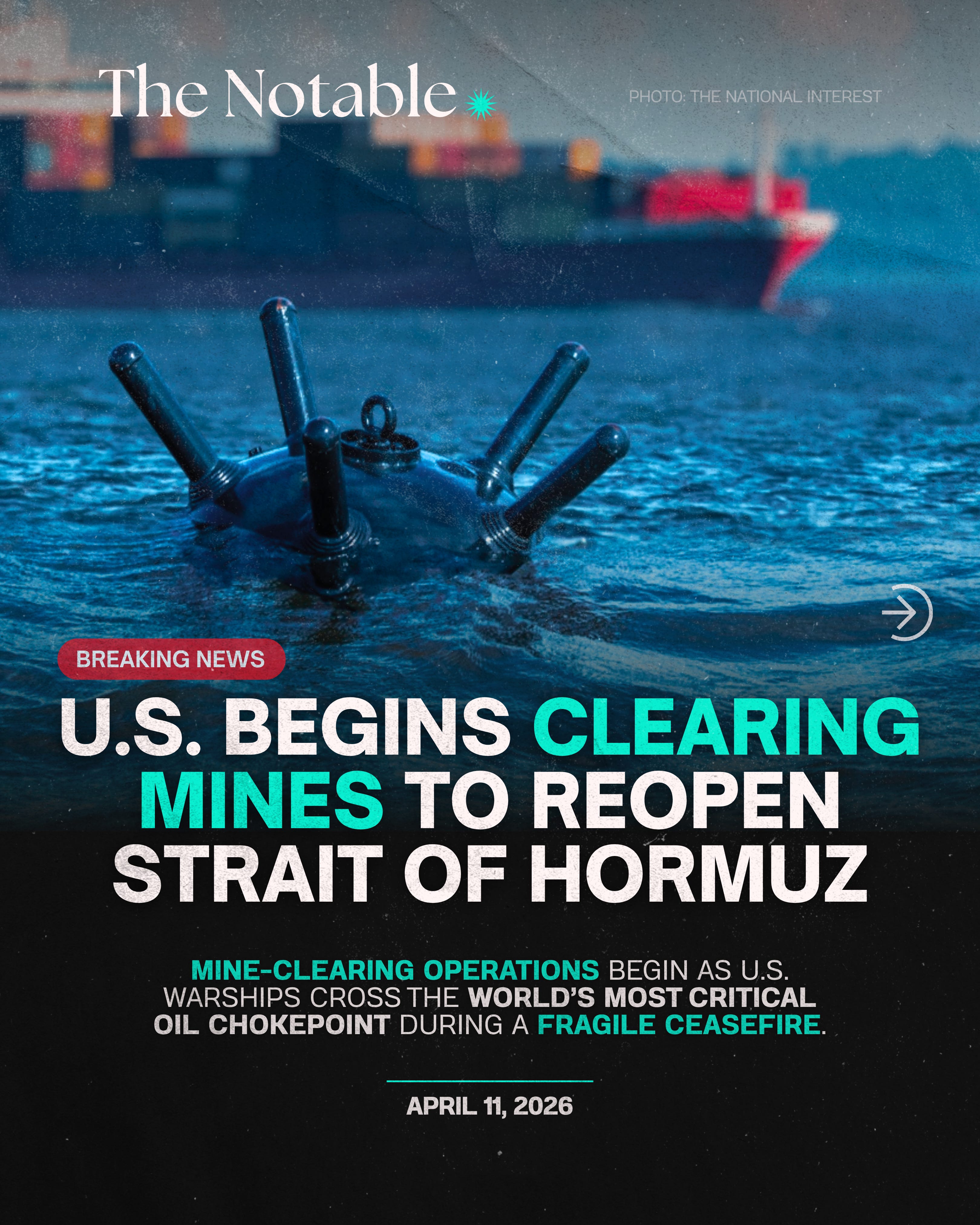
The United States has begun clearing naval mines in the Strait of Hormuz, signaling a decisive shift from active conflict toward control of one of the most critical arteries in the global economy.
President Donald Trump announced that U.S. forces are now engaged in mine-clearing operations, following weeks of disruption triggered by Iran’s decision to seed the waterway with naval mines. Around the same time, U.S. Navy vessels were seen crossing the strait, marking a visible and strategic re-entry into contested waters.
This is not a routine military maneuver. It is a direct intervention in the flow of global energy.
The Strait of Hormuz is a narrow passage between Iran and Oman, but its significance extends far beyond geography.
Roughly one-fifth of the world’s oil supply passes through this corridor each day. Tankers carrying crude from the Gulf must navigate this bottleneck to reach global markets. When the strait closes, even partially, the effects ripple instantly across energy prices, shipping routes, and inflation expectations.
Iran’s decision to deploy naval mines effectively turned this economic artery into a zone of uncertainty. Mines are not just weapons. They are deterrents that linger. Difficult to detect, slow to remove, and capable of damaging or destroying vessels long after deployment, they create a persistent risk that can halt commercial movement without a single shot being fired.
The current operation suggests a transition in U.S. posture.
Earlier phases of the conflict were defined by strikes, retaliation, and escalation. Now, the emphasis appears to be shifting toward stabilization through control. Clearing mines is not simply about safety. It is about restoring function to a system the global economy depends on.
At the same time, this move is unfolding during a fragile ceasefire and ongoing diplomatic engagement between Washington and Tehran. That dual-track approach matters.
On one hand, negotiations signal an attempt to de-escalate. On the other, the physical act of clearing mines and escorting ships through the strait demonstrates a willingness to act independently of those talks.
In effect, the U.S. is not waiting for stability to be agreed upon. It is attempting to enforce it in real time.
Mine-clearing operations are slow, complex, and inherently dangerous. Even with advanced detection systems, there is no guarantee that every device can be located quickly. A single missed mine can have outsized consequences, both economically and militarily.
There is also the question of escalation. While the presence of U.S. naval forces may deter further interference, it also raises the stakes. Any miscalculation in such a confined and strategically sensitive waterway could trigger renewed confrontation.
And then there is the uncertainty surrounding Iran’s capabilities. While U.S. officials suggest that key Iranian assets involved in laying mines have been neutralized, independent verification remains limited. The extent of remaining threats is not fully clear.
What is unfolding in the Strait of Hormuz is not just a regional development. It is a test of how global systems are maintained under pressure.
Modern economies are built on the assumption that critical infrastructure, from shipping lanes to energy routes, remains accessible. When that assumption breaks, even briefly, the consequences cascade across markets and borders.
By moving to clear mines and reopen the strait, the United States is doing more than responding to a tactical problem. It is reasserting control over a system that underpins global stability.
That carries implications.
It signals that control of key economic chokepoints may not always be negotiated. At times, it may be enforced.
The immediate objective is clear: restore safe passage through the Strait of Hormuz.
But the broader trajectory is less certain.
If mine-clearing efforts succeed and shipping resumes without incident, the operation could stabilize markets and reinforce U.S. influence over critical trade routes. If tensions rise again, the same narrow corridor could quickly return to being a focal point of global risk.
For now, the world is watching a transition in real time.
From disruption to restoration.
From conflict to control.
And beneath it all, a deeper question remains:
In a fragmented geopolitical landscape, who ultimately ensures that the systems the world depends on continue to function?