


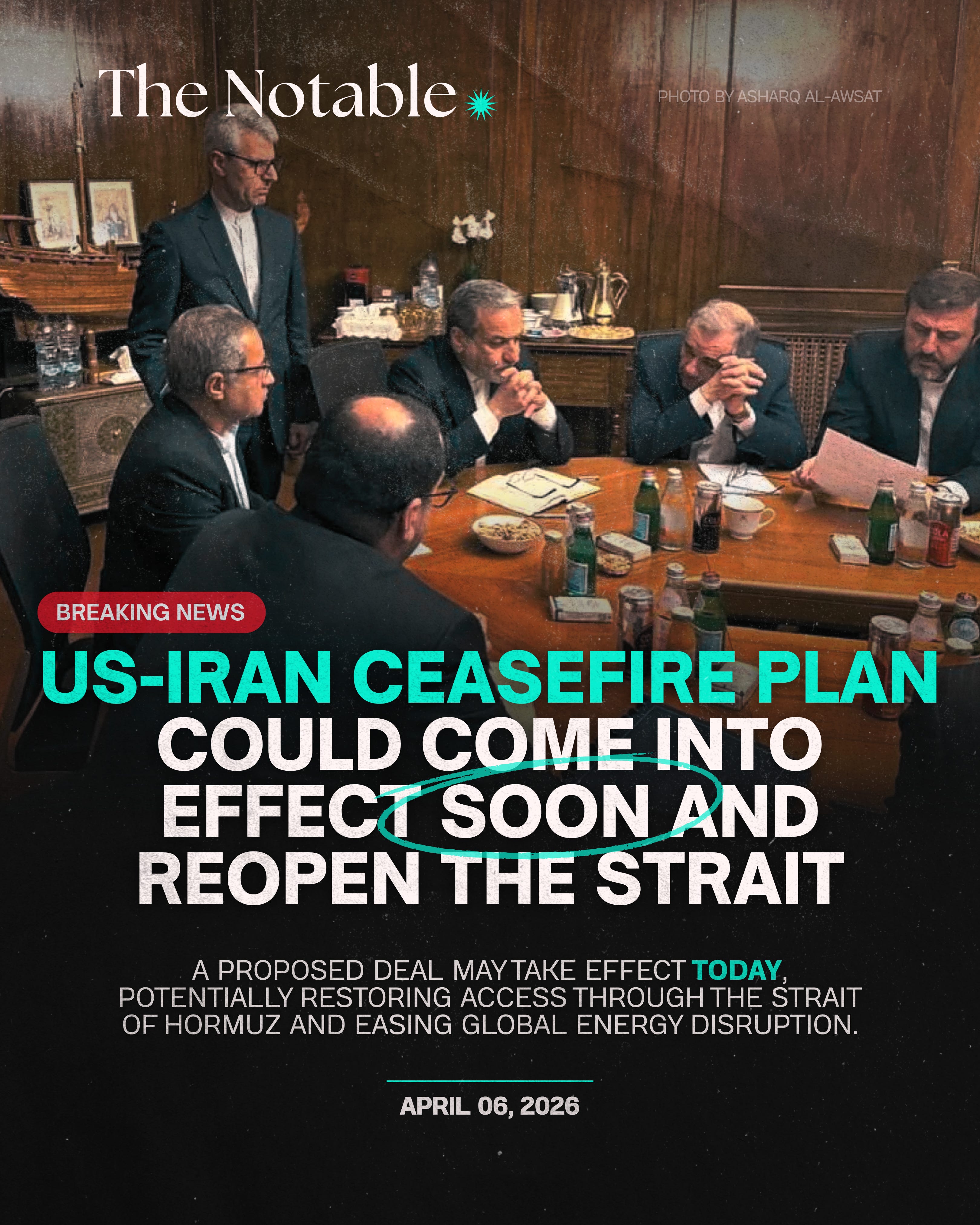
A proposed ceasefire between the United States and Iran could take effect within hours. If it holds, it would reopen the Strait of Hormuz, restoring one of the most critical flows in the global economy.
But the deal is not yet accepted. And the outcome remains uncertain.
The Proposal
According to Reuters and aligned reporting, a ceasefire framework has been delivered to both Washington and Tehran through indirect diplomatic channels, with Pakistan playing a central mediating role alongside other regional actors.
The structure is straightforward but fragile.
Phase one calls for an immediate cessation of hostilities and the reopening of the Strait of Hormuz, a narrow maritime corridor through which roughly 20% of the world’s oil supply passes. Phase two would initiate a 15 to 45 day negotiation window, aimed at reaching a broader political settlement.
That longer-term agreement could include elements long tied to U.S.-Iran tensions: sanctions relief, the release of frozen Iranian assets, and potential constraints on Iran’s nuclear program.
On paper, it is a pathway out of escalation.
In reality, it is a test of political will on both sides.
The Standoff
The central obstacle is not the structure of the deal. It is trust and sequencing.
Donald Trump has taken a hard line, signaling that Iran must reopen the strait quickly or face further military consequences. The message is clear: de-escalation must begin with restored global shipping.
Iran, however, appears unwilling to concede under pressure.
Senior Iranian officials have indicated that reopening Hormuz under a temporary ceasefire, without guarantees on sanctions relief or longer-term commitments, is not acceptable. From Tehran’s perspective, the strait is not just a bargaining chip. It is leverage built through escalation, and relinquishing it too early risks losing negotiating power.
This creates a classic deadlock.
The United States wants immediate de-escalation as proof of intent. Iran wants structural concessions before giving up its strongest position.
The ceasefire proposal sits directly between those positions.
How We Got Here
The current crisis began in late February, when U.S.-aligned strikes on Iranian targets triggered a rapid and expansive retaliation.
Iran responded with missile and drone operations across the region and moved to effectively close the Strait of Hormuz. Through a combination of naval threats, mines, and enforcement actions, it created a de facto blockade of one of the world’s most important energy corridors.
The consequences were immediate.
Global shipping routes were disrupted. Insurance costs surged. Oil markets reacted with sharp volatility. The closure of Hormuz did not just signal escalation. It exposed a structural vulnerability in the global economy that has long been understood but rarely tested at this scale.
What followed was a period of controlled escalation.
The United States increased military pressure while avoiding full-scale war. Iran maintained its position without expanding the conflict uncontrollably. Meanwhile, a quiet but urgent diplomatic track began to form, involving Pakistan, Turkey, Egypt, and China, all seeking to prevent further destabilization.
That track has now produced the current proposal.
Why Hormuz Matters
The Strait of Hormuz is not just another geopolitical flashpoint. It is a systemic chokepoint.
Nearly one-fifth of global oil consumption flows through a narrow passage bordered by Iran to the north and Gulf states to the south. There are few viable alternatives at scale. When the strait closes, the impact is not regional. It is global.
Energy markets tighten. Shipping reroutes. Costs cascade through supply chains.
In that sense, the ceasefire is not only about ending hostilities. It is about restoring the basic functioning of a critical global system.
This is why the stakes extend far beyond Washington and Tehran.
What Happens Next
The coming hours are decisive.
If Iran agrees to the ceasefire terms and reopens the strait, the immediate effect would be stabilization. Oil flows would resume. Markets would adjust. And negotiations would move into a more structured phase.
If Iran refuses, the situation could escalate quickly.
The United States has already signaled that prolonged closure is unacceptable. Further military action would become more likely, raising the risk of a wider regional conflict and deeper disruption to global energy supply.
There is also a third possibility.
A partial or delayed agreement, where both sides signal openness but continue to negotiate details, could prolong uncertainty. In that scenario, the strait may remain restricted, and markets would continue to price in risk.
The Underlying Reality
At its core, this moment is not just about a ceasefire.
It is about leverage, sequencing, and the balance between military pressure and diplomatic outcome.
Iran has created a position of strategic influence by closing Hormuz. The United States is attempting to convert military pressure into immediate de-escalation. The ceasefire proposal is the bridge between those two strategies.
Whether that bridge holds will determine not only the trajectory of this conflict, but the stability of a system the world depends on every day.
For now, everything hinges on a single decision in Tehran.
And the clock is already running.