


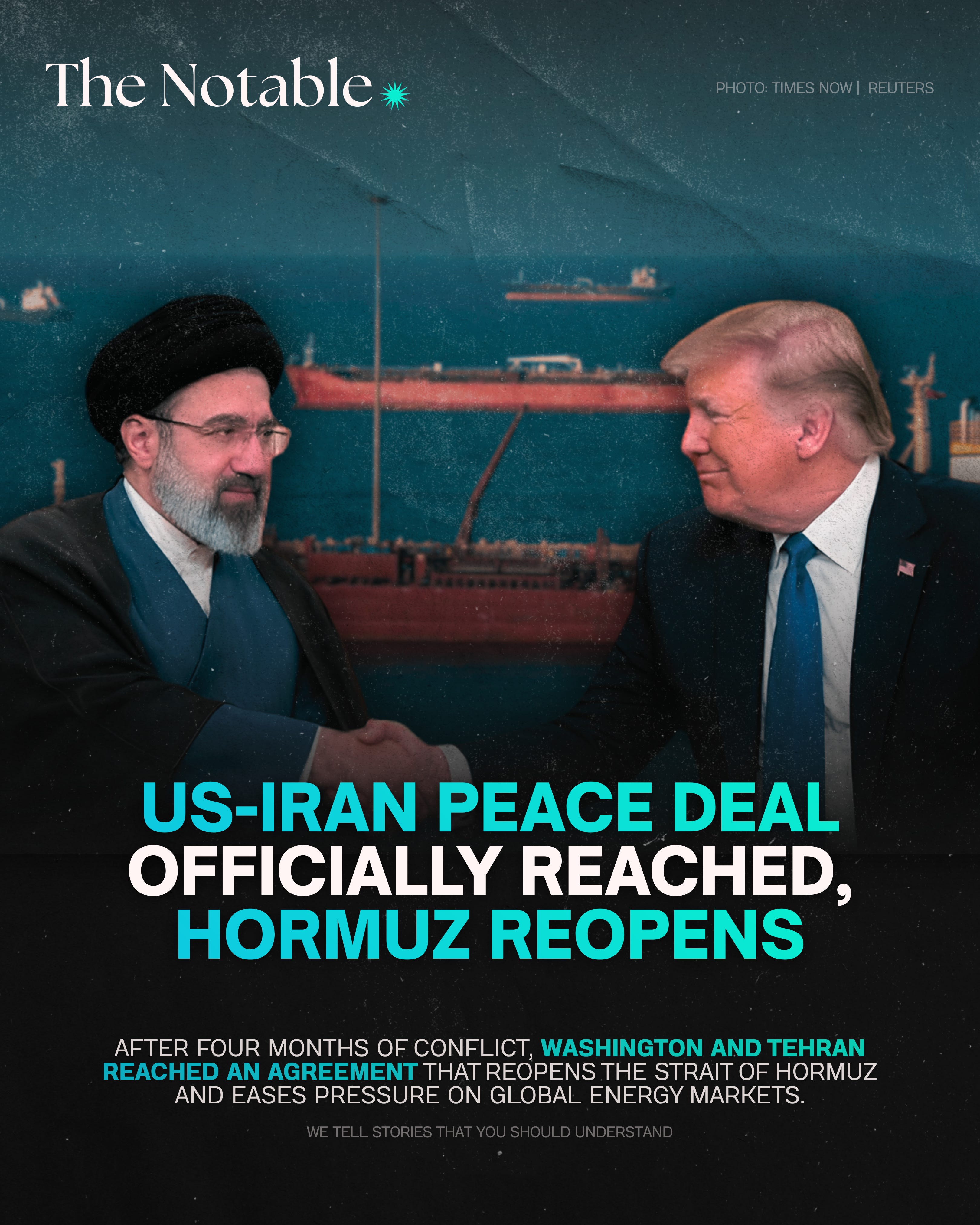
After four months of conflict that threatened global energy supplies and raised fears of a wider Middle East war, the United States and Iran have reached a peace agreement that could mark a major turning point in one of the world’s most consequential geopolitical confrontations.
President Donald Trump announced that a deal had been reached with Tehran and ordered the immediate removal of the U.S. naval blockade imposed during the conflict. The agreement also paves the way for the reopening of the Strait of Hormuz, a waterway through which roughly one-fifth of global oil and LNG trade passes.
The Breakthrough
The agreement follows months of fighting, economic pressure, and diplomatic negotiations involving multiple regional actors.
Pakistan played a central role in mediating talks between Washington and Tehran, helping both sides move toward a framework designed to end hostilities and restore maritime traffic through the Persian Gulf.
Trump described the deal as complete and authorized the lifting of the blockade that had targeted Iranian maritime trade during the conflict.
The reopening of the Strait of Hormuz is one of the agreement’s most important immediate outcomes.
Why Hormuz Matters
The Strait of Hormuz is one of the most strategically important waterways in the world.
The narrow passage connects the Persian Gulf to international markets and serves as a critical route for energy exports from major producers including Saudi Arabia, Iraq, Kuwait, the United Arab Emirates, and Iran.
Approximately 20% of global oil trade moves through the strait under normal conditions.
As tensions escalated during the conflict, fears of prolonged disruption sent shockwaves through energy markets and raised concerns about inflation, shipping costs, and global economic stability.
The reopening of the waterway significantly reduces those risks.
Financial markets quickly responded to news of the agreement.
Oil prices fell as traders anticipated a return to more stable shipping conditions and reduced geopolitical risk in the Gulf.
The agreement also lowers the likelihood of supply disruptions that could have affected energy-importing economies across Asia and Europe.
For governments and businesses already navigating economic uncertainty, the return of stability to one of the world’s most important trade routes is a welcome development.
What Is Actually in the Deal?
While the announcement has been widely described as a peace deal, current reporting suggests it functions more as a framework for de-escalation than a final settlement.
According to reports surrounding the agreement, Iran is expected to halt further nuclear advancement during a follow-up negotiation period.
In return, the United States is expected to provide limited sanctions relief and facilitate the release of frozen Iranian assets.
Additional negotiations are expected to address longer-term issues that remain unresolved.
The Bigger Challenges Remain
The agreement may have ended the immediate crisis, but it does not eliminate the deeper sources of tension between Washington and Tehran.
Questions surrounding Iran’s nuclear program, regional influence, sanctions policy, and long-term security arrangements remain unresolved.
These issues have shaped U.S.-Iran relations for decades and will likely continue to define future negotiations.
Whether the current breakthrough develops into a lasting peace or merely a temporary pause will depend on what happens next.
Why This Matters
The significance of this agreement extends beyond the United States and Iran.
Over the past four months, the conflict became one of the most dangerous geopolitical flashpoints in the world, carrying the risk of broader regional escalation and severe disruption to global energy markets.
The deal lowers those risks and shifts the focus from military confrontation back to diplomacy.
For now, that represents a meaningful strategic victory for all sides involved.
Attention will now turn to implementation.
Both governments must demonstrate that they are prepared to follow through on their commitments, while negotiators work toward a more comprehensive agreement addressing the underlying disputes that fueled the conflict.
A formal signing ceremony is expected in the coming days, providing the first major test of whether the breakthrough can be translated into a durable diplomatic settlement.
The immediate crisis may be ending.
The larger U.S.-Iran relationship, however, is entering a new chapter rather than reaching its final conclusion.