


The United States and Iran are approaching a possible interim arrangement to reopen the Strait of Hormuz, potentially creating a path toward renewed negotiations and a broader de-escalation of the five-month conflict.
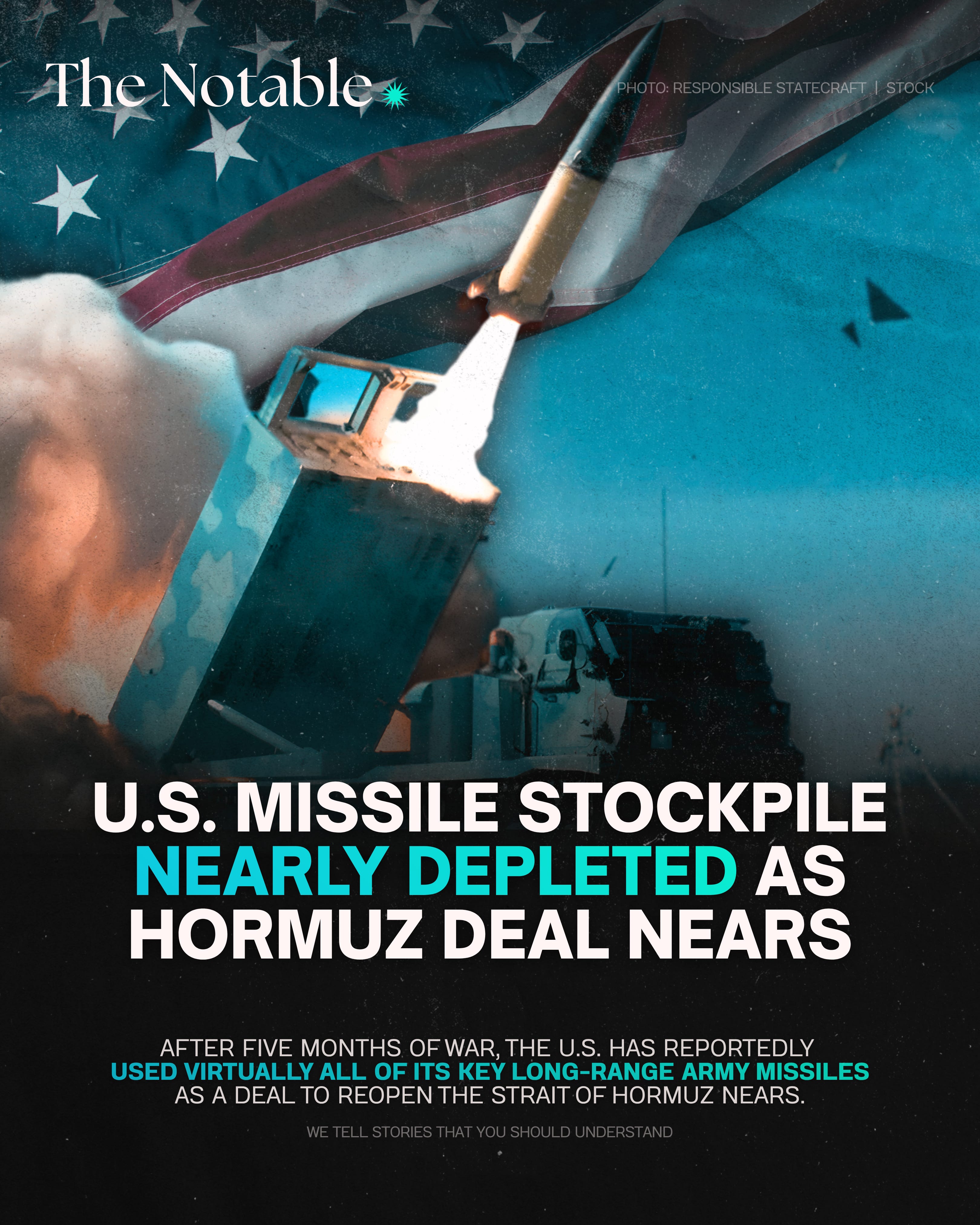
At the same time, a new Reuters report highlights another consequence of the war: the U.S. Army has reportedly used virtually all of its stockpile of two key long-range precision missile systems, the Army Tactical Missile System, or ATACMS, and the newer Precision Strike Missile, or PrSM.
The two developments are occurring at the same moment, but there is no evidence that the missile depletion directly caused Washington to pursue the emerging agreement. The significance lies in what they reveal together: the war has imposed substantial military and economic costs while diplomacy is attempting to contain a crisis with consequences far beyond Iran.
The U.S. Has Consumed a Major Missile Stockpile
According to Reuters, people familiar with U.S. military data say the Army has used virtually all of its global stockpile of ATACMS and PrSM missiles during the conflict.
That does not mean the United States has run out of long-range missiles altogether. The report concerns specific Army surface-to-surface systems, while the broader U.S. military maintains other strike capabilities, including air-launched weapons and the Navy’s Tomahawk cruise missiles.
The distinction matters.
ATACMS and PrSM allow U.S. forces to strike targets at significant distances from ground-based launchers. They are particularly valuable because they can provide long-range fires without requiring aircraft and pilots to enter the same level of risk.
The Pentagon has also been able to replenish forward-deployed supplies by drawing from U.S. military stockpiles elsewhere around the world.
But moving missiles from one location to another does not eliminate the underlying problem. It can shift the pressure from a theater-level inventory to the broader U.S. reserve.
The War Is Consuming More Than Missiles
The pressure extends beyond ATACMS and PrSM.
U.S. forces have also consumed substantial quantities of air-defense interceptors and other precision weapons during the conflict. Patriot and THAAD interceptors have been heavily used, while the Navy’s Tomahawk inventory has also come under pressure.
This creates a difficult strategic calculation for Washington.
The United States does not plan its weapons inventory around a single conflict. Its military must maintain the ability to respond to crises in multiple theaters, including the Indo-Pacific and Europe.
That makes ammunition consumption more consequential than simply asking whether the U.S. can continue fighting Iran.
The question is whether Washington can sustain a prolonged high-intensity campaign while preserving enough stocks for another major contingency.
That concern has been raised by defense analysts even before the latest Reuters report. A recent assessment by the Center for Strategic and International Studies warned that the pace of U.S. munitions consumption in the Iran war could create significant readiness challenges and expose weaknesses in America’s ability to rapidly replenish precision weapons.
Meanwhile, the Strait of Hormuz Has Become the Central Diplomatic Question
The military pressure is unfolding alongside a diplomatic effort focused on one of the world’s most important maritime chokepoints.
The Strait of Hormuz sits between Iran and Oman and connects the Persian Gulf with the Gulf of Oman and the wider Arabian Sea.
A large share of the world’s oil and LNG exports normally passes through the waterway. That makes the strait strategically important not only to the United States and Iran, but also to Asian economies that depend heavily on Gulf energy supplies.
The conflict has disrupted that system.
Shipping companies have faced increased security risks, while energy markets have reacted to uncertainty over whether commercial vessels can safely transit the strait.
A sustained disruption would therefore extend the consequences of the war well beyond the battlefield.
Oman Is at the Center of the Emerging Arrangement
Oman has played an important intermediary role between Washington and Tehran throughout the crisis.
The latest proposal under discussion would establish a temporary framework allowing commercial shipping to resume through Hormuz while creating space for renewed negotiations.
Reports indicate that the arrangement could initially last around 60 days, potentially giving the sides time to restore a ceasefire framework and resume discussions over Iran’s nuclear program.
The proposal is not simply about opening a shipping lane.
A major issue is who controls and administers maritime movement through the strait.
Iran maintains sovereignty over its territorial waters and has sought recognition of its rights in the waterway. Oman, which controls the other side of the strait, also has sovereign rights in its territorial waters.
The United States, meanwhile, does not want a system in which Iran can effectively determine which international vessels may pass or impose unilateral control over global shipping.
That makes the details of any agreement critical.
Hormuz Is an Energy Problem for the World
The importance of the strait extends far beyond military strategy.
The Strait of Hormuz is one of the world’s primary energy chokepoints. Disruption affects oil, liquefied natural gas, shipping insurance, freight costs and ultimately consumer prices.
The consequences are especially significant for Asia.
Major Asian economies rely heavily on energy shipped from the Persian Gulf. A prolonged disruption could therefore translate into higher energy costs, tighter LNG markets and increased inflationary pressure across economies far from the Middle East.
The U.S. Energy Information Administration has also highlighted the impact on global LNG markets, with disruption to flows from the region affecting a significant portion of international LNG trade.
This is why a reopening of Hormuz could immediately influence global markets even if the broader U.S.-Iran conflict remains unresolved.
A Deal Is Not the Same as a Settlement
The emerging agreement should therefore be viewed carefully.
The United States and Iran may be moving toward a temporary arrangement, but that does not mean the underlying disputes have disappeared.
Several issues remain unresolved, including Iran’s nuclear program, sanctions, maritime sovereignty, the rules governing commercial passage and the broader security architecture of the Persian Gulf.
Iranian officials have also disputed some American descriptions of the negotiations, underscoring how fragile the diplomatic process remains.
A temporary reopening of Hormuz could reduce immediate pressure without solving the deeper confrontation.
That distinction will be important in the days ahead.
The Strategic Problem for Washington
The convergence of these developments creates a difficult strategic picture for the United States.
Washington has demonstrated substantial military power during the conflict, but high-intensity warfare consumes weapons faster than the industrial base can necessarily replace them.
Precision missiles are not ordinary commodities. Production involves specialized components, complex manufacturing processes and lengthy procurement timelines.
The result is a strategic tension between using weapons today and preserving the capacity to fight tomorrow.
That matters particularly for a U.S. military preparing for the possibility of major conflict elsewhere.
The Indo-Pacific is the obvious concern.
A future conflict involving China would likely demand enormous quantities of long-range precision weapons and air-defense systems. Every missile consumed in one theater therefore has implications for the reserves available for another.
This does not mean the United States is incapable of fighting another war.
It means the Iran conflict has made the costs of maintaining multiple simultaneous military commitments more visible.
What Happens Next
The immediate question is whether Washington, Tehran and Oman can finalize the interim arrangement and restore reliable commercial passage through Hormuz.
If they do, the first effects could appear quickly in energy and shipping markets.
But reopening the strait would only solve one part of the crisis.
The more consequential test will be whether the temporary arrangement can lead to sustained negotiations over Iran’s nuclear program and a durable reduction in military confrontation.
For Washington, there is another question that will persist regardless of the diplomatic outcome: how quickly can the United States rebuild the precision-munition inventories consumed during the war?
The Bigger Picture
The most important story is not simply that the United States is running low on certain missiles or that a Hormuz deal may be close.
It is that military power has limits even for the world’s most capable military.
Five months of high-intensity warfare have consumed substantial quantities of precision weapons and air-defense interceptors while disrupting one of the world’s most important energy corridors.
Now diplomacy is attempting to create an exit.
If the Hormuz agreement holds, it could reduce immediate military and economic pressure and create room for negotiations. If it fails, Washington and Tehran could once again face a choice between escalation and a diplomatic compromise, with the costs of continued confrontation becoming increasingly difficult to ignore.
For the United States, the lesson extends beyond Iran.
A military can possess overwhelming capabilities and still face strategic constraints when a conflict becomes long, expensive and ammunition-intensive.
The Iran war is testing not only American firepower, but the sustainability of American power itself.