


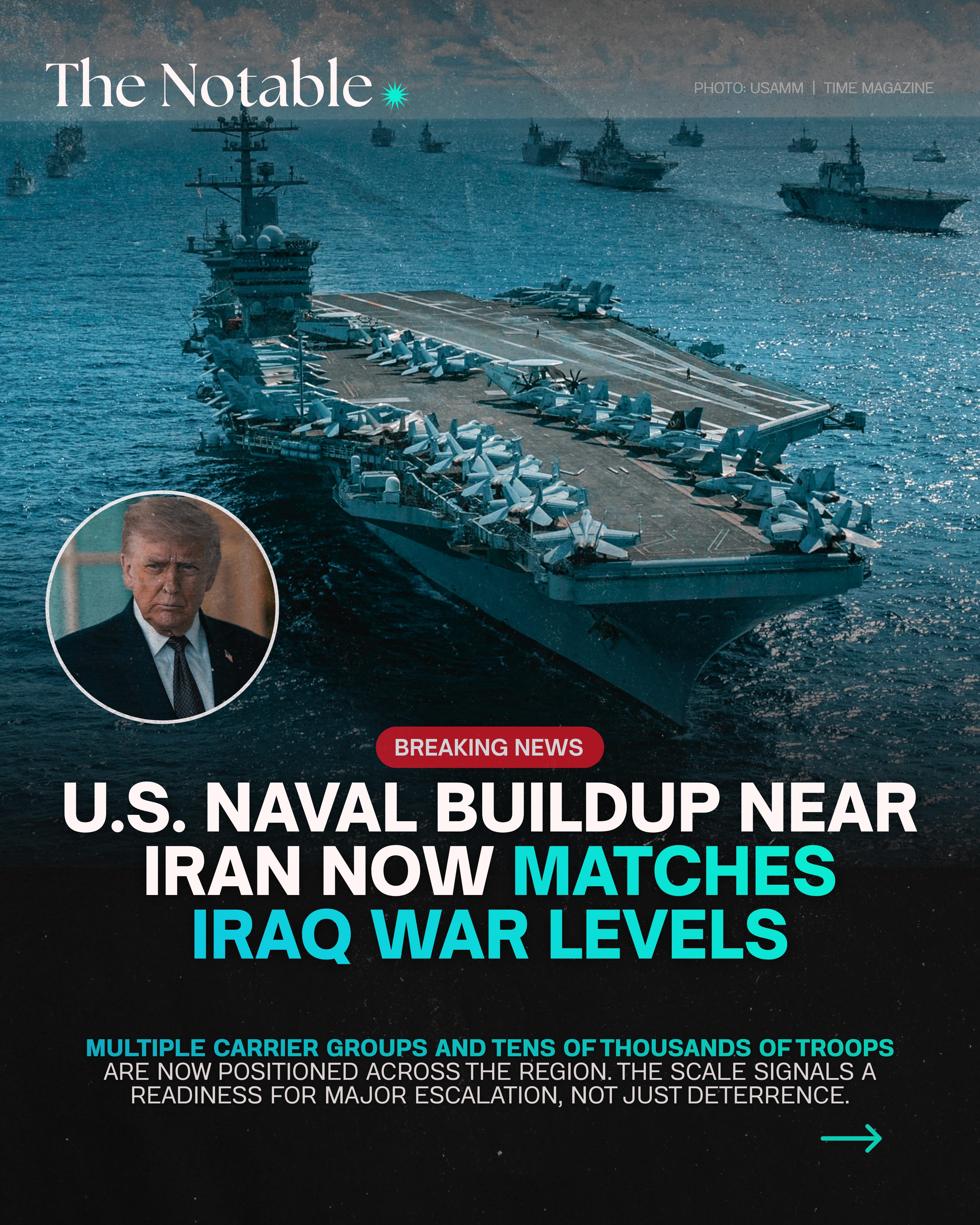
The United States has assembled a naval and military presence in the Middle East at a scale not seen since the Iraq War. Multiple aircraft carrier strike groups, additional warships, and tens of thousands of troops are now positioned across the region, stretching from the eastern Mediterranean to the Persian Gulf.
This is not a routine deployment. It is a signal.
At the center of this buildup is a rapidly intensifying standoff with Iran. While a fragile ceasefire technically remains in place, conditions on the ground suggest something closer to a suspended conflict than a resolved one. Maritime confrontations continue. Shipping routes are being tested. Military assets on both sides are moving, not standing down.
The most sensitive pressure point is the Strait of Hormuz, a narrow corridor through which roughly a fifth of the world’s oil supply passes. Iran has already demonstrated its ability to disrupt traffic in this channel through ship seizures and asymmetric naval tactics. The United States, in response, has expanded patrols and reinforced its presence to secure the flow of global energy.
This is where the buildup becomes consequential beyond the region.
Energy markets are highly sensitive to even minor disruptions in Hormuz. Sustained instability or a direct confrontation could send oil prices sharply higher, with immediate ripple effects across inflation, supply chains, and global economic stability. What unfolds in this narrow waterway does not stay local. It transmits outward, quickly.
The scale of current US deployments suggests preparation for two parallel scenarios.
The first is deterrence. By concentrating overwhelming force, Washington raises the cost of escalation for Iran, signaling that any major move would be met with decisive response. This is the traditional logic of power projection.
The second is readiness. Military assets at this level allow for rapid transition from posture to action. Carrier strike groups are not symbolic. They are operational platforms capable of sustained air campaigns, maritime control, and coordinated strikes.
This dual posture reflects a deeper strategic reality. The United States is not simply reacting to events. It is shaping the environment in which the next move will occur.
For Iran, the strategy is different but equally deliberate. Rather than matching force with force, it leverages geography and asymmetry. By exerting pressure on chokepoints like Hormuz, it introduces global consequences into a regional conflict. It raises the stakes not just for Washington, but for the international system that depends on stable energy flows.
This creates a dangerous equilibrium.
Both sides are signaling strength. Both are positioning for advantage. Neither appears willing to de-escalate without concessions. And in this kind of environment, the greatest risk is not necessarily a planned escalation, but an unintended one.
A miscalculation at sea. A misinterpreted maneuver. A localized incident that expands before either side can contain it.
History shows that large military buildups do not guarantee conflict. But they do change the margin for error.
The comparison to the Iraq War era is not just about scale. It is about posture. Then, as now, the concentration of US military power in the region marked a moment when options narrowed and consequences expanded.
Today’s situation is more complex. The Middle East is more interconnected. Global energy dependence remains high. And the geopolitical landscape includes more actors, more interests, and less predictability.
What is unfolding is not yet a war.
But it is no longer a low-level standoff.
It is a system under pressure, with military force, economic risk, and strategic signaling all converging in one of the most sensitive regions in the world.
And once that pressure crosses a certain threshold, events tend to move faster than intentions.