


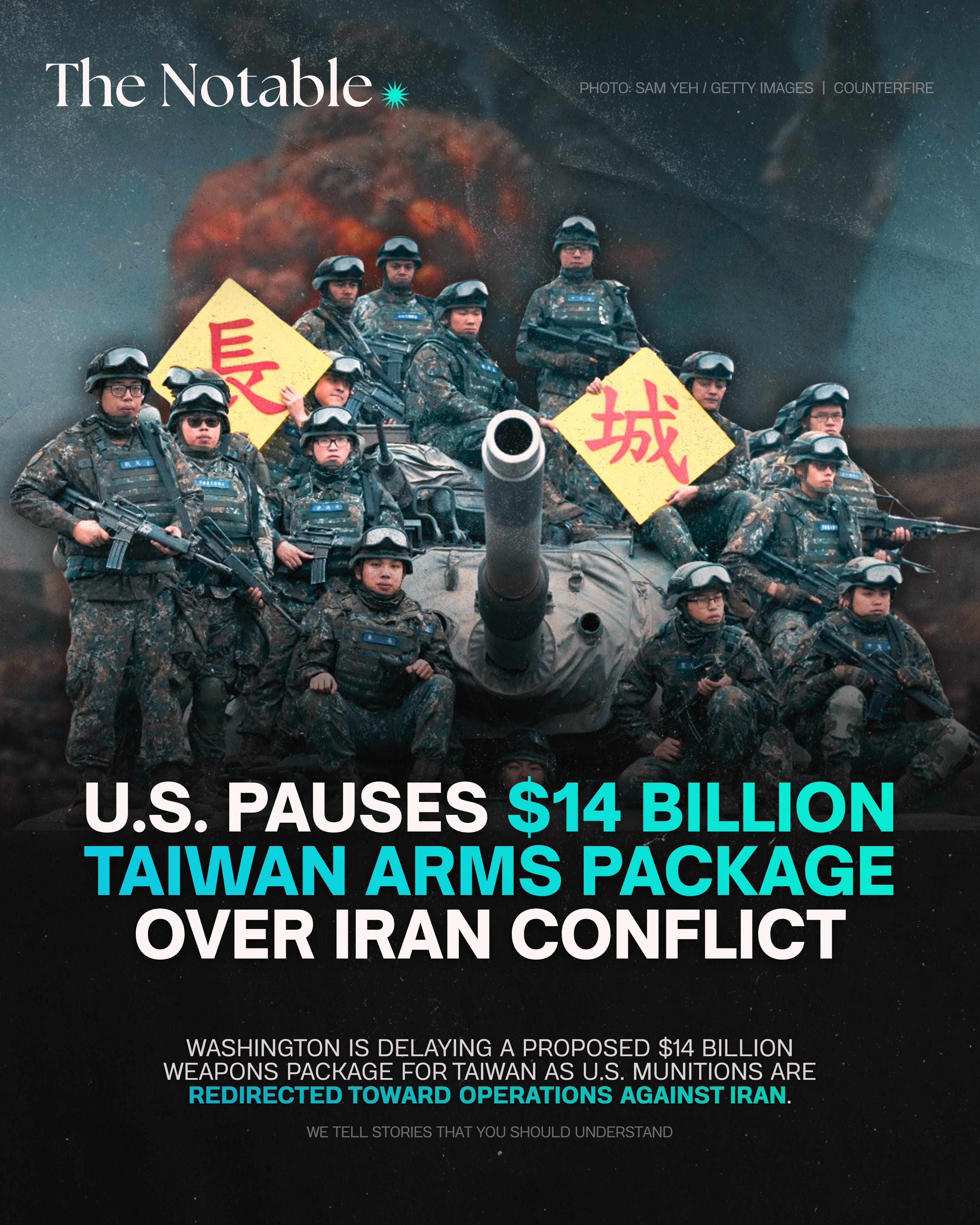
The United States is reportedly pausing a proposed $14 billion weapons package for Taiwan as Washington redirects critical missile stockpiles and military resources toward ongoing operations linked to the Iran conflict.
A senior Pentagon official confirmed this week that the Taiwan package is being placed on “pause” in order to preserve munitions for operations in the Middle East. The package reportedly included advanced air defense systems and precision-guided weapons intended to strengthen Taiwan’s ability to deter a potential Chinese attack.
Taiwan has stated that it has not received formal notification from Washington that the package has been canceled or permanently suspended. But even a temporary delay carries major geopolitical implications.
A Growing Strategic Strain
For years, the United States has tried to maintain military pressure and deterrence across several regions at once: supporting Ukraine against Russia, reinforcing allies in the Indo-Pacific, and maintaining a heavy military presence in the Middle East.
The Taiwan delay now suggests those priorities may increasingly be colliding with each other.
At the center of the issue is a growing strain on U.S. military stockpiles. Modern warfare relies heavily on precision-guided missiles, interceptors, and advanced munitions that are expensive, technologically complex, and difficult to replace quickly.
Conflicts in Ukraine and the Middle East have already consumed large quantities of these systems, while tensions with China continue driving demand for additional deployments in the Pacific.
The Defense Production Problem
The deeper issue is structural.
Defense analysts have warned for years that the U.S. defense industrial base may struggle to sustain multiple major geopolitical confrontations simultaneously over long periods of time.
Weapons production capacity, supply chains, and replacement timelines have become increasingly important strategic concerns as global instability rises.
The Taiwan pause is now becoming visible evidence of those limitations.
What once appeared to be separate geopolitical crises are increasingly competing for the same military resources.
Trump, China, and Taiwan
The timing of the pause is also politically significant.
Donald Trump recently described the Taiwan weapons package as a possible “negotiating chip” in discussions with China after meeting Xi Jinping. That has raised concerns in both Washington and Taipei that Taiwan security could become more directly tied to broader U.S.-China bargaining.
For decades, U.S. policy toward Taiwan relied on maintaining a careful balance. Washington supported Taiwan militarily while avoiding explicit guarantees of military intervention against China, a framework often referred to as “strategic ambiguity.”
Trump’s comments have introduced a more transactional tone into the issue.
China has long demanded that the United States halt arms sales to Taiwan, which Beijing considers part of its territory under the “One China” principle.
Why Taiwan Matters
Taiwan faces growing military pressure from Beijing.
Chinese military aircraft and naval vessels now operate near Taiwan on an almost daily basis, while the People’s Liberation Army continues expanding its missile capabilities and regional military presence.
Taiwan has increasingly focused on acquiring asymmetric defense systems designed to make a potential invasion more costly and difficult for China.
That makes delays in weapons deliveries especially sensitive.
Even if temporary, the pause could influence how Beijing evaluates American military readiness and political commitment in the Indo-Pacific.
The Bigger Picture
The situation does not mean the United States is abandoning Taiwan.
Washington continues military cooperation with Taipei under the Taiwan Relations Act, and there has been no formal announcement canceling the proposed package.
But the development highlights a larger reality that is becoming increasingly difficult to ignore:
The United States is attempting to manage simultaneous geopolitical confrontations across Europe, the Middle East, and Asia while facing growing constraints in military production, supply chains, and strategic bandwidth.
The Taiwan pause is therefore about more than Taiwan alone.
It is becoming an early test of whether the current global order can still be maintained under rising geopolitical fragmentation, expanding military competition, and mounting pressure on American power projection itself.