


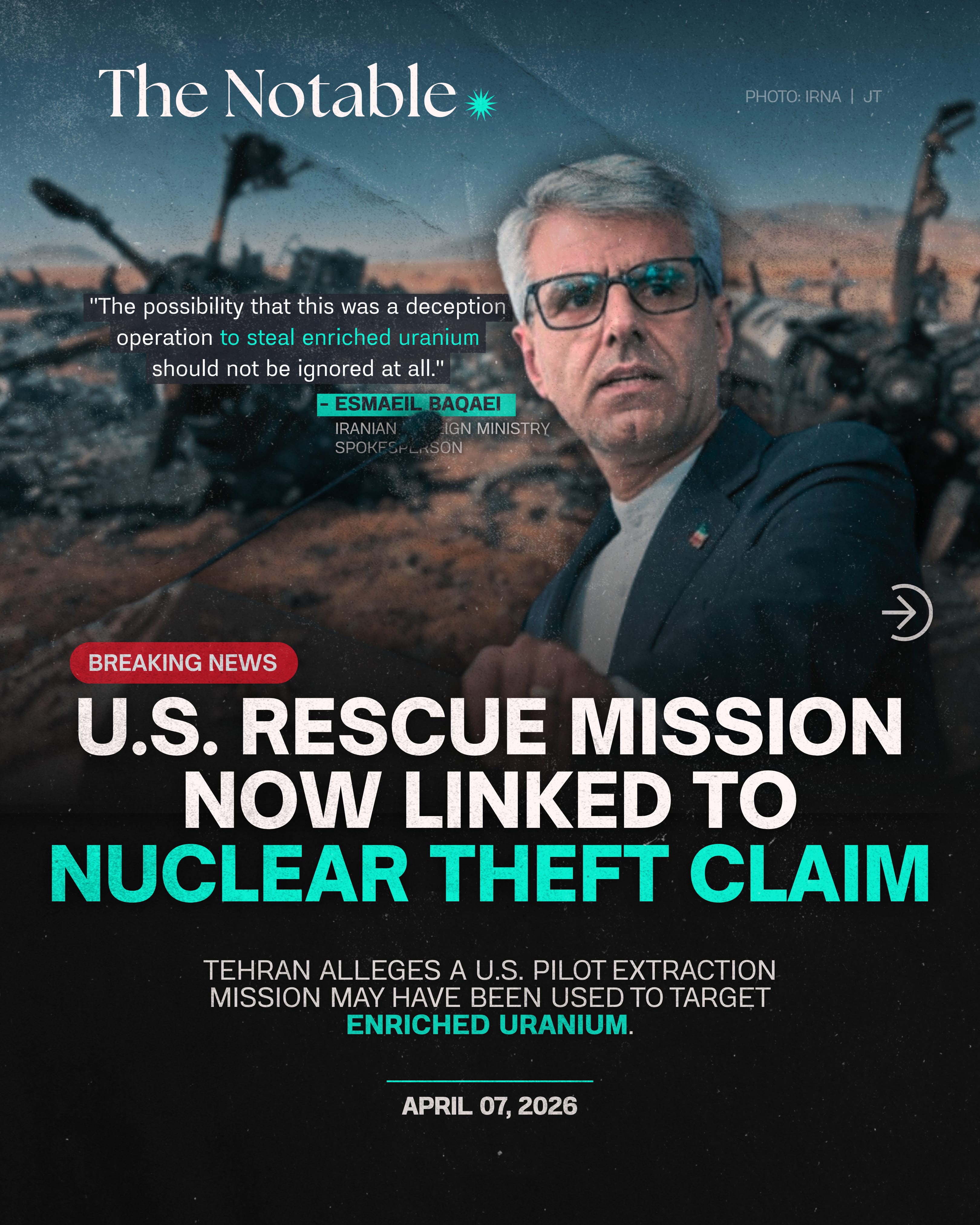
U.S. Rescue Mission Is Now Being Reframed as a Nuclear Operation
A high-risk U.S. military rescue inside Iran is no longer being treated as a simple battlefield operation.
It is now at the center of a far more consequential claim.
Iran says the mission may have been something else entirely.
The Incident That Triggered Everything
The sequence began with a downed aircraft.
A U.S. F-15 fighter jet was shot down over Iranian territory during active military operations, forcing at least one American airman to eject and land inside hostile territory. What followed was a scenario the U.S. military trains for but rarely executes at this scale.
A stranded pilot, deep inside Iran, with limited time before capture.
The response was immediate.
A Rescue Operation Deep Inside Iran
The United States launched a complex and high-risk extraction mission involving special operations forces, air support, and coordinated intelligence.
Roughly a hundred personnel were involved in the operation, which required penetrating Iranian territory, securing the pilot, and exiting before Iranian forces could fully respond.
The mission was not without complications.
Reports indicate mechanical failures affected some aircraft during the operation, raising the risk that U.S. troops themselves could become stranded. In response, multiple aircraft were destroyed on the ground to prevent sensitive technology from falling into Iranian hands.
Despite the setbacks, the objective was achieved.
The pilot was extracted.
Washington presented the operation as a success, with Donald Trump describing it as one of the most daring rescue missions in recent memory.
Iran Challenges the Narrative
Then the story shifted.
Iran’s foreign ministry, through spokesman Esmaeil Baqaei, introduced a new and far more serious allegation.
According to Tehran, the operation may not have been solely about rescuing a pilot. Instead, officials claim it could have been a cover for accessing or removing enriched uranium.
The argument centers on inconsistencies.
Iranian officials say the location and execution of the mission do not align with a standard rescue operation. They point to what they describe as unusual movements and unanswered questions about where U.S. forces attempted to land and operate.
No evidence has been publicly presented to support the claim.
But the accusation itself is significant.
From Battlefield to Nuclear Narrative
This is where the story changes meaning.
A pilot rescue, even a dangerous one, remains within the logic of conventional military operations. It is contained, tactical, and expected.
A covert attempt to seize nuclear material is something else entirely.
It reframes the event from a recovery mission into a potential strategic operation targeting Iran’s nuclear program.
That shift matters.
Because it moves the conflict from the battlefield into the domain of nuclear risk, where perception alone can escalate tensions, regardless of what actually occurred.
Why This Claim Matters
Iran’s accusation does not need to be proven to have an impact.
By linking the operation to enriched uranium, Tehran is expanding the narrative beyond the immediate event. It introduces the possibility that U.S. actions inside Iran are not just reactive, but proactive, and potentially aimed at undermining nuclear capabilities directly.
That has implications on multiple levels:
It raises the stakes of the current conflict
It increases global concern around nuclear escalation
It complicates diplomatic pathways, especially if the claim is repeated or amplified
At a minimum, it creates ambiguity.
And ambiguity, in a conflict like this, is destabilizing.
The Reality: Confirmed vs Claimed
What is known remains relatively clear.
A U.S. jet was shot down.
A pilot was stranded.
A rescue mission took place.
The airman was extracted.
Aircraft were destroyed during the operation.
What is not confirmed is equally important.
There is no publicly available evidence that the mission involved any attempt to access nuclear material. The United States has not indicated any objective beyond rescuing the pilot.
The uranium claim, for now, sits in the realm of strategic messaging rather than verified fact.
What Happens Next
The trajectory of this story will depend less on what happened, and more on what each side chooses to emphasize.
If Iran continues to frame the mission as a nuclear operation, it could justify further escalation, whether diplomatic or military.
If the United States maintains its position and provides no additional detail, the gap between narratives may widen rather than close.
And in that gap, the risk grows.
Because in modern conflict, perception is not just a reflection of events.
It is part of the battlefield itself.