


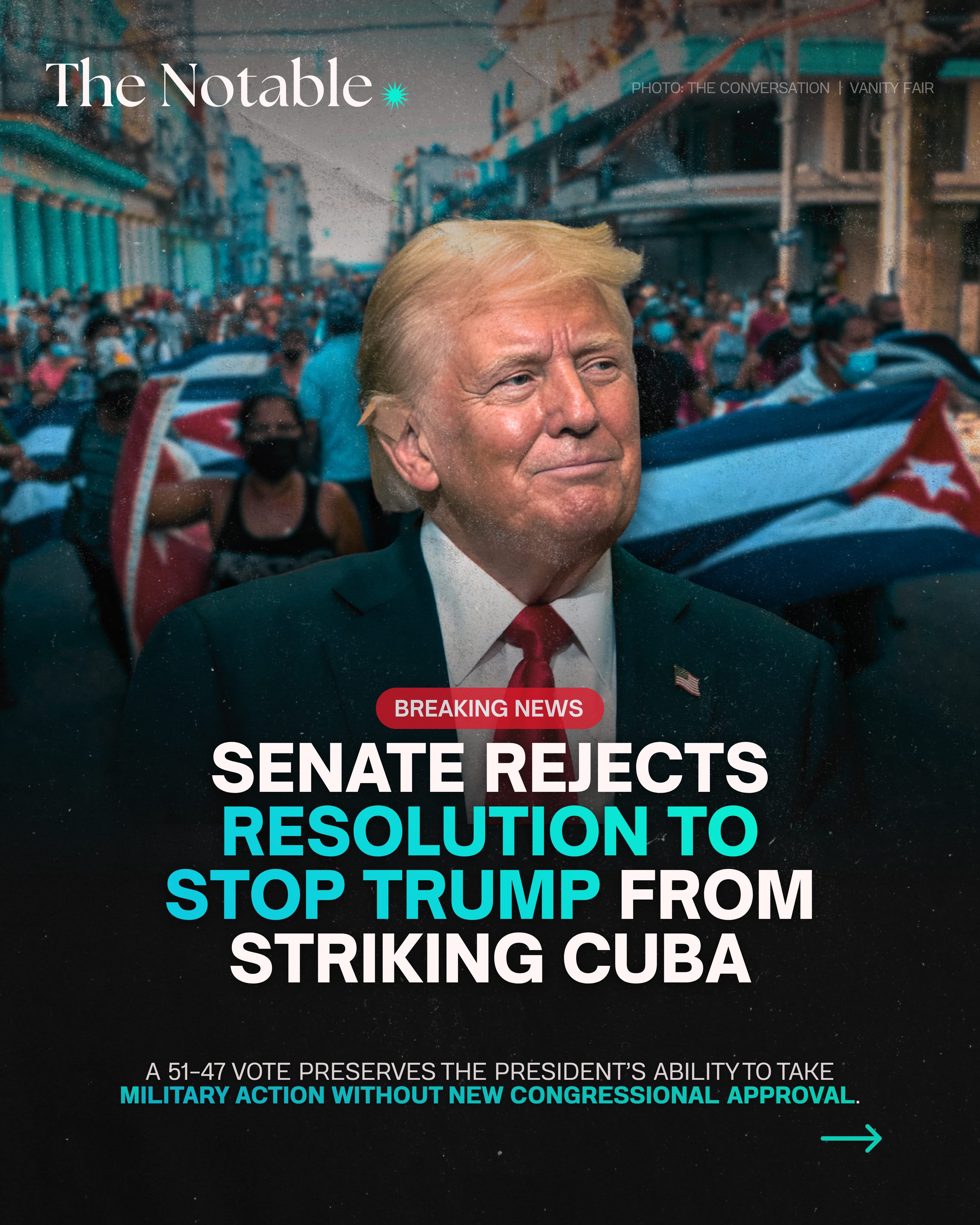
The U.S. Senate has rejected an effort to require congressional approval before any American military action against Cuba, preserving the president’s existing authority at a moment of rising tension in the Caribbean.
In a narrow 51–47 vote on April 28th, senators blocked a War Powers resolution introduced by Tim Kaine, a Democrat of Virginia. The measure sought to compel President Donald Trump to seek explicit authorization from Congress before launching strikes on the island. Its failure does not expand presidential power. It leaves intact the status quo, under which the executive branch retains considerable latitude to initiate limited military action without prior approval.
The debate turns on an old and unresolved question in American governance: what counts as “hostilities”. Under the War Powers Resolution of 1973, Congress holds the constitutional authority to declare war, while the president may deploy force in limited circumstances without advance consent. Yet the law hinges on interpretation. Supporters of the resolution argued that current U.S. actions toward Cuba, including efforts to disrupt fuel flows and intensify economic pressure, could already approach that threshold in practice. Opponents countered that, absent the deployment of U.S. troops or direct kinetic engagement, the legal trigger has not been met.
The dispute is not merely legalistic. It reflects a broader pattern in which Congress has struggled to reassert control over decisions to use force. Similar efforts to constrain Trump’s authority in Iran and Venezuela have also failed in the Senate. In practice, the centre of gravity has continued to shift toward the presidency, even as Congress retains formal war-making powers under the Constitution.
Cuba, meanwhile, has become a renewed focus of U.S. pressure. The island’s economy is under strain, exacerbated by energy shortages linked in part to disruptions in Venezuelan fuel shipments. Washington has tightened enforcement measures in recent months, framing them as part of a broader strategy to isolate Havana and limit its regional influence. While no military operation has been announced, the rhetoric surrounding Cuba has sharpened, raising concerns among some lawmakers that escalation could follow.
For now, there is no indication that a strike is imminent. But the Senate’s vote leaves open a familiar grey zone. Economic coercion, naval pressure and other forms of state power sit uneasily between peace and war, often blurring the legal and political boundaries that are meant to constrain them. The question is less whether the United States is at war with Cuba, and more who decides when that line has been crossed.
In declining to act, the Senate has chosen not to resolve that ambiguity. Instead, it has reaffirmed a pattern that has become increasingly characteristic of American foreign policy: decisions over the use of force remain, in practice, concentrated in the hands of the president, even when Congress retains the authority to say otherwise.