


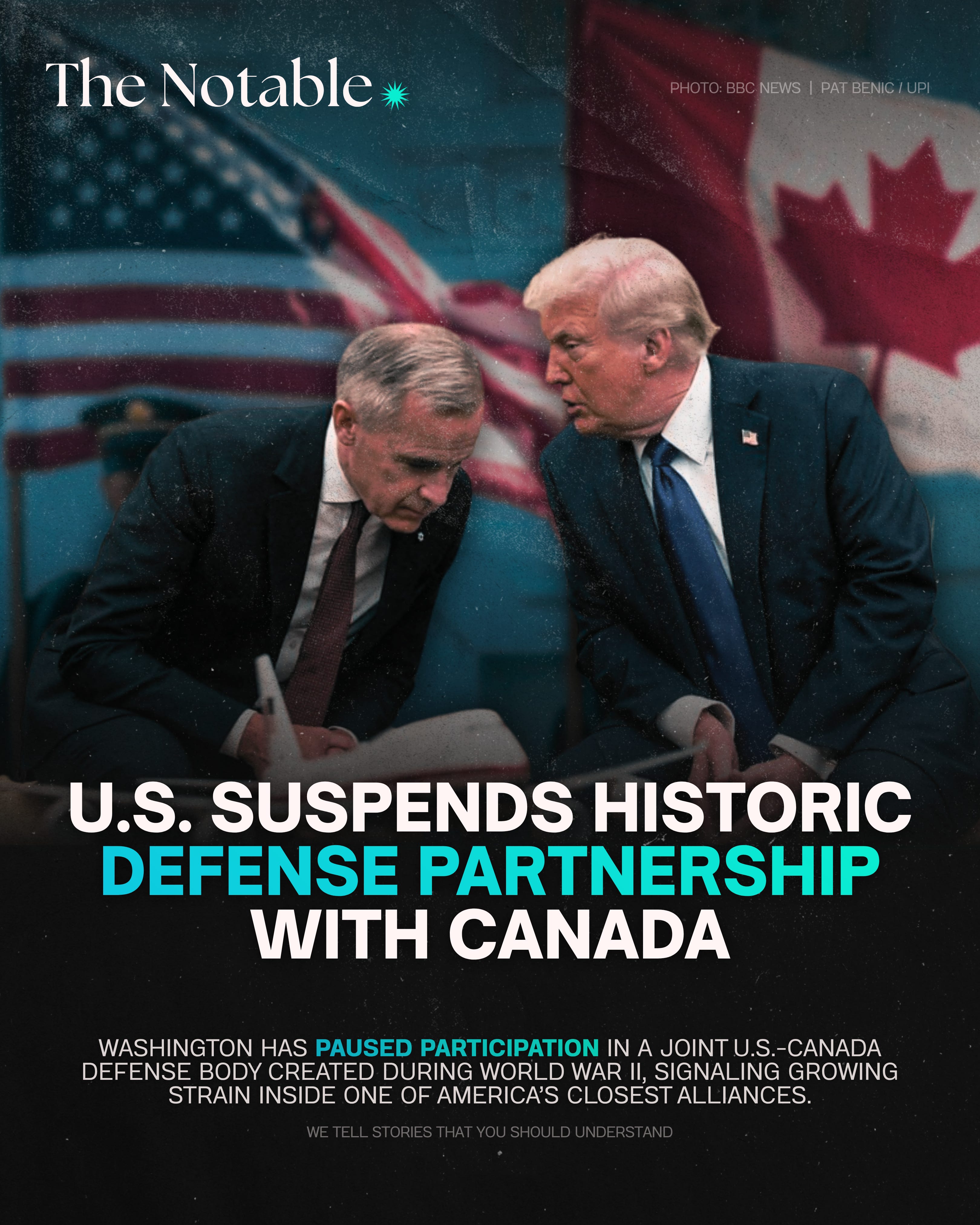
For more than 80 years, the United States and Canada maintained one of the closest defense relationships in the world.
It survived World War II, the Cold War, Iraq War disagreements, trade disputes, and changing governments on both sides of the border.
Now, for the first time in decades, Washington is stepping back from one of the foundational institutions behind that alliance.
The Pentagon has officially paused U.S. participation in the Permanent Joint Board on Defense, a bilateral military coordination body created in 1940 under the Ogdensburg Agreement between President Franklin D. Roosevelt and Canadian Prime Minister William Lyon Mackenzie King.
The decision marks a rare rupture inside one of America’s oldest and most stable security partnerships.
A World War II Institution Suddenly Under Pressure
The Permanent Joint Board on Defense was established during World War II as the United States and Canada sought to coordinate continental defense against external threats.
Over time, the institution became one of the core pillars of North American security cooperation.
It helped shape:
early continental defense planning
Arctic security coordination
Cold War military strategy
the eventual creation of NORAD in 1958
For decades, the board symbolized something larger than military coordination.
It represented the assumption that the United States and Canada would remain strategically aligned regardless of political disagreements.
That assumption is now being tested.
What The Pentagon Said
The Pentagon confirmed the United States is “pausing participation” in the defense board as part of a broader reassessment of whether the institution still advances American strategic interests.
U.S. Under Secretary of Defense for Policy Elbridge Colby said Washington could no longer ignore the “gaps between rhetoric and reality” regarding defense commitments.
While the administration did not explicitly threaten the broader alliance, the message was clear: long-standing partnerships are no longer immune from pressure.
The move comes amid rising tensions between Washington and Ottawa over:
NATO spending
tariffs and trade disputes
Arctic strategy
defense modernization
broader political friction between President Donald Trump and Canadian Prime Minister Mark Carney
What This Does NOT Mean
At least for now, the development is more symbolic and political than operational.
NORAD remains active.
Joint military coordination continues.
There has been no announcement of troop withdrawals, command restructuring, or broader military disengagement.
The defense board itself has not been dissolved.
But symbolism matters in geopolitics.
And this is an unusually serious signal between two countries that historically avoided public security ruptures.
Why This Matters Beyond Canada
The story is ultimately about something larger than the U.S.-Canada relationship.
It reflects the continued transformation of American foreign policy under Donald Trump.
For decades, U.S. alliances were treated as strategic constants.
Under Trump, they are increasingly treated as conditional arrangements tied to:
defense spending
economic leverage
transactional bargaining
perceived strategic value
That shift is reshaping how allies interpret American power.
Even countries with deep institutional ties to Washington are now facing a new reality: historical closeness alone may no longer guarantee stability inside U.S.-led alliances.
The Canada Spending Debate Is More Complicated Than It Appears
The Trump administration has repeatedly criticized NATO allies for relying too heavily on American military power.
Canada has long been one of the most frequent targets of those criticisms.
But the current dispute is more nuanced than simple underinvestment.
Ottawa recently increased military spending significantly and backed NATO’s long-term defense targets. Canada has also pledged new investments tied to Arctic security and modernization efforts.
Washington appears unconvinced that the pace or scale of those changes is sufficient.
That matters because it suggests the disagreement is no longer purely about spending numbers.
It is increasingly about strategic trust and political leverage.
A Warning About The Future Of Western Alliances
The suspension of participation in a World War II-era defense institution would have once been almost unthinkable between the United States and Canada.
Today, it reflects a broader pattern emerging across the Western alliance system.
Institutions that once appeared permanent are becoming more conditional.
Security relationships are becoming more openly transactional.
And geopolitical trust between allies is becoming harder to assume.
The board itself may eventually resume normal operations.
But the signal sent by Washington is already clear.
Even America’s oldest alliances are now subject to renegotiation.