


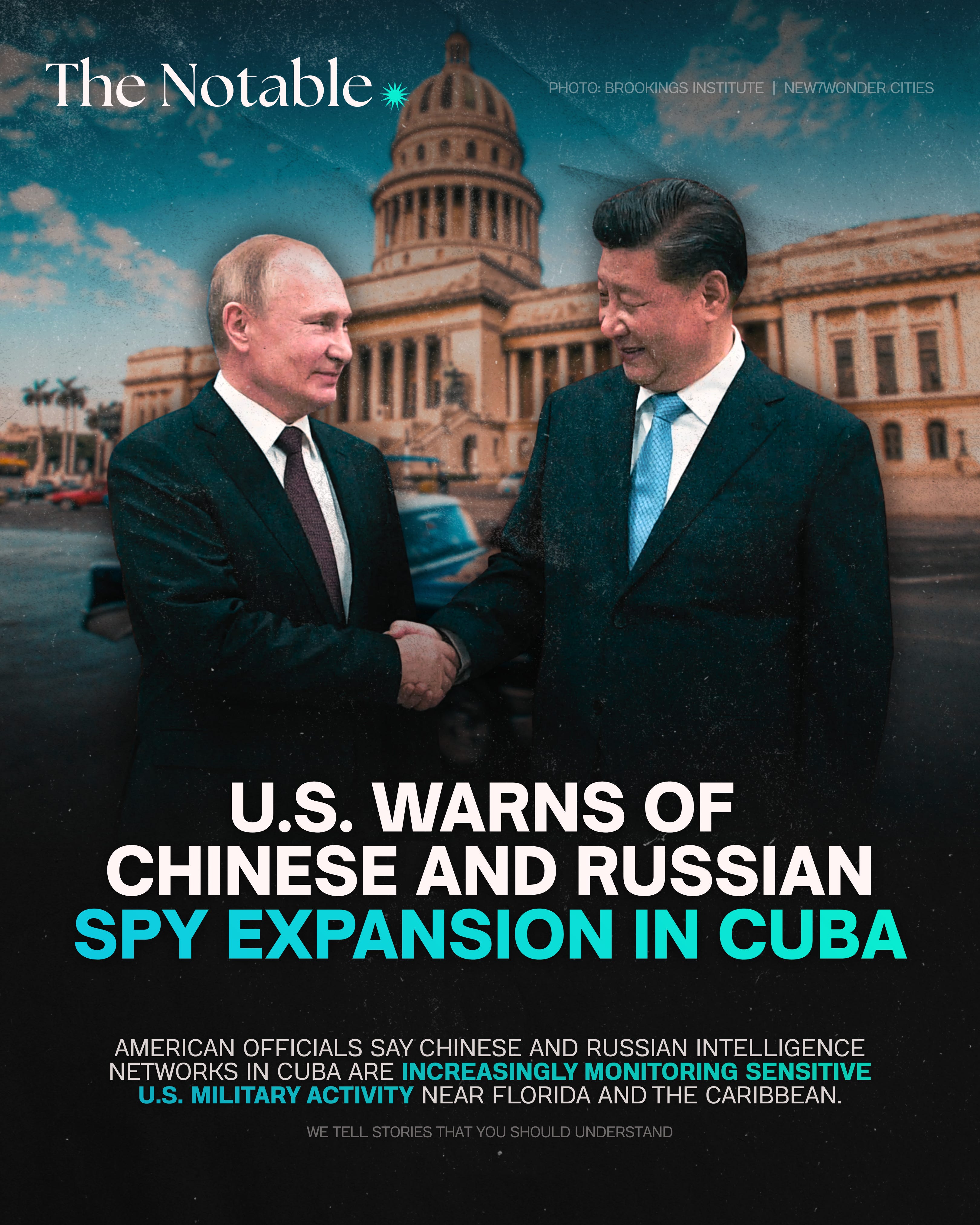
The United States is warning that China and Russia are expanding intelligence and surveillance operations in Cuba, reviving concerns about foreign espionage activity just miles from the American mainland.
According to new U.S. intelligence assessments reported by The Wall Street Journal, Chinese and Russian-linked facilities in Cuba are allegedly being used to monitor sensitive American military activity across Florida and the wider Caribbean region. Officials reportedly believe the operations include upgraded electronic surveillance systems, signals intelligence infrastructure, and radar capabilities designed to intercept military communications and track regional operations.
The developments come as geopolitical tensions between Washington, Beijing, and Moscow continue to intensify over military competition, Taiwan, Ukraine, and global influence.
What the U.S. Is Alleging
American officials say multiple intelligence sites across Cuba have undergone significant upgrades in recent years. The facilities are reportedly focused on monitoring U.S. military operations, naval activity, communications systems, and aerospace infrastructure near the southeastern United States.
Among the reported targets are U.S. Central Command in Tampa, U.S. Southern Command, and military activity around Guantanamo Bay.
According to the latest reporting, U.S. intelligence believes the number of Chinese and Russian intelligence personnel operating in Cuba has increased substantially since 2023.
Satellite imagery and independent analysis over the past two years have also identified expanded radar and surveillance infrastructure at several locations across the island, including sites near Bejucal, El Salao, and Wajay.
While the full operational capabilities of the facilities remain unclear, American officials increasingly view Cuba as a growing intelligence platform for rival powers operating near U.S. territory.
A Return to Cold War Geography
The allegations carry strong historical symbolism.
During the Cold War, Cuba served as one of the Soviet Union’s most important overseas intelligence hubs. The Lourdes signals intelligence station near Havana became one of Moscow’s largest foreign surveillance facilities, monitoring American military communications for decades because of Cuba’s proximity to Florida.
Although Russia officially shut down the facility in the early 2000s, concerns about renewed intelligence cooperation between Havana and Moscow never fully disappeared.
Now, U.S. officials believe China is becoming an increasingly important player in Cuba’s intelligence landscape as Beijing expands its global surveillance and military reach.
The strategic logic is straightforward: Cuba sits less than 100 miles from the U.S. mainland.
That proximity potentially allows foreign intelligence services to monitor communications, military exercises, naval movements, radar systems, and aerospace activity across a large portion of the southeastern United States.
Why This Matters Now
The issue extends far beyond Cuba itself.
The story reflects a broader transformation in global power competition, where the Western Hemisphere is once again becoming an active arena for geopolitical rivalry.
For years, much of the strategic focus between the United States and China centered on the Indo-Pacific, Taiwan, semiconductor supply chains, and maritime power. But Washington increasingly believes Beijing is also expanding its footprint closer to American territory through infrastructure projects, telecommunications systems, economic influence, and intelligence operations.
Russia’s continued involvement adds another layer to the picture. Amid worsening relations with Washington following the Ukraine war, Moscow has steadily deepened military and intelligence coordination with anti-U.S. governments in Latin America.
The result is a geopolitical dynamic that increasingly resembles a modernized version of Cold War competition, though centered less on nuclear deployments and more on cyber capabilities, electronic surveillance, intelligence gathering, and technological infrastructure.
Denials and Uncertainty
China and Cuba have repeatedly denied allegations that Beijing operates spy bases on the island.
Chinese officials previously accused the United States of spreading misinformation, while Cuban authorities rejected claims that foreign surveillance facilities are being used against Washington.
Russia has also historically downplayed reports suggesting renewed intelligence activity in Cuba.
Importantly, some of the latest allegations rely heavily on anonymous intelligence assessments, and many operational details remain unverified publicly. Independent experts caution that while satellite imagery confirms infrastructure expansion, the exact purpose and ownership of some facilities cannot be conclusively determined from open-source evidence alone.
Still, the broader concern inside Washington appears increasingly bipartisan: rival powers are expanding intelligence capabilities near the United States at a moment of rising global instability.
The Bigger Picture
This story is ultimately about more than espionage.
It highlights how global power competition is becoming geographically broader, technologically deeper, and increasingly focused on intelligence dominance.
The modern contest between the United States, China, and Russia is no longer confined to distant regions or traditional military deployments. It now includes data systems, surveillance infrastructure, cyber operations, undersea cables, satellite networks, artificial intelligence, and strategic positioning close to rival territory.
For Washington, the idea that Chinese and Russian intelligence infrastructure could be expanding less than 100 miles from Florida carries both strategic and political significance.
And for the wider world, it signals something larger: the return of great power rivalry to America’s immediate neighborhood.