


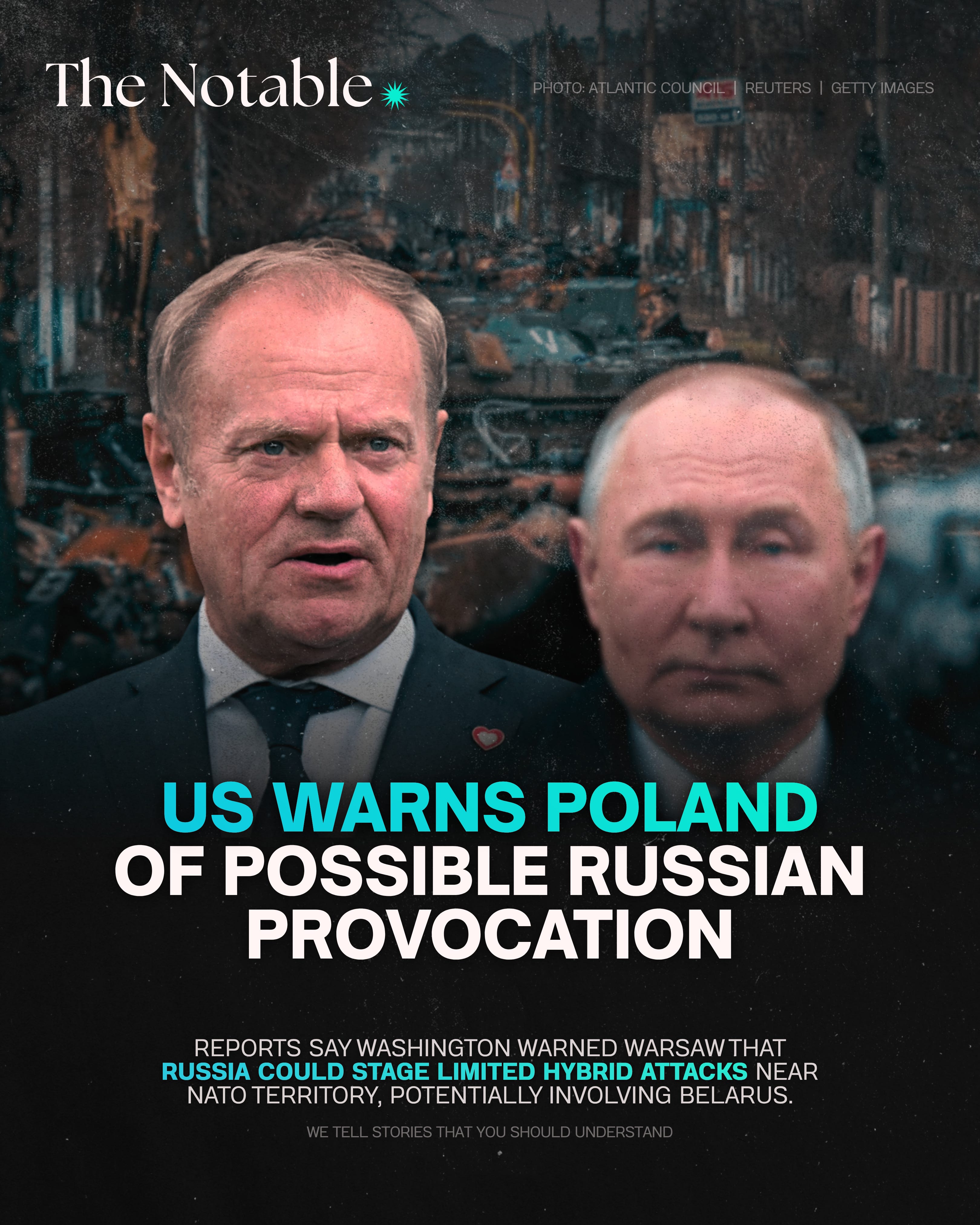
New reports from Polish and European media claim the United States has warned Poland that Russia could be preparing a limited “provocation” near NATO territory, raising fresh concerns about the expanding risks surrounding the war in Ukraine.
According to the reports, US intelligence shared with Warsaw described possible scenarios involving drone or missile strikes, cyber attacks, GPS disruption, or ambiguous border incidents near Poland’s frontier with Ukraine. Some of the alleged scenarios may involve Belarusian territory or forces, allowing Moscow greater deniability while increasing pressure on NATO’s eastern flank.
Importantly, there is currently no public confirmation from the White House, NATO, or the Polish government that an attack is imminent. The reports rely largely on unnamed security and political sources familiar with the intelligence discussions.
Still, the warning reflects a growing concern inside Europe that Russia may increasingly rely on hybrid tactics designed to pressure NATO without triggering full-scale war.
A Different Kind of Escalation
Western officials reportedly do not believe Russia is preparing a conventional invasion of Poland.
Instead, the concern centers on controlled escalation tactics that could create confusion, delay collective decision-making, and test the political cohesion of the NATO alliance.
The reported scenarios include:
limited infrastructure strikes
cyber disruptions
GPS interference
border incidents framed as accidents
ambiguous military activity difficult to immediately attribute
Such operations fall within what many European security officials describe as Russia’s broader “hybrid warfare” strategy.
Unlike traditional military confrontation, hybrid operations are designed to remain below the threshold that would automatically trigger a unified military response from NATO under Article 5.
That ambiguity is precisely what makes these scenarios strategically dangerous.
Why Poland Matters
Poland has become one of the most important frontline states in Europe since Russia’s invasion of Ukraine began.
The country serves as a major logistical hub for Western military support flowing into Ukraine and has emerged as one of Kyiv’s strongest political and military backers inside NATO.
Its geographic position also makes it central to NATO’s eastern defense posture. Poland borders both Belarus and the Russian exclave of Kaliningrad, placing it directly along one of Europe’s most sensitive security corridors.
For Moscow, pressure on Poland carries broader strategic implications beyond the country itself.
Any successful attempt to create uncertainty or hesitation inside NATO could weaken alliance unity at a time when Western governments are already debating the long-term costs of supporting Ukraine.
The Belarus Factor
Belarus plays a critical role in the reported intelligence concerns.
Since the start of the Ukraine war, Russian forces have operated extensively from Belarusian territory. The country has also become increasingly integrated into Moscow’s military planning and regional pressure strategy.
Security analysts say Belarus provides Russia with two major advantages:
geographic proximity to NATO territory
plausible deniability for ambiguous operations
This has fueled ongoing fears among Eastern European governments that future provocations could originate from Belarusian territory while remaining difficult to immediately attribute directly to Moscow.
That uncertainty alone could complicate NATO’s response calculations during a crisis.
A Broader Pattern Across Europe
The reports involving Poland come amid a wider wave of European concern over Russian hybrid activity.
Over the past two years, NATO governments have repeatedly accused Russia of expanding sabotage operations, cyber attacks, disinformation campaigns, and infrastructure disruption efforts across Europe.
Baltic states in particular have issued repeated warnings about:
GPS jamming
cyber interference
border pressure
covert destabilization attempts
attacks on critical infrastructure
European intelligence agencies increasingly believe the Ukraine war is evolving beyond the battlefield itself, with competition spreading into cyber systems, logistics networks, transportation infrastructure, and political stability inside NATO countries.
In this environment, even relatively small incidents can carry outsized geopolitical consequences.
Growing Pressure on NATO
The reports also arrive ahead of renewed NATO discussions focused on eastern flank security and long-term deterrence strategy.
As the war in Ukraine continues, alliance leaders face a growing challenge: how to deter escalation without allowing ambiguous provocations to fracture political unity inside the alliance.
That balancing act has become increasingly difficult.
Russia continues to face heavy military and economic pressure from the prolonged war, while NATO governments remain divided over how long Western support for Ukraine can realistically continue at current levels.
Security analysts warn that hybrid tactics offer Moscow a way to raise pressure on Europe without crossing the threshold into direct war with NATO.
The strategic objective would not necessarily be territorial conquest.
Instead, it would be to create uncertainty, hesitation, and political division inside the Western alliance itself.
What Happens Next
At this stage, there is no public evidence that a Russian attack on Poland is imminent.
But the reports reflect something larger and increasingly visible across Europe: a growing belief that future escalation may look very different from conventional warfare.
Rather than tanks crossing borders, the next phase of confrontation could involve sabotage, cyber disruption, infrastructure pressure, deniable operations, and carefully calibrated incidents designed to test how far NATO unity can be stretched.
For European governments, the fear is no longer only about military invasion.
It is about whether the alliance can remain politically cohesive in an era of ambiguity, hybrid conflict, and constant strategic pressure.