


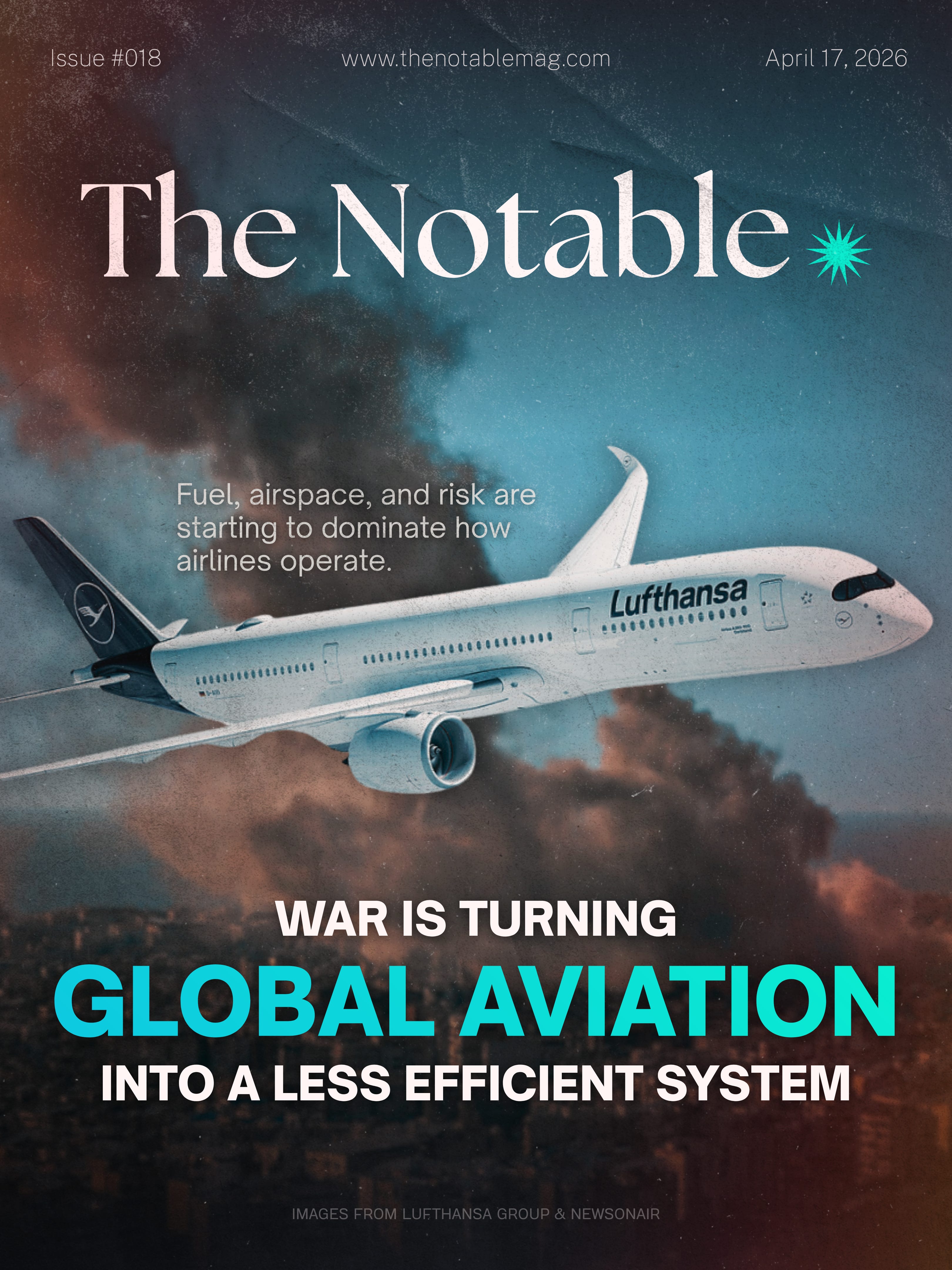
When Lufthansa began grounding aircraft this month, the move looked tactical. Older planes were being taken out of rotation. Capacity was being trimmed. Costs were being controlled.
But the constraint was not internal.
It was arriving through fuel markets and airspace at the same time.
Modern aviation was built on a simple assumption. The fastest route is usually the cheapest one.
That assumption is beginning to fail.
The pressure starts with fuel, but not in the way airlines typically hedge against.
Crude prices have risen sharply since the escalation around Iran. More important is what happened after. The spread between crude and jet fuel widened, reflecting stress in refining and distribution. Roughly a fifth of the world’s jet fuel flows through routes linked to the Strait of Hormuz. When that corridor tightens, airlines do not just pay more. They pay disproportionately more.
Jet fuel prices have surged to levels far above crude, in some cases doubling since the conflict intensified.
For an industry where fuel already accounts for up to a third of costs, the distinction matters.
Airlines are not exposed to oil. They are exposed to its bottlenecks.
At the same time, the map itself is becoming less usable.
European carriers had already been avoiding Russian airspace since the invasion of Ukraine. The Middle East became the alternative corridor linking Europe and Asia.
That corridor is now unstable.
Flights are being rerouted again, often in real time. Journeys lengthen. Aircraft burn more fuel. Crew scheduling becomes more complex. Fleet utilisation falls.
Efficiency is not being optimised anymore. It is being sacrificed.
This is where the structure of the industry begins to shift.
For two decades, airlines such as Emirates built their advantage on geography. By positioning themselves between continents, they turned long-haul travel into a hub-and-spoke system centred on the Gulf. Passengers flowed through Dubai, Doha, and Abu Dhabi because it was efficient to do so.
The model depended on two conditions. Stable airspace and predictable fuel flows.
Both are now under strain.
The disruption is immediate but uneven.
Tens of thousands of passengers have been stranded as Gulf carriers cancel or scale back flights. Attempts to resume limited operations have been inconsistent. Even when flights continue, uncertainty lingers around routing and timing.
For transit passengers, this is an inconvenience. For destination traffic, it is a deterrent.
Dubai’s transformation into both a hub and a destination now creates a dual exposure. The same connectivity that drove growth also concentrates risk.
Elsewhere, the effects are playing out differently.
European airlines, long disadvantaged by geography, are beginning to regain relevance. British Airways has added capacity on Asian routes. Lufthansa has reported a sharp increase in bookings to Asia, even as it cuts less efficient aircraft.
The shift is not driven by improvement.
It is driven by relative stability.
This is the inversion the industry has not had to confront for years.
The Gulf carriers were designed for a world where efficiency dominated. Shorter routes, seamless transfers, and scale advantages pulled global traffic toward them.
War changes the variable.
When airspace becomes uncertain and fuel becomes volatile, the most efficient system can become the most exposed.
The financial impact is starting to follow.
Airlines that hedged fuel costs earlier, including parts of International Airlines Group and Ryanair, are partially shielded in the near term. Others, particularly large American carriers, remain largely unhedged and face rising costs more directly.
If elevated fuel prices persist, the additional burden could reach tens of billions of dollars across the industry.
Some airlines are already responding by grounding aircraft and cutting routes. Others are raising fares into constrained corridors.
The system is adjusting, but not evenly.
There is a tendency to treat aviation disruptions as temporary.
Demand falls, then returns. Routes close, then reopen. The system resets.
But this moment is not defined by a collapse in demand.
It is defined by a change in how the system allocates cost and risk.
Fuel is no longer just a cost to manage. It is a constraint that shapes capacity.
Airspace is no longer just a route to optimise. It is a variable that can disappear.
And geography, once an advantage, is becoming conditional.
Airlines are still flying.
Passengers are still booking.
But the logic that made global aviation efficient is no longer the logic that determines how it operates.