


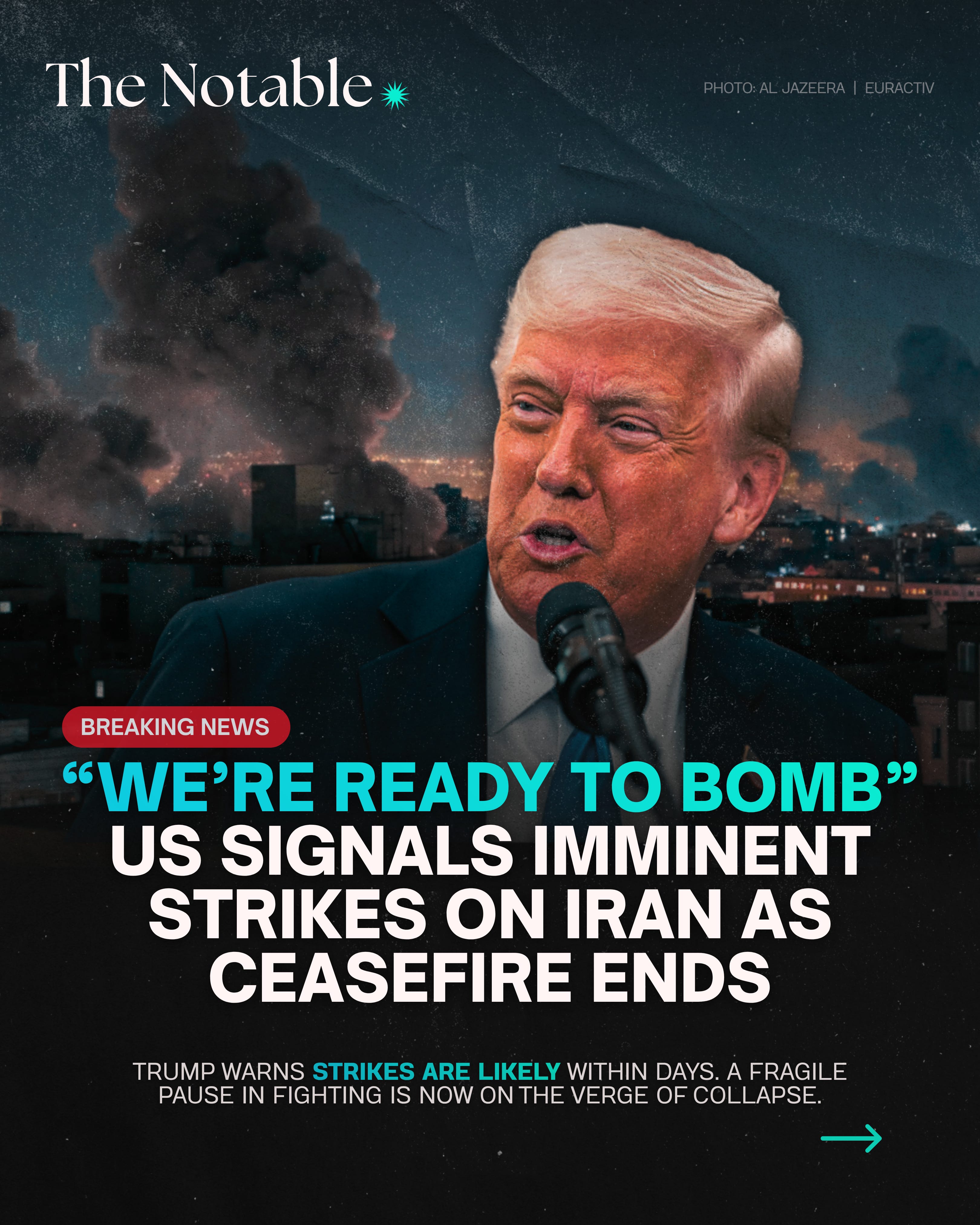
The United States is moving toward renewed military action against Iran as a temporary ceasefire reaches its final hours.
President Donald Trump has made the position explicit. If negotiations fail, strikes will follow. His statement that the U.S. is “ready to bomb” signals a shift from conditional pressure to an active readiness to escalate.
This is not the start of a conflict. It is the potential continuation of one that has already been underway.
A pause, not a resolution
The current standoff traces back to late February, when the United States, alongside Israel, launched coordinated strikes targeting Iran’s military and nuclear-linked infrastructure. The objective was clear: degrade capabilities and reassert deterrence.
What followed was a controlled escalation. Iran avoided direct large-scale confrontation but responded through indirect pressure, including disruptions tied to regional shipping routes and strategic signaling across the Middle East.
By early April, both sides had reached a threshold. The risk of broader escalation was rising, and a temporary ceasefire was agreed.
But the ceasefire was never designed to resolve the conflict. It was designed to pause it.
The terms were narrow. Iran would ease pressure on critical maritime routes, and negotiations would begin through intermediaries, including Pakistan. The United States, in turn, would hold off on further strikes.
From the outset, it was a fragile arrangement.
Talks stall, pressure returns
In the days leading up to the deadline, negotiations have failed to gain traction.
Iran has resisted entering talks under explicit military threat. The United States has shown little willingness to extend the timeline without concessions. Incidents during the ceasefire, including the seizure of an Iranian-linked vessel, have further eroded trust.
At the same time, the military posture has not relaxed. U.S. forces remain deployed across the region, with naval and air assets positioned for rapid action. Iran, for its part, has warned it is prepared to respond with new battlefield measures if strikes resume.
Diplomacy has not broken down entirely. But it has narrowed to a final window.
A compressed model of power
What is unfolding reflects a broader shift in how power is being exercised.
Ceasefires are no longer extended periods for negotiation and recalibration. They are increasingly being used as short, conditional deadlines backed by credible force. The expectation is not that diplomacy will gradually resolve tensions, but that it must produce results quickly or give way to escalation.
This compresses the entire decision cycle.
Negotiations are conducted under immediate pressure. Military options remain active in parallel. And when talks stall, the transition from diplomacy to force becomes rapid rather than gradual.
The result is a more volatile system. Stability is no longer maintained through prolonged engagement, but through repeated cycles of pause and pressure.
Why this moment matters
The immediate question is whether strikes will resume. The broader issue is what this pattern means.
A return to military action would not only reignite direct confrontation between the United States and Iran. It would also reinforce a model where geopolitical disputes are managed through tightly coupled diplomacy and force.
This has consequences beyond the two countries involved.
The Middle East remains a system where local conflicts can quickly expand, drawing in regional actors and affecting global markets, particularly energy. Even limited strikes carry the risk of miscalculation, especially when both sides are operating with forces already in place.
At the same time, the signaling extends beyond the region. It reflects how major powers are redefining the balance between negotiation and coercion in an increasingly fragmented global order.
The next 24 to 48 hours are critical.
If negotiations fail to restart or produce movement, U.S. strikes are likely to resume. The scale and targets of those strikes remain unclear. Equally uncertain is Iran’s response, which will determine whether the conflict remains contained or expands.
What is clear is that the ceasefire is not an endpoint. It is a threshold.
And that threshold is now being crossed.