


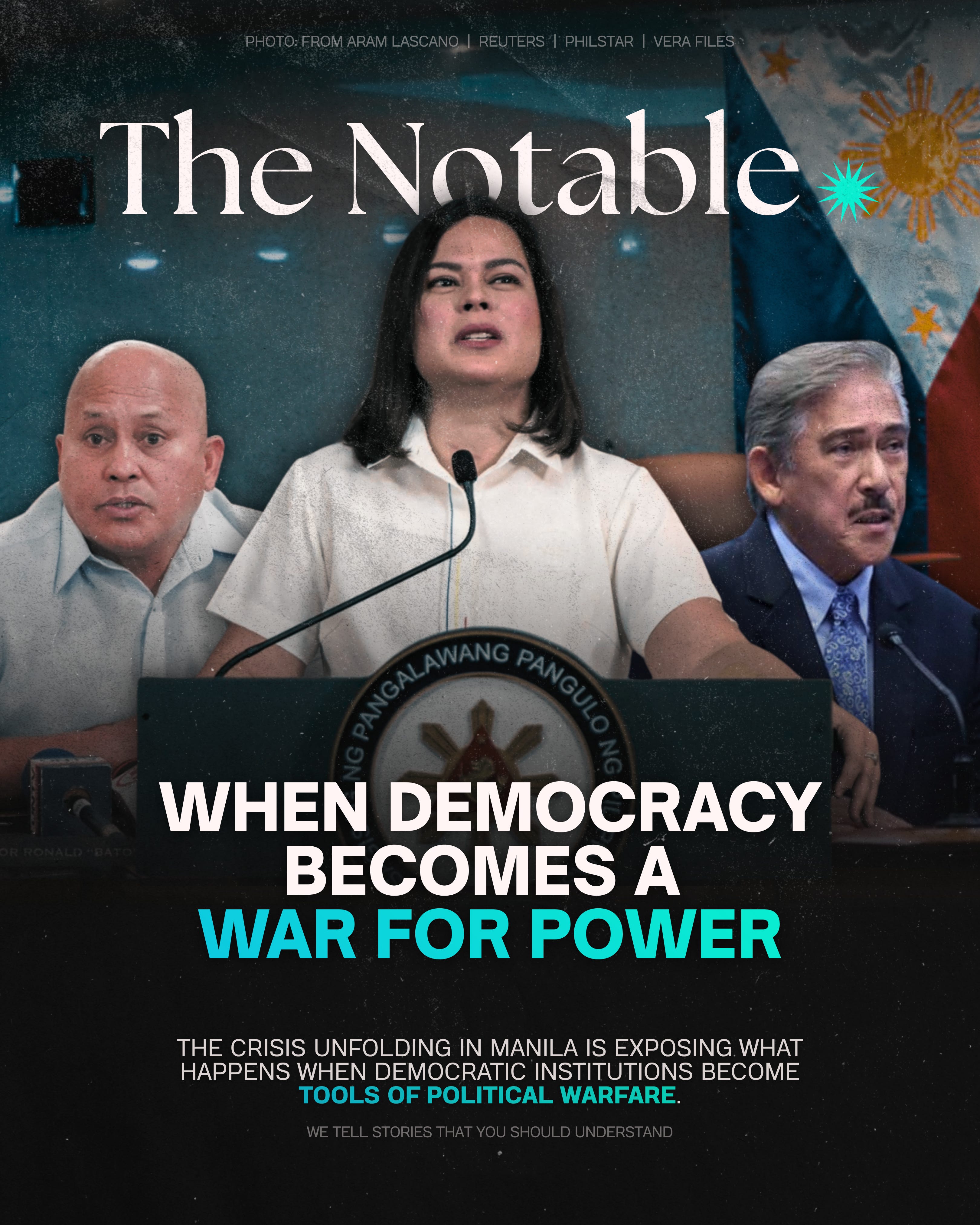
The dramatic scenes unfolding in the Philippines tonight looked, at first glance, like another episode of political chaos in a country long accustomed to spectacle.
→ The vice president was impeached again.
→ The Senate president was abruptly ousted.
→ Alliances collapsed in public.
→ Politicians traded accusations of corruption, betrayal, and political persecution.
→ Rumors of arrests and institutional maneuvering spread through Manila’s political class almost by the hour.
But beneath the drama is something far more important than a domestic political feud.
What is happening inside the Philippine Senate is a window into how modern democracies increasingly operate beneath the surface — not as stable systems of neutral institutions, but as arenas of continuous elite power struggle.
The Philippines may now be one of the clearest case studies in the world of what happens when democratic institutions become deeply entangled in elite survival warfare.
This story is no longer simply about the Dutertes or the Marcoses - it is about what modern politics becomes when elections never truly end.
The impeachment crisis
The impeachment of Vice President Sara Duterte, daughter of former president Rodrigo Duterte and one of the country’s most powerful political figures, triggered a rapid escalation inside the Philippine political system.
The House of Representatives voted overwhelmingly to impeach Sara on allegations ranging from misuse of confidential funds to corruption and alleged threats against President Ferdinand Marcos Jr. and his allies.
Sara Duterte denies the accusations and insists the impeachment is politically motivated.
But the deeper significance of the moment may lie elsewhere.
Hours before the impeachment escalated, Senate President Tito Sotto was ousted and replaced by Alan Peter Cayetano - a major political shift that immediately changed the power balance in the chamber.
The Senate presidency suddenly became one of the most strategically important political positions in the country because of its role in the Vice President’s impeachment trial.
Lawmakers are now scrambling to their feet, hurriedly taking sides waged on their loyalty to the people they serve - may it be their fellow politician or their countrymen.
The collapse of the Marcos-Duterte alliance
The 2022 coalition between Ferdinand Marcos Jr. and Sara Duterte united two of the most powerful political dynasties in Philippine history. Together, they represented a formidable combination of regional influence, populist appeal, and social media dominance.
After winning their respective seats, the relationship between the two eventually went sour - transforming an alliance into a rivalry. Similar to oil and water, their relationship is doomed to fall apart at the gun start no matter how hard they try to “unite”.
As the 2028 presidential election approaches, this could weigh on the current political fiasco in the Philippines.
The closer political actors move toward the next presidential cycle, the more every institution becomes strategic terrain.
Once politics enters a permanent election cycle, governance itself changes. Institutions stop functioning merely as governing bodies and increasingly become instruments of positioning, protection, retaliation, and political survival.
Even accountability itself becomes politically contested.
This does not automatically mean allegations are false.
But it does mean that citizens increasingly struggle to separate justice from power struggles because both processes become intertwined.
That ambiguity is corrosive for democratic trust.
A global democratic pattern
And it is not unique to the Philippines.
Across the world, democracies are entering an era where institutions are increasingly viewed through the lens of factional conflict.
In the United States, political actors accuse courts, prosecutors, and congressional investigations of partisan weaponization.
In Brazil, the Bolsonaro-era polarization transformed judicial institutions into central political actors.
In Pakistan, courts, military structures, and political parties became deeply entangled in succession struggles.
In South Korea, former presidents routinely face investigations, imprisonment, or impeachment.
In many democracies, politics no longer pauses between elections long enough for institutions to regain neutrality in the public imagination.
The Philippines simply reveals these dynamics more visibly than most.
Its dynastic political structure makes elite competition unusually explicit.
The country’s politics are deeply personal, heavily regional, emotionally polarized, and dominated by powerful family brands whose influence often transcends formal party systems.
Duterte’s institutional encirclement
What makes the current moment especially volatile is that multiple forms of pressure are converging simultaneously on the Duterte political machine.
The current events unfolding are a widening perception that the Duterte camp is no longer merely facing political opposition. Instead, it faces institutional encirclement.
Sara Duterte faces impeachment threats.
Former President Rodrigo Duterte continues facing international legal scrutiny related to his drug war.
Senator Ronald dela Rosa, one of Duterte’s closest allies and the former police chief who helped implement the anti-drug campaign, reportedly became the subject of heightened security tensions inside the Senate amid growing legal pressure connected to international investigations.
Once political factions begin to believe institutions are being mobilized existentially against them, escalation becomes more likely.
That is how democracies drift into permanent political warfare without ever formally abandoning democratic structures.
When institutions lose neutrality
Democracy relies not only on laws, but on public belief that institutions still operate with at least some degree of neutrality and legitimacy beyond factional interest.
Once that belief weakens, politics gradually stops feeling like governance and starts feeling like endless strategic combat. Institutions themselves are becoming the battlefield.
For ordinary citizens, the unfolding events can produce a profound sense of alienation:
the feeling that institutions no longer exist primarily to govern society, but to mediate elite conflict.
What’s unfolding in Manila today is not merely the collapse of a political alliance but the exposure of a deeper global shift:
→ a world where democratic politics increasingly revolves around institutional control, procedural leverage, permanent campaigning, and elite survival management.