


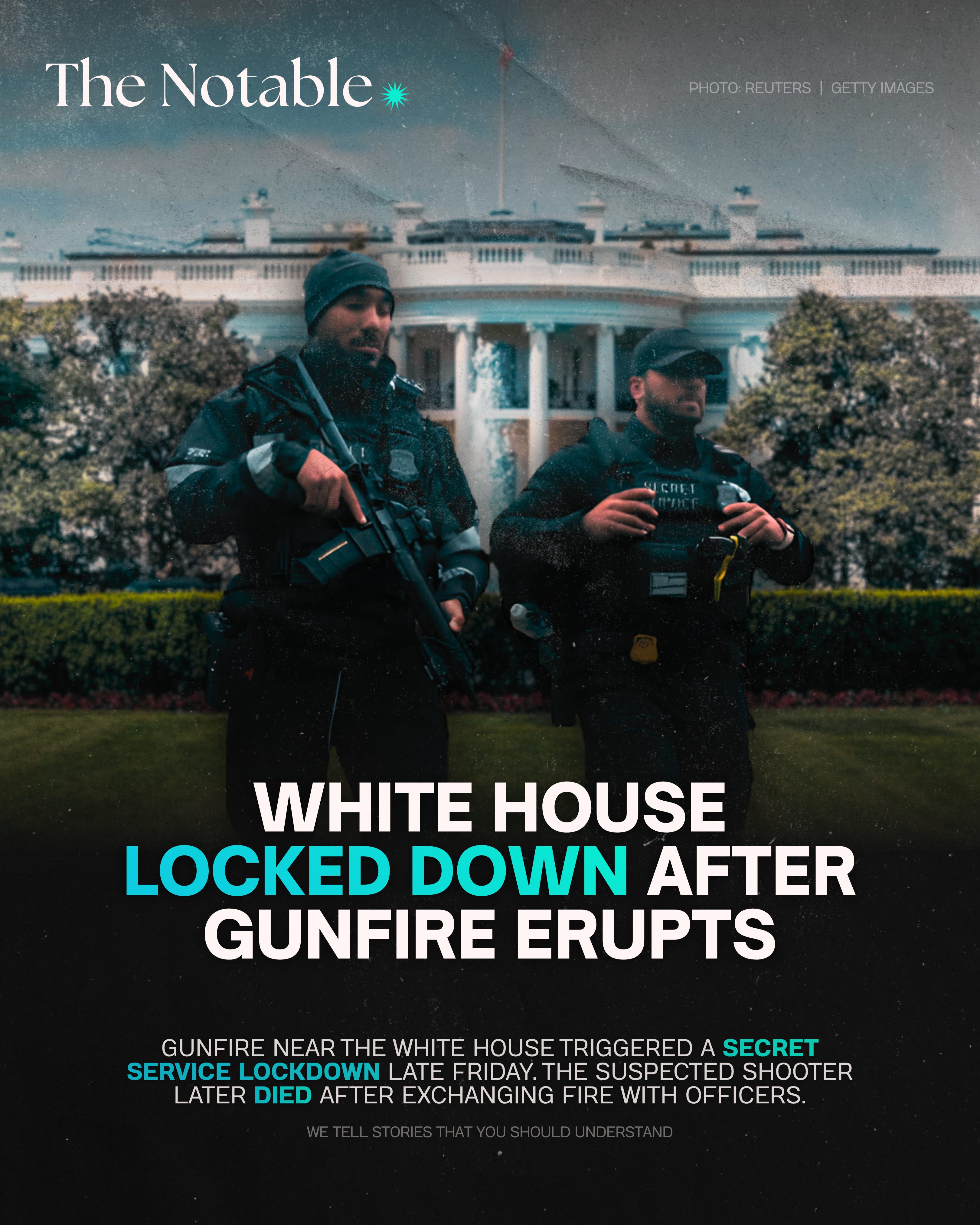
The White House was temporarily locked down late Friday night after gunfire erupted near the presidential complex, triggering a large-scale Secret Service response in the center of Washington, D.C.
According to federal authorities, the incident began near 17th Street and Pennsylvania Avenue NW, just outside the White House perimeter. Witnesses described hearing rapid gunfire, with some estimating that as many as 20 to 30 shots were fired during the confrontation.
The suspected gunman later died at a hospital after exchanging fire with Secret Service officers.
What Happened
Officials said the suspect approached a Secret Service security checkpoint carrying a bag before pulling out a firearm and opening fire toward officers stationed near the White House grounds.
Secret Service agents returned fire almost immediately, leading to a chaotic scene near one of the most heavily protected locations in the United States.
Journalists gathered on the White House North Lawn reported being rushed into secure areas as armed personnel flooded the perimeter. Streets surrounding the complex were quickly sealed off while emergency responders and federal investigators moved into the area.
President Donald Trump was reportedly inside the White House during the shooting but was not harmed, according to officials familiar with the situation.
Authorities later confirmed that no Secret Service personnel were injured during the exchange. One bystander was wounded and transported for medical treatment.
The suspect was initially taken to a hospital in critical condition before later being pronounced dead.
Federal Investigation Underway
The FBI and Secret Service are now investigating the motive behind the shooting, including whether the White House itself was the intended target.
Officials have not yet released a full timeline of events or identified a clear motive. Some reports indicate the suspect may have previously been known to law enforcement and subject to restrictions involving the White House area, though investigators have not publicly confirmed additional details.
Ballistic evidence, surveillance footage, and witness testimony are expected to play a central role in reconstructing the incident.
Authorities also have not confirmed the exact number of shots fired. Early witness estimates varied significantly, likely due to the intensity and speed of the exchange between the suspect and multiple Secret Service officers.
A Growing Security Concern
The shooting is likely to intensify concerns around political violence and security threats in the United States.
In recent months, Washington has seen several high-profile security incidents involving federal sites and government personnel. While attacks near the White House remain rare, even isolated incidents carry enormous symbolic and political weight because of the location involved.
The event also underscores the increasingly difficult security environment facing federal agencies tasked with protecting political institutions during a period of elevated polarization and domestic instability.
For the Secret Service, the rapid response demonstrated the layered security structure surrounding the White House complex. But the incident will almost certainly prompt renewed scrutiny over perimeter protection, threat assessment procedures, and the growing frequency of armed confrontations near politically sensitive locations.
As investigators continue examining the suspect’s background and motives, the incident is already becoming part of a broader national conversation around domestic security, extremism, and the normalization of political violence in America.
More updates are expected as federal authorities release additional details.