


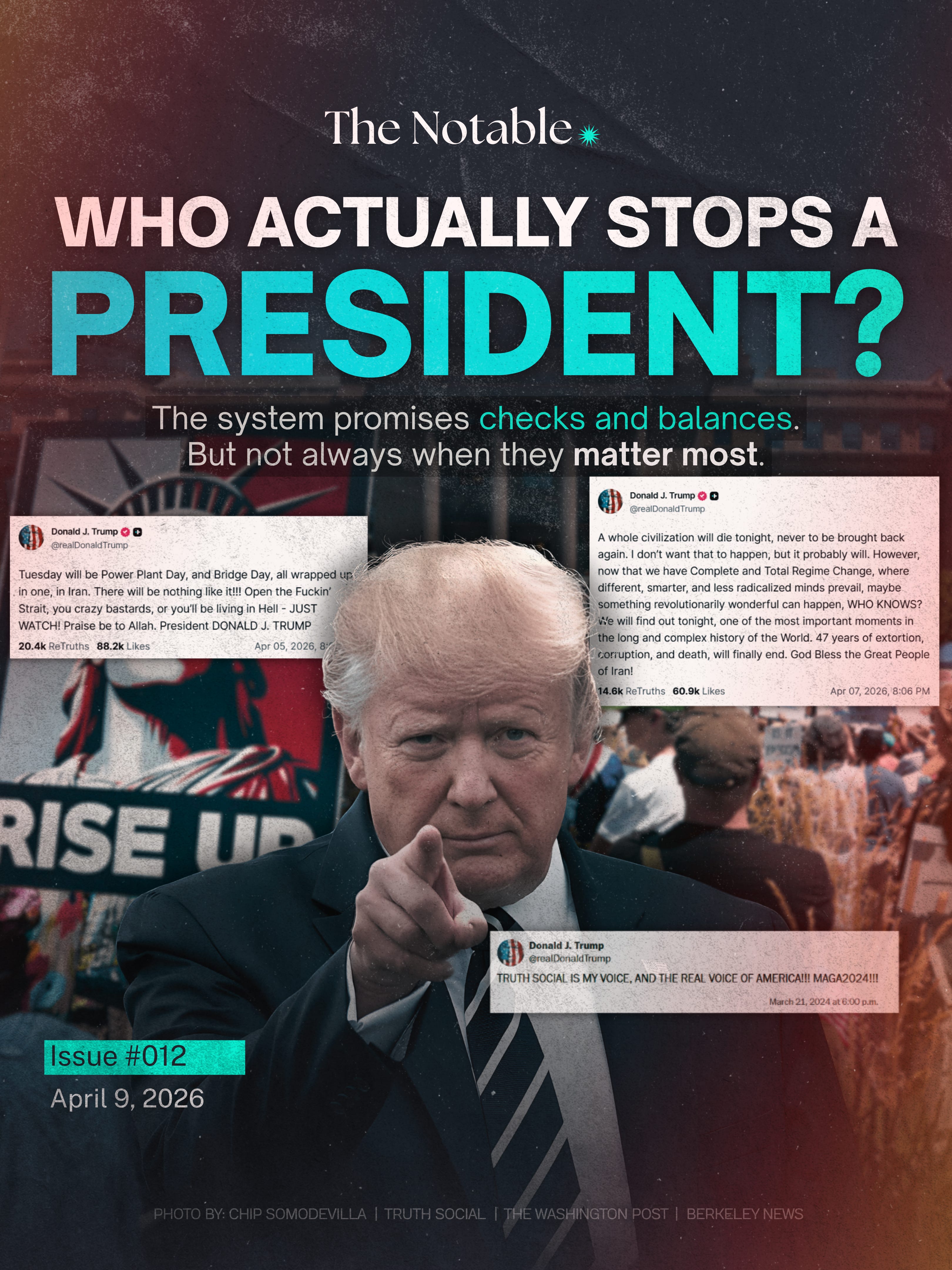
He did not call a press conference.
There was no podium, no briefing room, no formal statement drafted through layers of institutional review. Just a post. Typed, published, and immediately seen.
When Donald Trump issued a direct threat toward Iran on Truth Social, the medium felt informal. The implications did not.
Within minutes, the message traveled through the same channels as any official policy signal. Newsrooms picked it up. Analysts parsed its meaning. Foreign governments assessed its credibility. Markets registered the tension. And somewhere inside the U.S. national security apparatus, people began asking the only question that matters in moments like this:
Is this real?
No one voted on it. No institution approved it. And yet, it was treated as something that could alter the trajectory of a geopolitical relationship that has been volatile for decades.
This is where the gap begins—not between rhetoric and reality, but between how power is supposed to work and how it actually does.
The United States presents itself as a system designed to restrain individuals. Power is divided. Authority is shared. No single actor is meant to move unilaterally on matters as consequential as war.
The architecture is familiar: U.S. Congress declares war, controls funding, and provides oversight. The U.S. Supreme Court interprets legality. The executive enforces.
In theory, this creates friction. In practice, it creates delay.
And delay, in modern geopolitics, is a structural disadvantage.
Since the mid-20th century, U.S. presidents have repeatedly initiated military actions without formal declarations of war. Korea, Vietnam, Iraq, Libya—each instance followed a pattern where executive action preceded institutional consensus. The system did not stop the action. It responded to it.
The attempt to correct this imbalance came with the War Powers Resolution. It was designed to reassert Congressional authority, requiring presidents to notify lawmakers within 48 hours of deploying forces and limiting unauthorized engagement to 60 days.
But the law did not eliminate unilateral power. It structured it.
It acknowledged, implicitly, that the president would act first.
This is not about a breakdown of the system.
It is about how the system has evolved under pressure.
What appears as a failure of checks and balances is, in many ways, their reconfiguration. The system still functions, but not in the way people imagine.
This is not about whether Trump can be stopped.
It is about when.
The assumption that “someone will intervene” rests on a misunderstanding of how institutional power behaves under real conditions.
Checks and balances are not automatic safeguards. They are political processes.
For Congress to constrain a president, it must act collectively. That requires alignment, timing, and willingness to absorb political cost. None of these are guaranteed. In a polarized environment, they are increasingly rare.
Members of Congress operate within electoral cycles. Their incentives are local, not systemic. Challenging a president, especially one aligned with their party, carries immediate risk and uncertain reward. Even opposition parties face constraints. They can criticize, delay, investigate—but without majority control, enforcement remains limited.
The judiciary, often seen as a neutral arbiter, is structurally unsuited for real-time intervention. Legal processes move slowly. Cases must be brought, argued, and adjudicated. By the time a decision is reached, the underlying action has often already occurred.
The military, bound by the chain of command, does not function as a political counterweight. Its role is execution, not arbitration.
Which leaves the public—the ultimate source of democratic legitimacy.
But public opinion does not operate on the same timeline as executive power.
Polling consistently shows that Americans have grown increasingly reluctant to support new large-scale wars, particularly after prolonged engagements in Iraq and Afghanistan. That sentiment is real. It shapes elections. It influences long-term political positioning.
It does not stop immediate decisions.
Public disapproval accumulates. It does not interrupt.
What has changed, more subtly, is how power is communicated—and therefore how it is exercised.
When Trump uses Truth Social to issue a threat, the platform is not the story. The removal of friction is.
Traditional foreign policy signaling moved through controlled channels: official statements, diplomatic cables, coordinated messaging between agencies. Each step introduced deliberation, and with it, constraint.
Social media eliminates that process.
A message can now be issued instantly, without internal negotiation, and still carry the weight of state power. It is informal in origin, but formal in consequence.
This shift did not begin with Truth Social. During his first presidency, Trump used Twitter to communicate directly with adversaries, including North Korea. Threats were issued publicly, in real time, outside traditional frameworks. Yet they were treated by foreign governments as credible signals of intent.
The pattern has not disappeared. It has been normalized.
And with normalization comes a quiet expansion of executive capacity.
Not through new laws, but through new behavior.
There is a contradiction embedded in this moment.
The United States continues to describe itself as a system of constrained leadership. Power is meant to be checked, balanced, and accountable.
Yet in practice, during moments of geopolitical tension, the system behaves differently.
A single individual can introduce risk into the global system faster than any institution can respond to it.
This is not unique to the United States. Across the world, executive power has been consolidating, even within democratic systems. Leaders in Turkey and Russia operate with varying degrees of centralized authority, but the underlying trend is consistent: speed has become a form of power.
And speed favors the executive.
Because only one actor can move without coordination.
The uncomfortable part is not that Trump is acting in a way that appears unconstrained.
It is that the system allows for it—by design, by evolution, or by neglect.
The checks exist. But they are structured as responses, not barriers.
Congress can cut funding. But only after action has begun.
Courts can rule on legality. But only after cases are brought.
Elections can remove leaders. But only after decisions have already shaped reality.
Even the War Powers framework, often cited as a safeguard, reflects this logic. It does not prevent deployment. It regulates its duration.
The system does not stop the first move.
It evaluates it.
This distinction matters because it reframes the central question.
The question is not: why is no one stopping the president?
It is: why do we expect the system to stop him in real time?
The answer lies in a lingering belief that democratic structures function as immediate constraints on power. That belief is partially true, but temporally misplaced.
Democracy is slow.
It is designed to process, not to interrupt.
And in domains where decisions must be made quickly—national security, foreign policy, crisis response—the system implicitly shifts toward the actor capable of acting fastest.
That actor is the president.
There is also a quieter dynamic at play, one that is less visible, but equally important.
Silence does not always indicate agreement. Often, it reflects calculation.
Political actors assess not only whether they disagree with a statement, but whether responding is strategically advantageous. Speaking out may escalate tensions. Remaining quiet may preserve flexibility. Public opposition may satisfy constituents. Private negotiation may be more effective.
From the outside, this looks like inaction.
From the inside, it is often deliberate restraint.
The result is a system that appears passive at precisely the moments when it is most active behind the scenes.
But that activity rarely manifests as immediate constraint.
It manifests as positioning.
The consequence is a widening gap between perception and reality.
From the public’s perspective, the sequence is confusing.
A leader issues a threat. Many disagree. Yet nothing seems to happen.
The assumption is that the system has failed.
The reality is more complicated.
The system is functioning—but along a different timeline, and according to different incentives than most people expect.
Immediate control is weak. Delayed accountability is strong.
What this leads to is not necessarily more conflict, but more volatility.
When signals can be issued instantly and interpreted globally, the risk is not just what is done, but how it is perceived.
A message intended as political positioning domestically can be interpreted as escalation internationally. An informal statement can trigger formal responses. Misalignment between intent and interpretation becomes more likely.
And because institutional responses are slower, the window for miscalculation widens.
This is where second-order effects begin to emerge.
Allies may become uncertain about the reliability of U.S. signaling. Adversaries may test boundaries, unsure of how seriously to take informal threats. Markets may react to statements that are not yet policy, but could become it.
The system absorbs these shocks—but not without cost.
In the end, the image of a president constrained by a web of immediate checks is less accurate than it appears.
The reality is closer to something else.
A system where one actor moves first.
And everyone else decides how to respond after.
The tension is not whether the system works.
It is whether its timing still fits the world it operates in.
Because in a landscape defined by speed, the difference between acting first and responding later is not procedural.
It is structural.
And that structure is still unfolding.